Freedom251 › Deep Learning Software
OpenVINO
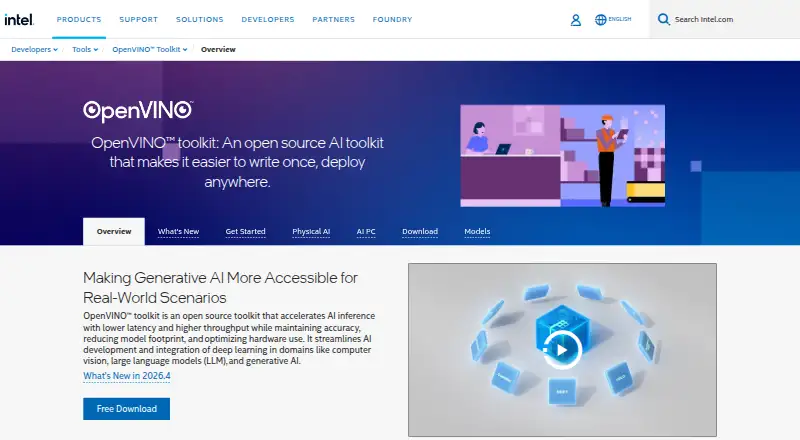
What OpenVINO is
OpenVINO is a free, open-source toolkit for speeding up AI inference, reducing model footprint, and making efficient use of hardware. It supports deep learning work in computer vision, large language models, and generative AI. Models from PyTorch, TensorFlow, TensorFlow Lite, PaddlePaddle, and ONNX are supported. Deployment options for Intel hardware include on-premises systems, devices, browsers, and cloud environments. The toolkit offers C++, Python, C, and NodeJS APIs; its documentation describes the NodeJS API as early and actively developed. NNCF provides training-time and post-training compression methods, including pruning, sparsity, quantization, and weight compression. Serving options include OpenVINO Model Server and integrations with vLLM and Triton. Packages are listed for Windows, macOS, and Linux; the listed macOS package is for macOS 12.6 and later. OpenVINO does not provide model encryption, decryption, or authentication, and its security guidance refers to third-party tools for those protections. Listed support channels include an Intel community forum, Intel Support, GitHub issues, and Stack Overflow.
Who it suits
OpenVINO suits developers and teams working on deep learning inference, including computer vision, large language models, and generative AI. It supports several model formats and deployment settings on Intel hardware.
What it does well
- Free, open-source toolkit
- Supports five listed model frameworks
- Offers C++, Python, C, and NodeJS APIs
- Compression includes pruning and quantization
What to know first
- Does not provide model encryption, decryption, or authentication
- NodeJS API is described as early and actively developed
- Listed macOS package is for macOS 12.6 and later
Limits
The toolkit is free, with no paid plan limits listed. The macOS package supports macOS 12.6 and later, and the NodeJS API is early and actively developed.
Plans
| Plan | Billed and limits | Price |
|---|---|---|
| OpenVINO toolkit | Open source toolkit · Free download | Free |
As openvino.ai lists them, read 7 Oct 2026. The maker's own page has the final word.
Getting started
- Visit the OpenVINO website.
- Download the package for Windows, Linux, or macOS 12.6 and later.
- Use a supported model format or framework.
- Choose among the C++, Python, C, or NodeJS APIs.
- Select an Intel hardware deployment target.
- Use OpenVINO Model Server, vLLM, or Triton for serving.
Verdict
OpenVINO brings model optimization, compression, and serving options into a free toolkit. Its security protections require third-party tools, and the NodeJS API is still early in development.
Questions
Is OpenVINO free?
Yes. The OpenVINO toolkit is free and open source.
Which operating systems have packages?
Packages are listed for Windows, Linux, and macOS. The listed macOS package is for macOS 12.6 and later.
Which models and frameworks does it support?
It supports models from PyTorch, TensorFlow, TensorFlow Lite, PaddlePaddle, and ONNX. Listed model formats also include OpenVINO IR.
Which programming languages have APIs?
APIs are available for C++, Python, C, and NodeJS. The NodeJS API is early and actively developed.
Where can OpenVINO models be deployed?
The maker says models can be deployed across Intel hardware on-premises, on-device, in a browser, or in the cloud.
Does OpenVINO provide model security protections?
It does not provide model encryption, decryption, or authentication; its security guidance describes using third-party tools for these protections.
Facts from OpenVINO's own pages
- APIs
- OpenVINO offers C++, Python, C, and NodeJS APIs; its documentation describes the NodeJS API as early and actively developed. · docs.openvino.ai, 7 Oct 2026
- Deployment
- The maker says models can be deployed across Intel hardware on-premises, on-device, in a browser, or in the cloud. · intel.com, 7 Oct 2026
- Frameworks
- OpenVINO supports models from PyTorch, TensorFlow, TensorFlow Lite, PaddlePaddle, and ONNX. · docs.openvino.ai, 7 Oct 2026
- Optimization
- NNCF provides training-time and post-training model compression methods including pruning, sparsity, quantization, and weight compression. · docs.openvino.ai, 7 Oct 2026
- Platform limit
- The download page lists Windows, macOS, and Linux packages; the listed macOS package is for macOS 12.6 and later. · intel.com, 7 Oct 2026
- Purpose
- OpenVINO is an open-source toolkit that accelerates AI inference while reducing model footprint and optimizing hardware use. · intel.com, 7 Oct 2026
- Security
- OpenVINO does not provide model encryption, decryption, or authentication; its security guidance describes using third-party tools for those protections. · docs.openvino.ai, 7 Oct 2026
- Serving integrations
- OpenVINO supports remote serving through OpenVINO Model Server and is also integrated with vLLM and Triton services. · docs.openvino.ai, 7 Oct 2026
- Support
- The maker lists an Intel community forum, Intel Support, GitHub issues, and Stack Overflow as help channels. · intel.com, 7 Oct 2026
- Use cases
- The toolkit supports deep learning work in computer vision, large language models, and generative AI. · intel.com, 7 Oct 2026
Where OpenVINO stands on Freedom251
- Deep Learning Software#19 of 35