Freedom251 › Deep Learning Software
NVIDIA TensorRT
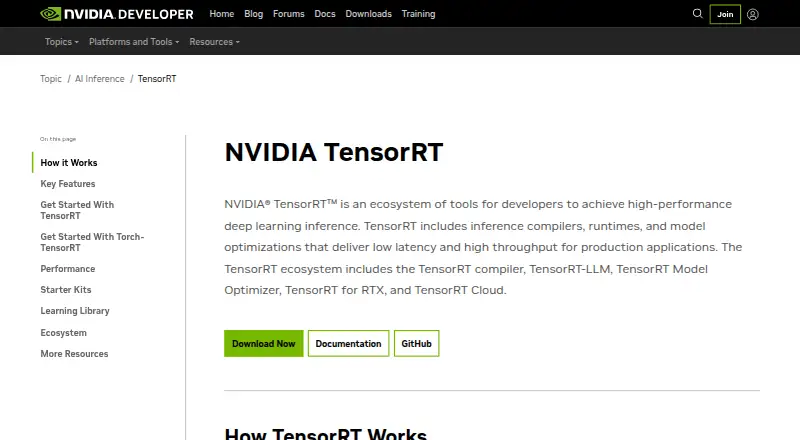
What NVIDIA TensorRT is
NVIDIA TensorRT is a toolkit for compiling, running, and optimizing deep learning inference on NVIDIA GPUs. Its optimization tools apply quantization, layer and tensor fusion, and kernel tuning. TensorRT Model Optimizer supports FP8, FP4, INT8, INT4, and AWQ techniques, while TensorRT-LLM is an open-source library with a Python API for accelerating large language model inference on the NVIDIA AI platform.
TensorRT works with PyTorch and Hugging Face, imports ONNX models, and connects with MATLAB through GPU Coder. For serving, NVIDIA Triton offers TensorRT as a backend and supports dynamic batching, concurrent model execution, model ensembling, and streaming audio and video inputs. Deployment can span NVIDIA GPUs in data centers, workstations, laptops, and edge devices. The SDK is free for development and available for Linux, Windows, and self-hosted use. The support matrix requires NVIDIA hardware with compute capability SM 7.5 or higher. Serialized engines cannot move across platforms such as Linux and Windows, and NVIDIA warns that loading an engine from an untrusted source runs untrusted native code on the GPU and host.
Who it suits
TensorRT suits developers and teams optimizing inference workloads on supported NVIDIA GPUs, including large language models and models served through Triton. It supports C++ and Python workflows and integrations with PyTorch, Hugging Face, ONNX, and MATLAB through GPU Coder.
What it does well
- Free development SDK with binary and NVIDIA NGC container downloads.
- Optimization includes quantization, layer and tensor fusion, and kernel tuning.
- TensorRT Model Optimizer supports FP8, FP4, INT8, INT4, and AWQ.
- Integrates with PyTorch and Hugging Face and imports ONNX models.
- Triton backend supports dynamic batching and concurrent model execution.
- Targets NVIDIA GPUs from data centers to edge devices.
What to know first
- Requires NVIDIA hardware with compute capability SM 7.5 or higher.
- Serialized engines are not portable between platforms such as Linux and Windows.
- TensorRT 10.0 GA download requires NVIDIA Developer Program membership.
- NVIDIA says it has not tested or certified the SDK for critical applications.
Limits
The free TensorRT plan is for development. TensorRT 10.0 GA download requires NVIDIA Developer Program membership, and supported hardware must have compute capability SM 7.5 or higher.
Plans
| Plan | Billed and limits | Price |
|---|---|---|
| TensorRT | Free for development · Download as a binary or NVIDIA NGC container · TensorRT 10.0 GA download requires NVIDIA Developer Program membership | Free |
| NVIDIA AI Enterprise | Paid offering · Mission-critical AI inference · Enterprise-grade security, stability, manageability, and support | On request |
As developer.nvidia.com lists them, read 5 Oct 2026. The maker's own page has the final word.
Getting started
- Visit the TensorRT developer website.
- Choose the binary download or NVIDIA NGC container for development.
- Join the NVIDIA Developer Program if downloading TensorRT 10.0 GA.
- Use supported NVIDIA hardware with compute capability SM 7.5 or higher.
- Use the documentation, quick-start guides, sample code, and troubleshooting resources to begin.
Verdict
Choose NVIDIA TensorRT if you need a free development toolkit to optimize deep learning inference on supported NVIDIA GPUs, with integrations for common model workflows and Triton serving. Look elsewhere if you need serialized engines to move between operating systems or require an SDK NVIDIA has tested and certified for critical applications.
Questions
Is NVIDIA TensorRT free?
The TensorRT plan is free for development and costs nothing. NVIDIA AI Enterprise is a paid offering, with no price listed.
Which platforms does TensorRT support?
The listed platforms are Linux, Windows, and self-hosted deployment. Serialized engines are not portable across platforms such as Linux and Windows.
What hardware does TensorRT require?
The support matrix requires NVIDIA hardware with compute capability SM 7.5 or higher.
Which model formats and languages are supported?
The listed formats are ONNX and TensorRT engine or plan files. Supported languages are C++ and Python.
Is TensorRT open source?
TensorRT-LLM is an open-source library for large language model inference. The TensorRT plan is described as a free SDK for development.
Can anyone use TensorRT Cloud?
TensorRT Cloud access is limited to select partners and subject to approval.
Facts from NVIDIA TensorRT's own pages
- Cloud service access
- TensorRT Cloud is available with limited access to select partners, subject to approval. · developer.nvidia.com, 5 Oct 2026
- Deployment range
- TensorRT targets NVIDIA GPUs in data centers, workstations, laptops, and edge devices. · developer.nvidia.com, 5 Oct 2026
- Engine portability
- Serialized TensorRT engines are not portable across platforms such as Linux and Windows. · docs.nvidia.com, 5 Oct 2026
- Framework integrations
- TensorRT integrates with PyTorch and Hugging Face, imports ONNX models, and connects with MATLAB through GPU Coder. · developer.nvidia.com, 5 Oct 2026
- Hardware requirement
- The support matrix states that TensorRT supports NVIDIA hardware with compute capability SM 7.5 or higher. · docs.nvidia.com, 5 Oct 2026
- License limitation
- The SDK license says NVIDIA has not tested or certified the SDK for critical applications and places responsibility for applicable legal and regulatory compliance on the user. · docs.nvidia.com, 5 Oct 2026
- LLM inference
- TensorRT-LLM is an open-source library with a simplified Python API for accelerating and optimizing large language model inference on the NVIDIA AI platform. · developer.nvidia.com, 5 Oct 2026
- Optimization
- TensorRT optimizes inference with quantization, layer and tensor fusion, and kernel tuning. · developer.nvidia.com, 5 Oct 2026
- Purpose
- TensorRT is an ecosystem of inference compilers, runtimes, and model optimization tools for high-performance deep learning inference. · developer.nvidia.com, 5 Oct 2026
- Security
- NVIDIA warns that deserializing an engine from an untrusted source is equivalent to running untrusted native code on the GPU and host. · docs.nvidia.com, 5 Oct 2026
- Security guidance
- NVIDIA recommends deserializing only engines built by the user or received through a trusted, authenticated channel. · docs.nvidia.com, 5 Oct 2026
- Serving
- NVIDIA Triton includes TensorRT as a backend and supports dynamic batching, concurrent model execution, model ensembling, and streaming audio and video inputs. · developer.nvidia.com, 5 Oct 2026
- Supported precisions
- TensorRT Model Optimizer supports FP8, FP4, INT8, INT4, and AWQ techniques. · developer.nvidia.com, 5 Oct 2026
- Support resources
- NVIDIA provides TensorRT documentation, quick-start guides, sample code, and troubleshooting resources. · developer.nvidia.com, 5 Oct 2026
Where NVIDIA TensorRT stands on Freedom251
- Deep Learning Software#21 of 35