Freedom251 › Deep Learning Software
MindSpore
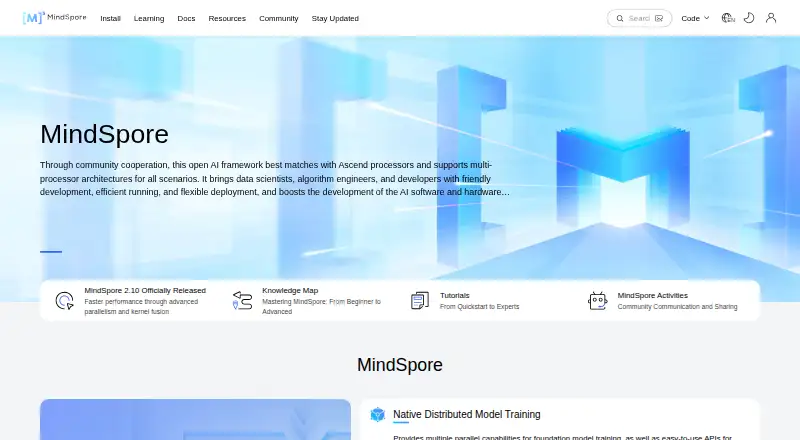
What MindSpore is
MindSpore is a free, open-source AI framework for developing, training, and deploying models across device, edge, and cloud scenarios. Python interfaces support model development, while its suite includes MindSpore Transformers, MindSpore ONE, and scientific-computing libraries. It handles training and inference through dynamic and static graph modes, and distributed work can use automatic parallel-strategy search plus data, model, pipeline, and optimizer parallelism. The framework supports CPU, GPU, NPU, and Ascend hardware, can generate offline models, and allows third-party chip plugins through Kernel and Graph integration. Documentation covers deployment to clouds, servers, mobile and embedded devices, and lightweight hardware such as earphones. MindSpore Transformers targets large-model pre-training, fine-tuning, inference, and deployment for language and multimodal models. Installation uses pip, Docker, or source compilation, with CPU support documented for Linux, Windows, and Mac.
Who it suits
It fits developers and research teams building AI models locally or across cloud, server, edge, and device targets. Users working with Python, C++, distributed training, or varied accelerator hardware may find its tooling relevant.
What it does well
- Free and open source
- Supports training and inference
- Dynamic and static graph modes
- Distributed parallelism strategies
- CPU, GPU, and NPU support
What to know first
- Installation requires internet or configured internal networking
- Some Transformers capabilities remain in deprecated documentation
- Support is directed to forums and AtomGit
Verdict
MindSpore provides a broad framework for model development, training, and deployment across hardware and environments. Review the current Transformers documentation and installation requirements before selecting it for a project.
Facts from MindSpore's own pages
- Cloud platforms
- The installation guide links to ModelArts and OpenI as cloud platforms for creating and deploying models and managing AI workflows. · mindspore.cn, 9 Oct 2026
- Deployment
- The documentation describes deployment on cloud, servers, mobile and embedded devices, and ultra-lightweight devices such as earphones. · mindspore.cn, 9 Oct 2026
- Distributed training
- The official site says MindSpore provides parallel capabilities and APIs for configuring distributed training of foundation models. · mindspore.cn, 9 Oct 2026
- Documentation caveat
- The Transformers documentation says dynamic graph is its primary development path starting with r2.0.0 and directs readers to a deprecated section for capabilities not yet covered there, including inference, service-oriented deployment, and quantization. · mindspore.cn, 9 Oct 2026
- Graph modes
- It supports dynamic and static graph programming modes with consistent code-level interfaces. · mindspore.cn, 9 Oct 2026
- Hardware integration
- MindSpore supports third-party chip plugins, with Kernel and Graph integration methods. · mindspore.cn, 9 Oct 2026
- Hardware support
- The framework supports CPU, GPU, and NPU chips and can generate offline models for execution on different hardware. · mindspore.cn, 9 Oct 2026
- Help and support
- The official site directs users to submit issues on AtomGit and ask for help in the MindSpore forum. · mindspore.cn, 9 Oct 2026
- Installation methods
- The documentation lists installation by pip, Docker, or source-code compilation. · mindspore.cn, 9 Oct 2026
- Installation requirement
- Installing MindSpore requires access to the public internet, or a properly configured network connection in an internal network environment. · mindspore.cn, 9 Oct 2026
- Large models
- MindSpore Transformers is described as a development suite for large-model pre-training, fine-tuning, inference, and deployment, with Transformer-based LLMs and multimodal models. · mindspore.cn, 9 Oct 2026
- Model development
- Its Python interfaces support AI model development, while its model suite includes MindSpore Transformers, MindSpore ONE, and scientific computing libraries. · mindspore.cn, 9 Oct 2026
- Model ecosystem
- The official site describes its ecosystem as providing open-source AI research projects, case collections, and task-specific models and derivatives. · mindspore.cn, 9 Oct 2026
- Open source
- Huawei announced that MindSpore became open source on Gitee on March 28, 2020. · mindspore.cn, 9 Oct 2026
- Purpose
- MindSpore is an AI framework designed for applications across device, edge, and cloud scenarios. · mindspore.cn, 9 Oct 2026
- Security
- MindSpore's documentation says its unified device-edge-cloud architecture addresses enterprise deployment and security challenges. · mindspore.cn, 9 Oct 2026
- Security and privacy
- Huawei’s launch announcement identifies privacy protection as a consideration in MindSpore’s all-scenario framework design. · mindspore.cn, 9 Oct 2026
- Support
- The official site directs users to its forum for help and professional answers, and to AtomGit to submit issues. · mindspore.cn, 9 Oct 2026
- Supported hardware
- The documentation describes support for Ascend, GPU, CPU, and other hardware. · mindspore.cn, 9 Oct 2026
- Supported systems
- The installation documentation says MindSpore CPU supports Linux, Windows, and Mac. · mindspore.cn, 9 Oct 2026
- Training and inference
- MindSpore supports both model training and inference. · mindspore.cn, 9 Oct 2026
Where MindSpore stands on Freedom251
- Deep Learning Software#20 of 35