Freedom251 › Speaker Management Software

OpenSession
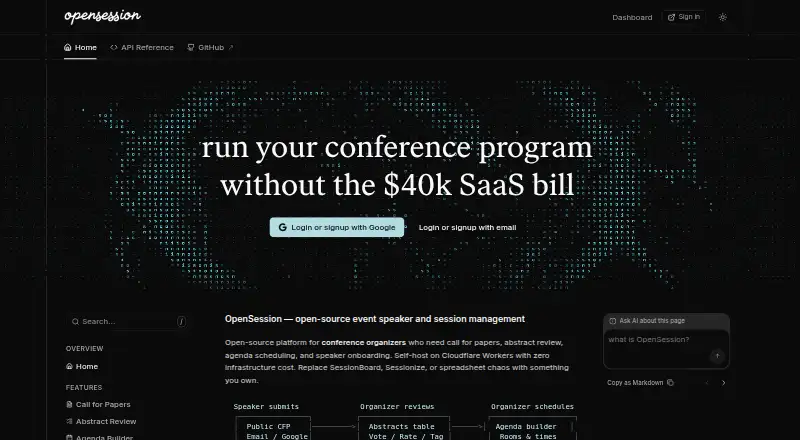
What OpenSession is
OpenSession is an open-source platform for managing conference programs, from calls for papers and abstract review to agenda scheduling and speaker onboarding. Organizers can build submission forms with MDX, conditional logic, multiple speakers and file uploads; each speaker can submit up to three talks per event. Reviewers can vote, comment and see aggregate scores without administrator access. The agenda builder places accepted sessions into rooms and time slots, and flags conflicts involving rooms or speakers. OpenSession sends RFC 5545 ICS invitations and automatically sends updates when the schedule changes. Accepted speakers can use a self-service portal to manage profiles, follow submissions, complete onboarding tasks and upload files. Organizers can publish embeddable agendas and speaker galleries, plus JSON and ICS feeds for integrations. The software is MIT-licensed and can be self-hosted on Cloudflare Workers, using D1 for its database and R2 for file storage. Its free plan is billed free forever. OpenSession covers conference program management, but does not include CRM, marketing pages or payment processing.
Who it suits
OpenSession suits conference organizers who need to collect proposals, review submissions, schedule sessions and coordinate speakers. It may fit teams able to self-host on Cloudflare Workers and that do not need CRM, marketing pages or payment processing in the platform.
What it does well
- MIT-licensed and free forever.
- Submission forms support conditional logic and uploads.
- Reviewers can see aggregate scores without admin access.
- Agenda tools flag room and speaker conflicts.
- Speaker portal supports onboarding and file uploads.
What to know first
- Each speaker can submit at most three talks per event.
- Does not include CRM.
- Does not include marketing pages.
- Does not include payment processing.
Limits
The plan is free, billed free forever, and is self-hosted on your Cloudflare account. The guide lists free-tier limits of 100,000 Workers requests per day, 5 GB of D1 storage, and 10 GB of R2 storage; each speaker may submit up to three talks per event.
Plans
| Plan | Billed and limits | Price |
|---|---|---|
| OpenSession | Free, forever · Self-hosted on your Cloudflare account · Cloudflare free tier covers most conference workloads | Free |
| Free | self-hosted · Cloudflare Workers deployment · MIT license | Free |
As opensession.dev lists them, read 30 Sept 2026. The maker's own page has the final word.
Getting started
- Visit the OpenSession website.
- Set up self-hosting on your Cloudflare account using Cloudflare Workers.
- Use Cloudflare D1 for the database and R2 for file storage.
- Optionally configure Google OAuth credentials for self-hosting.
- Sign in with email or Google and create a call-for-papers form.
Verdict
OpenSession covers proposal intake, review, scheduling and speaker coordination, with self-hosting available on Cloudflare Workers. Its scope stops short of CRM, marketing pages and payment processing.
Questions
How much does OpenSession cost?
The OpenSession plan is free, billed free forever. It is self-hosted on your Cloudflare account.
Is OpenSession open source?
Yes. The site says OpenSession is MIT-licensed.
Where can OpenSession run?
It can be self-hosted on Cloudflare Workers. The setup uses Cloudflare D1 for its database and R2 for file storage.
How many talks can a speaker submit?
Each speaker can submit up to three talks per event.
How can users sign in?
Organizers and speakers can sign in with email or Google. Google OAuth credentials are optional for self-hosting.
What does OpenSession cover?
It manages conference program tasks such as submissions, reviews, agenda scheduling, and speaker onboarding. It does not include CRM, marketing pages, or payment processing.
Facts from OpenSession's own pages
- Agenda builder
- The agenda interface supports list, week, room, and conflict views for scheduled sessions. · opensession.dev, 15 Oct 2026
- API authentication
- The public API uses an event API key supplied as a Bearer token. · opensession.dev, 15 Oct 2026
- API resources
- The API documents events, schedules, sessions, speakers, tracks, formats, rooms, and reviews. · opensession.dev, 15 Oct 2026
- API scheduling
- The scheduling endpoint accepts a room, start and end timestamps, and an option to confirm conflicts. · opensession.dev, 15 Oct 2026
- API session creation
- Session creation accepts content or service kind, title, description, visibility, track, and format fields. · opensession.dev, 15 Oct 2026
- Authentication
- Organizers and speakers can sign in with email or Google; Google OAuth credentials are optional for self-hosting. · opensession.dev, 30 Sept 2026
- Calendar
- OpenSession sends RFC 5545 ICS invites, and schedule changes send updates automatically. · opensession.dev, 30 Sept 2026
- Calendar invites
- Moving or removing a scheduled session sends RFC 5545 ICS updates or cancellations to confirmed speakers. · opensession.dev, 15 Oct 2026
- Call for Papers
- Organizers build MDX submission forms with custom components, conditional fields, file uploads, and multi-speaker support. · opensession.dev, 15 Oct 2026
- Cloudflare free-tier capacity
- The guide lists 100,000 Worker requests and 5 million D1 reads per day, plus 5 GB D1 and 10 GB R2 storage in the free tier. · opensession.dev, 15 Oct 2026
- Conflict detection
- Scheduling checks overlapping rooms and double-booked speakers, but conflicts are warnings that organizers can override. · opensession.dev, 15 Oct 2026
- Data and storage
- The self-hosted setup uses Cloudflare D1 for its database and R2 for file storage. · opensession.dev, 30 Sept 2026
- Deployment architecture
- The application runs as a Cloudflare Worker backed by D1 SQLite, R2 storage, and the send_email binding. · opensession.dev, 15 Oct 2026
- File storage
- Speaker-uploaded files are stored in Cloudflare R2 using event, identifier, and filename path components. · opensession.dev, 15 Oct 2026
- Form versioning
- Submitted responses remain tied to the exact immutable form version that speakers used. · opensession.dev, 15 Oct 2026
- Hosting limits
- The guide lists Cloudflare Workers free-tier limits of 100,000 requests per day, 5 GB of D1 storage, and 10 GB of R2 storage. · opensession.dev, 30 Sept 2026
- Independent feature summary
- The repository lists CFP forms, abstract voting and ratings, conflict-aware agendas, speaker portals, email and ICS workflows, and JSON/XML/ICS feeds. · github.com, 15 Oct 2026
- Independent implementation report
- A separate public repository reports that the app was built solo over a weekend for the Kill My SaaS competition. · github.com, 15 Oct 2026
- Independent repository description
- The public repository describes OpenSession as an open-source SessionBoard and Sessionize alternative for conference programs. · github.com, 15 Oct 2026
- Independent stack summary
- The repository identifies Cloudflare Workers, D1, R2, Spiceflow, Drizzle ORM, BetterAuth, and Holocron as the main stack. · github.com, 15 Oct 2026
- Integrations and publishing
- The product provides embeddable agendas and speaker galleries, plus JSON and ICS feeds for third-party integrations. · opensession.dev, 30 Sept 2026
- License
- The repository publishes the software under the MIT license. · github.com, 15 Oct 2026
- License and hosting
- The site says OpenSession is MIT-licensed and can be self-hosted on Cloudflare Workers. · opensession.dev, 30 Sept 2026
- Limit: conflict handling
- The independent report says agenda conflicts are detected and warned about but are not blocked. · github.com, 15 Oct 2026
Where OpenSession stands on Freedom251
- Speaker Management Software#2 of 28