Freedom251 › AI LLM Observability Tools
OpenLIT
What OpenLIT is
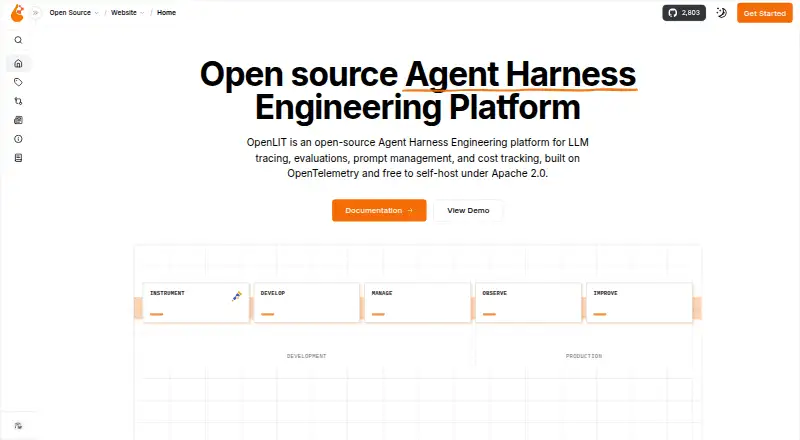
OpenLIT is an open-source Agent Harness Engineering platform for monitoring and managing LLM applications. Built on OpenTelemetry, it brings together tracing, evaluations, prompt management, model comparison, and cost tracking. Its traces can capture model calls, tool use, and retrievals, with filters for user, session, cost, latency, and metadata. Evaluations can apply an LLM judge, heuristics, or human review to production traffic or experiments. Prompt Hub supports versioning, dynamic variables, API retrieval, unlimited prompt fetching, and AI-assisted improvement. OpenGround compares models for latency, token use, and cost, including comparisons made with your own key. Coding-agent monitoring covers sessions, cost, tokens, repository activity, and code impact. OpenLIT lists more than 56 integrations spanning LLMs, agent frameworks, vector databases, and GPUs, including OpenAI, Anthropic, LangChain, Pinecone, and NVIDIA NIM. You can receive OpenTelemetry data through OTLP and deploy with Docker Compose or Kubernetes Helm. The Apache 2.0-licensed project says self-hosting keeps prompts, traces, and secrets in your environment. Its free OSS plan includes unlimited self-hosted usage, users, projects, and environments, with community support on GitHub. A hosted Cloud plan is marked as coming soon.
Who it suits
OpenLIT suits developers and teams building LLM applications who need tracing, evaluation, prompt management, or cost tracking in one platform. Its self-hosted deployment and unlimited OSS plan may suit teams that want to keep prompts, traces, and secrets in their own environment.
What it does well
- Captures LLM calls, tool use, and retrievals in traces.
- Supports LLM-as-a-judge, heuristic, and human evaluations.
- Prompt Hub includes versioning, dynamic variables, and API retrieval.
- OpenGround compares models by latency, tokens, and cost.
- Free OSS plan includes unlimited users, projects, and environments.
- Apache 2.0 licensed, with 56+ listed integrations.
What to know first
- Self-hosted deployment requires Docker Compose or Kubernetes Helm.
- Hosted Cloud plan is coming soon.
- OSS support is community-based through GitHub.
Limits
The free OSS plan lists unlimited self-hosted usage, users, projects, and environments. Fleet Hub lists monitoring for a single collector cluster.
Plans
| Plan | Billed and limits | Price |
|---|---|---|
| OSS | Unlimited self-hosted usage · unlimited users · unlimited projects/environments · community GitHub support · Apache 2.0 | Free |
| Cloud | Fully hosted service · managed infrastructure and upgrades · pricing shared at launch · waitlist only | On request |
As openlit.io lists them, read 14 Oct 2026. The maker's own page has the final word.
Getting started
- Visit the OpenLIT website.
- Choose self-hosted deployment with Docker Compose or Kubernetes Helm.
- Send OpenTelemetry data through OTLP.
- Sign in with Google, Azure AD, or GitHub.
OpenLIT is an open-source platform for observing LLM and agent applications, with tracing, evaluations, prompt management, and cost tracking. It suits teams prepared to run their own OpenTelemetry-based tooling. Its broad self-hosted feature set is compelling, but teams seeking a managed service must wait for Cloud.
Overview
OpenLIT brings operational visibility and prompt workflows together: teams can inspect calls, tools, and retrievals, evaluate traffic, compare models, and track costs in one platform. That breadth can help teams working across both LLM applications and coding agents avoid splitting these tasks across separate tools. The trade-off is operational responsibility: deployment is self-hosted, using Docker Compose or Kubernetes Helm.
The Apache 2.0 license supports using and running the software under an open-source license. OpenLIT says self-hosting keeps prompts, traces, and secrets in the user's environment, a useful property for teams that want control over their data. Its Cloud plan is coming soon, so it is not a current choice for teams that want a hosted service.
Key features
Tracing and evaluations
Tracing can capture model calls, tools, and retrievals, with filters for user, session, cost, latency, and metadata. These views help teams narrow an investigation to a particular interaction or cost and performance concern. Evaluations support LLM-as-a-judge, heuristics, and human review on production traffic or experiments. That range accommodates automated checks as well as human assessment, though teams will need to choose an evaluation approach suited to their use case.
Prompt workflows and model comparison
Prompt Hub provides versioning, dynamic variables, API retrieval, unlimited prompt fetching, and AI-assisted improvement. Those capabilities support teams that want prompts managed as part of the development workflow rather than handled separately. OpenGround compares models side by side on latency, tokens, and cost, and supports comparison with a bring-your-own key. It gives teams a way to weigh these measures, rather than treating model choice as a cost-only decision.
Agent visibility and integrations
Coding agent monitoring tracks sessions, cost, tokens, repository activity, and code impact, extending observability beyond model calls. The site lists more than 56 integrations across LLMs, agent frameworks, vector databases, and GPUs, including OpenAI, Anthropic, LangChain, Pinecone, and NVIDIA NIM. That range can suit teams with varied components, though an integration count alone does not establish how deeply any particular integration fits a workflow.
Deployment and data controls
OpenLIT accepts OpenTelemetry data through OTLP and can be deployed with Docker Compose or Kubernetes Helm. Vault stores LLM API keys with AES-256-GCM encryption, key- and tag-based retrieval, and API authentication. The OSS plan supports sign-in with Google, Azure AD, and GitHub. These controls add useful options for self-hosted teams; operating and securing the deployment remains their responsibility.
Pricing
OSS: free. It includes unlimited self-hosted usage, unlimited users, unlimited projects and environments, and community support on GitHub. This is the strongest fit for teams comfortable running the platform themselves and relying on community support. Fleet Hub lists single-cluster collector monitoring, a notable boundary for teams managing collectors across multiple clusters.
Cloud: custom pricing. The plan is coming soon, with a fully hosted service and pricing and feature set to be shared at launch. There is no current hosted plan to choose, so teams needing managed deployment now should consider another product.
The OSS plan's unlimited usage, users, projects, and environments make it unusually unconstrained on those dimensions for a self-hosted option. That does not remove the work of hosting it, and GitHub community support may not suit teams that need a formal support channel.
Platforms
OpenLIT supports API, Linux, macOS, web, and Windows, and offers self-hosted deployment. Its documented deployment methods are Docker Compose and Kubernetes Helm, with OTLP for incoming OpenTelemetry data.
Who it's for
OpenLIT is a good match for engineering teams that want a self-hosted view across LLM and agent traces, evaluations, prompts, and costs, especially when OpenTelemetry and data control matter. Coding-agent monitoring and model comparison broaden its use beyond basic tracing. It is less suitable for teams that need a hosted service today, or that require support beyond the OSS plan's GitHub community.
Pros and cons
- Pros: Unlimited self-hosted users, projects, environments, and usage make the OSS plan practical for teams that want to expand without per-seat or project caps.
- Pros: Traces, evaluations, prompt workflows, model comparison, and coding-agent monitoring cover several related needs in one platform.
- Pros: Apache 2.0 licensing and self-hosting give teams control over deployment and, according to OpenLIT, keep prompts, traces, and secrets in their environment.
- Cons: Cloud is not yet available, ruling out teams that need a hosted option now.
- Cons: OSS support is through GitHub community support, which may not meet teams' need for a dedicated support channel.
- Cons: Fleet Hub's single-cluster collector monitoring may constrain teams managing more than one cluster.
Alternatives
W&B Weave is worth considering if you want a free plan with published ingestion and storage allowances: it includes 1 GB/mo Weave data ingestion and 5 GB/mo storage, alongside evaluations, tracing, and scorers. OpenLIT instead offers unlimited self-hosted usage, users, projects, and environments.
LangWatch may suit teams seeking an Apache 2.0 open-source option with a free Developer plan capped at 50k events/month and 14-day data access. OpenLIT offers unlimited self-hosted usage and projects, but its support is community-based on GitHub.
Opik is another option for teams who want open-source observability and evaluation features they can download and run locally; OpenLIT adds prompt management and cost tracking to its stated scope.
Agenta may fit a small team that prefers a free Hobby plan with defined limits of 2 team members, 5,000 agent runs/month, 20 evaluations/month, and 1-week trace retention. OpenLIT's OSS plan instead lists unlimited users and usage for self-hosted deployments.
Arize AX is a hosted SaaS alternative with a free plan that includes 25k trace spans/month, 1 GB ingestion/month, and 15-day retention. Choose it over OpenLIT if those published SaaS limits suit you better than operating a self-hosted service.
Arize Phoenix is a free, open-source, self-hosted option for teams seeking user-managed trace spans, ingestion, and projects.
Braintrust offers a free Starter plan with 1 GB processed data, 10,000 scores, and 14-day retention; it may suit teams whose needs fit those defined allowances.
Confident AI has a free plan capped at 2 user seats, 1 project, 5 test runs per week, and 1 GB-month of trace spans. It may suit a small evaluation workflow that fits those caps; OpenLIT's OSS plan is less restrictive on users and projects.
Browse AI LLM Observability Tools, AI Agent Observability Tools, Model Monitoring Software, and LLM Observability Tools for more options.
Verdict
Choose OpenLIT if you want a wide set of LLM and agent observability tools in an Apache 2.0 self-hosted platform, with unlimited OSS users, projects, environments, and usage. The central reason to look elsewhere is equally clear: Cloud is not yet available, and GitHub community support is the OSS plan's support channel.
Verdict
Choose OpenLIT if you want LLM tracing, evaluations, prompt tools, and cost tracking, with the option to self-host under an Apache 2.0 license. Look elsewhere if you need a hosted Cloud plan now or support beyond the OSS plan’s GitHub community support.
Questions
Is OpenLIT free?
Yes. The OSS plan is free and lists unlimited self-hosted usage, users, projects, and environments.
Can I use OpenLIT as a hosted service?
A Cloud plan is marked as coming soon; its pricing and features are to be shared at launch.
Where can I deploy OpenLIT?
It can be self-hosted using Docker Compose or Kubernetes Helm, and accepts OpenTelemetry data through OTLP.
Is OpenLIT open source?
Yes. OpenLIT is Apache 2.0 licensed.
What integrations does OpenLIT list?
It lists 56+ integrations across LLMs, agent frameworks, vector databases, and GPUs, including OpenAI, Anthropic, LangChain, Pinecone, and NVIDIA NIM.
What support comes with the OSS plan?
The OSS plan includes community support on GitHub.
Facts from OpenLIT's own pages
- Agent observability
- The platform records LLM calls, tool calls and agent steps for production analysis. · openlit.io, 14 Oct 2026
- Coding-agent monitoring
- OpenLIT tracks coding-agent sessions, costs, tokens and repository activity. · openlit.io, 14 Oct 2026
- Company background
- OpenLIT says the project is community-driven, built in public on GitHub, and used by developers worldwide. · openlit.io, 29 Sept 2026
- Company founder
- Crunchbase identifies Aman Agarwal as a founder. · crunchbase.com, 14 Oct 2026
- Company headquarters
- Crunchbase places OpenLIT in New Delhi, Delhi, India. · crunchbase.com, 14 Oct 2026
- Company legal name
- Crunchbase lists the legal name as OpenLIT and operating status as active. · crunchbase.com, 14 Oct 2026
- Company size
- Crunchbase lists the company size as 1–10 employees. · crunchbase.com, 14 Oct 2026
- Company type
- Crunchbase classifies OpenLIT as a private non-profit company. · crunchbase.com, 14 Oct 2026
- Custom dashboards
- Dashboards are backed by ClickHouse and support charts, tables, filters, folders, import and export. · openlit.io, 14 Oct 2026
- Deployment
- The platform can be self-hosted using Docker Compose or Kubernetes Helm and accepts OpenTelemetry data through OTLP. · openlit.io, 29 Sept 2026
- Documentation depth
- The documentation includes provider-specific SDK guides, observability pages, controller deployment material, CLI configuration and an indexed documentation file. · docs.openlit.io, 14 Oct 2026
- Evaluations
- OpenLIT includes built-in evaluations, programmatic evaluations and LLM-as-a-judge workflows that can run locally or in CI. · openlit.io, 14 Oct 2026
- Funding disclosure
- The reviewed Crunchbase profile does not show a funding total or disclosed funding rounds for OpenLIT. · crunchbase.com, 14 Oct 2026
- Go SDK capability
- The Go SDK wraps provider clients and emits traces and metrics for standard and streaming calls, embeddings and image generation. · docs.openlit.io, 14 Oct 2026
- GPU monitoring
- The GPU collector and dashboards expose utilization, memory, temperature and power metrics. · openlit.io, 14 Oct 2026
- Guardrails
- The SDK includes guards for prompt injection, jailbreak and sensitive-topic detection using LLM and regular-expression checks. · openlit.io, 14 Oct 2026
- Integration examples
- Documented integrations include OpenAI, Anthropic, Cohere, Mistral, Ollama, Bedrock, Vertex AI, LangChain, LlamaIndex, Pinecone, Chroma, Qdrant and Milvus. · openlit.io, 14 Oct 2026
- Integrations
- The home page advertises more than 56 integrations spanning LLMs, agent frameworks, vector databases and GPUs. · openlit.io, 14 Oct 2026
- Licence
- The project is licensed under Apache License 2.0. · github.com, 14 Oct 2026
- License and data
- OpenLIT is Apache 2.0 licensed, and its site says self-hosting keeps prompts, traces, and secrets in the user's environment. · openlit.io, 29 Sept 2026
- Limit: independent review coverage
- Product Hunt lists OpenLIT launches but currently shows no user reviews. · producthunt.com, 14 Oct 2026
- Model comparison
- OpenGround compares models side by side for latency, tokens, and cost, and supports bring-your-own-key model comparison. · openlit.io, 29 Sept 2026
- Notable limits
- Fleet Hub lists single-cluster collector monitoring, while the self-hosted plan lists unlimited usage, historical data, users, projects, and environments. · openlit.io, 29 Sept 2026
- Notable news: integration expansion
- An OpenLIT LinkedIn post announced integrations with more than 50 AI tools during its launch week, including new model, agent and vector-database connectors. · linkedin.com, 14 Oct 2026
Where OpenLIT stands on Freedom251
- AI LLM Observability Tools#5 of 23
- AI Agent Observability Tools#7 of 31
- Llm Monitoring#6 of 26
- LLM Observability Tools#6 of 26
- Model Monitoring Software#7 of 24