Freedom251 › Virtual Reality Learning Platforms
Openlab
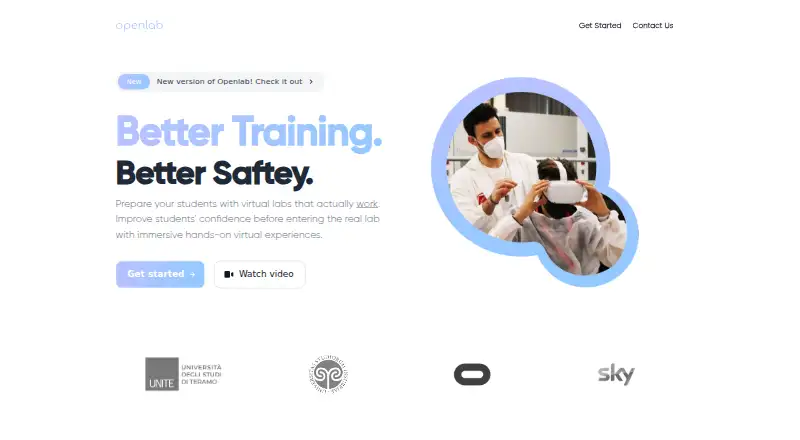
What Openlab is
Openlab provides virtual biology and chemistry labs so students can practice laboratory protocols before working in a physical lab. Learners interact with virtual equipment such as pipettes and test tubes, and can explore molecular structures and DNA. Interactive quizzes test progress at each protocol step, while teachers can follow learners through a web dashboard. Professors can request virtual labs built around an experiment described in a document or video.
The site says Openlab currently supports Oculus Quest 2 with hand tracking, letting students interact with their hands. The maker suggests using it before a real lab, as a classroom supplement, or for group activities. It also says it will ship a headset to an institute for a limited-time free trial and help with setup. The terms state that services are free of charge, while noting that fees or subscriptions may be introduced later with notice. The privacy policy says usage data may include IP addresses, experiences played, usage times, device identifiers, and diagnostic data such as headset details. Openlab says it uses commercially acceptable means to protect personal data but cannot guarantee absolute security. Its stated base is Varese, Italy.
Who it suits
Openlab is presented for students, professors, and educational institutes using virtual labs in teaching. It may suit classes that want learners to practice protocols before entering a physical lab.
What it does well
- Virtual labs cover biology and chemistry
- Interactive quizzes assess each protocol step
- Teachers can track progress through a web dashboard
- Services are currently stated to be free of charge
What to know first
- Current headset support is Oculus Quest 2
- Free headset trial is limited-time
- Fees or subscriptions may be introduced later with notice
- Absolute data security is not guaranteed
Limits
The listed Openlab plan is free of charge, and the VR headset trial lasts for a limited time. The terms say fees or subscriptions may be introduced in the future with notice.
Plans
| Plan | Billed and limits | Price |
|---|---|---|
| Openlab | Services provided free of charge · VR headset trial is for a limited time | Free |
As openlabvr.com lists them, read 7 Oct 2026. The maker's own page has the final word.
Getting started
- Visit the Openlab website and submit an inquiry through its contact form.
- Arrange the limited-time free trial for an institute.
- Receive the VR headset shipment and setup help from Openlab.
- Have students use the Oculus Quest 2 with hand tracking to work through lab protocols.
Openlab is a virtual biology and chemistry lab for students and instructors who want to rehearse laboratory procedures in VR. Its appeal is straightforward: practice and teacher progress tracking are free, while the main constraint is support for a single stated headset.
Overview
Students can handle virtual equipment such as pipettes and test tubes, explore molecular structures and DNA, and answer interactive quizzes as they work through a protocol. That combination makes Openlab more useful for structured rehearsal than a virtual lab that only presents scientific objects to explore. Teachers can follow progress in a web dashboard, which adds a way to monitor student work alongside classroom teaching.
Openlab is intended to prepare students for physical lab work, not replace it. The maker suggests using it before a lab session, as a class supplement, or for group activity. Professors can request a virtual lab based on an experiment described in a document or video; that may help connect practice to a course, although it is a request-based route rather than direct authoring by the instructor.
Key features
Protocol practice and teaching
Quizzes at each step encourage students to engage with the sequence of a protocol rather than simply move through a simulation. Progress tracking gives teachers visibility into learner activity. Together, these features suit instructors who want a practice activity with some assessment and oversight, particularly before students enter a physical lab.
Openlab says it supports Oculus Quest 2 with hand tracking, so students interact with their hands. That offers a more direct way to manipulate virtual equipment, but the stated headset support is narrow. Institutions should confirm that this device fits their planned deployment before relying on Openlab across a class.
Custom labs and setup
Professors can ask Openlab to create a virtual lab from an experiment described in a document or video. This can make the platform more relevant to a particular course than a fixed set of activities, but it depends on a custom request. Openlab also says it will ship a headset to an institute for a limited-time free trial and help with setup, a useful way for an institution to evaluate the teaching workflow before adopting it.
Pricing
Openlab's plan is free. The service is free of charge under its terms, and the free plan includes access to the service; the headset trial, however, is only for a limited time. The terms allow fees or subscriptions to be introduced in the future with notice, so institutions should not treat today's no-cost terms as a permanent guarantee.
There is no stated seat cap or usage quota to weigh against the free price. For institutions, the practical cost question is therefore less about a published per-user charge than whether the supported headset and teaching setup suit their needs. A free trial is available, with setup assistance for institutes.
Platforms
Openlab is listed for web. The learning activity itself is tied to VR, and the stated headset support is Oculus Quest 2 with hand tracking. A web dashboard supports teacher progress tracking, but web availability should not be confused with broad headset compatibility.
Who it's for
Openlab is best suited to schools, colleges, professors, and institutes teaching biology or chemistry who want students to rehearse protocols before using physical lab equipment. The quizzes and teacher dashboard give it a stronger classroom use case than an unstructured VR demonstration. It is a weaker fit for organizations that need broad headset coverage or training outside biology and chemistry.
Pros and cons
- Pro: Students can practice with virtual lab equipment and explore molecules and DNA, giving instructors a way to introduce procedures before physical lab work.
- Pro: Step-by-step quizzes and a teacher dashboard combine practice with progress monitoring.
- Pro: Free service and an institute trial with setup help lower the barrier to evaluating it.
- Con: Stated headset support is limited to Oculus Quest 2, which may constrain institutional deployment.
- Con: Custom labs require professors to request an activity based on a document or video rather than creating one directly.
- Con: The terms permit future fees or subscriptions with notice, so the current free price may not remain unchanged.
- Con: The privacy policy says usage data can include IP address, played experiences, usage times, device identifiers, and diagnostic data such as headset details. It says personal data is retained as needed for stated purposes, with usage data generally kept for a shorter period subject to exceptions; the company also says it cannot guarantee absolute security.
Alternatives
Virtual Reality Learning Platforms is a useful category to browse when the priority is comparing a wider range of VR learning tools.
- VictoryXR is worth considering when broader device coverage or a free-forever plan with AI creation and avatar and environment customization matters more than Openlab's biology and chemistry protocol focus.
- 3D Organon is a better fit for anatomy learning, with a free entry-level plan and a paid student subscription.
- LabTrainingVR: Biosafety Cabinet Edition suits a narrower biosafety-cabinet exercise if a 1.5-hour VR activity with HTC Vive or Meta Quest 2 is sufficient.
- FundamentalVR is another paid option for readers comparing VR training software.
- Pixaera may suit organizations seeking an enterprise platform with pricing provided through a demo request.
- VRLab Academy is worth comparing when a larger experiment collection, learner management, or LMS integration is the priority.
- Luminous XR is an option for readers looking for XR training content creation and hosting, with a demo portal and a stated starting price.
- Oxford Medical Simulation is another paid option to consider.
Verdict
Choose Openlab if you teach biology or chemistry and want a free way for students to rehearse protocols, answer step-based quizzes, and let instructors track progress before physical lab sessions. Look elsewhere if your institution needs wider headset compatibility, or if your training falls outside Openlab's stated subject focus.
Verdict
Openlab offers virtual lab practice, step-by-step quizzes, and teacher progress tracking. Institutions should consider its stated headset support and privacy disclosures before adopting it.
Questions
How much does Openlab cost?
The listed Openlab plan costs nothing. Its terms state that services are free of charge, though fees or subscriptions may be introduced later with notice.
Is there a free trial?
Yes. Openlab says it will ship a VR headset to an institute for a limited-time free trial and help with setup.
Which platforms and headsets does Openlab support?
The listed platform is web. The site says it currently supports Oculus Quest 2 with hand tracking.
Who makes Openlab?
The company is Openlab S.R.L., based in Varese, Italy.
Can professors request custom virtual labs?
Yes. Professors can request a virtual lab based on an experiment described in a document or video.
What learner tracking is available?
Teachers can track progress through a web dashboard, and interactive quizzes test learners at each protocol step.
Facts from Openlab's own pages
- Company
- The privacy policy identifies the company as Openlab S.R.L. and gives its address as Via Bicocca 17, Varese, Italy 21100. · openlabvr.com, 7 Oct 2026
- Custom curriculum
- Openlab says professors can request virtual labs based on an experiment described in a document or video. · openlabvr.com, 7 Oct 2026
- Data retention
- The policy says personal data is retained as necessary for stated purposes and usage data is generally retained for a shorter period, subject to exceptions. · openlabvr.com, 7 Oct 2026
- Getting started
- Openlab says it will ship a VR headset to an institute for a limited-time free trial and help set it up. · openlabvr.com, 7 Oct 2026
- Headquarters
- Varese, Italy · openlabvr.com, 28 Sept 2026
- Headset support
- The site says it currently supports Oculus Quest 2 with hand tracking and that students interact using their hands. · openlabvr.com, 7 Oct 2026
- Intended users
- The maker presents Openlab for students, professors, and educational institutes using virtual labs in teaching. · openlabvr.com, 7 Oct 2026
- Practice and assessment
- Learners are tested with interactive quizzes at each step of a protocol, and teachers can track progress through a web dashboard. · openlabvr.com, 7 Oct 2026
- Pricing terms
- The Terms of Service state that services are free of charge and that fees or subscriptions may be introduced in the future with notice. · openlabvr.com, 7 Oct 2026
- Privacy data
- The privacy policy says usage data may include IP address, experiences played, usage times, device identifiers, and diagnostic data, including headset details. · openlabvr.com, 7 Oct 2026
- Purpose
- Openlab provides immersive virtual biology and chemistry labs to help students practice laboratory protocols before entering a physical lab. · openlabvr.com, 7 Oct 2026
- Security
- The privacy policy says the company uses commercially acceptable means to protect personal data but cannot guarantee absolute security. · openlabvr.com, 7 Oct 2026
- Support
- The getting-started page says Openlab will help institutes set everything up and invites them to submit questions through its contact form. · openlabvr.com, 7 Oct 2026
- Use in teaching
- The maker suggests using Openlab before the real lab, as a class supplement, or as a group activity. · openlabvr.com, 7 Oct 2026
- Virtual lab activities
- Students interact with virtual equipment such as pipettes and test tubes and can explore molecular structures and DNA. · openlabvr.com, 7 Oct 2026