Freedom251 › Virtual Reality Learning Platforms
LabTrainingVR: Biosafety Cabinet Edition
Visit LabTrainingVR: Biosafety Cabinet Edition Alternatives Pricing
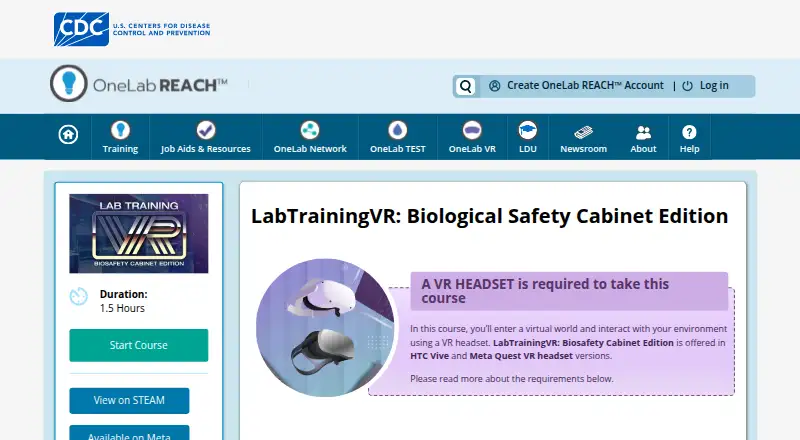
What LabTrainingVR: Biosafety Cabinet Edition is
LabTrainingVR: Biosafety Cabinet Edition is a free virtual reality course for practicing safe work in a biological safety cabinet (BSC). It is designed for laboratory professionals, including public health and clinical laboratory staff, safety professionals, and others interested in safe BSC use. In its 1.5-hour course, learners practice identifying Class II BSC parts, maintaining positive airflow, preparing for work, applying safe practices, decontaminating and shutting down, and carrying out emergency shutdown procedures. The virtual laboratory lets learners practice without exposure to pathogens or risk of accidental infection or release. The course supplements CDC’s existing eLearning course on working safely in a BSC. It is headset-only, with HTC Vive and Oculus Quest 2 versions; the equipment guide also identifies Meta Quest 2 and above and OpenXR-compatible headsets. A 360° tracking setup is required, with a minimum 3-by-3-foot play area and 20 by 20 feet listed as ideal. HTC Vive and tethered-headset setups require Windows 8.1 or later, at least 8 GB RAM, and 20 GB available storage, among other hardware requirements.
Who it suits
It suits laboratory professionals and others who want to practice BSC procedures in a virtual setting. The course is designed for headset use and requires tracked play space.
What it does well
- Free 1.5-hour course.
- Covers routine and emergency shutdown procedures.
- Virtual practice avoids exposure to pathogens.
- Includes Class II BSC airflow and setup practice.
What to know first
- Headset-only course.
- Requires 360° tracking and play area.
- Tethered setups require Windows 8.1 or later.
- Quest installation requires Wi-Fi and a mobile device.
Limits
This is a headset-only course, and 360° tracking and a play area of at least 3 by 3 feet are required. HTC Vive and tethered-headset setups also require Windows 8.1 or later, at least 8 GB RAM, and 20 GB of available storage, among other hardware requirements.
Plans
| Plan | Billed and limits | Price |
|---|---|---|
| LabTrainingVR: Biosafety Cabinet Edition | Free · VR only · HTC Vive or Meta Quest 2 · 1.5 hours · 360° tracking and play area required | Free |
| Free | VR headset and compatible computer required · Steam or Meta distribution | Free |
As reach.cdc.gov lists them, read 8 Oct 2026. The maker's own page has the final word.
Getting started
- Choose an HTC Vive or supported Quest headset; the equipment guide also identifies Meta Quest 2 and above and OpenXR-compatible headsets.
- Set up 360° tracking and a play area of at least 3 by 3 feet; 20 by 20 feet is listed as ideal.
- For HTC Vive or tethered-headset use, prepare a PC with Windows 8.1 or later, at least 8 GB RAM, and 20 GB available storage, among other hardware requirements.
- For Quest installation, arrange Wi-Fi and a mobile device for initial setup.
- Install the course from https://reach.cdc.gov/course/labtrainingvr-biological-safety-cabinet-edition; Quest setup directs users to accept an App Lab warning.
LabTrainingVR: Biosafety Cabinet Edition is a CDC virtual reality course for practicing biological safety cabinet procedures in a simulated lab. It best suits laboratory and safety professionals who need focused BSC practice; its narrow subject and headset requirements make it a poor fit for learners seeking broader lab training or a screen-based course.
Overview
The 1.5-hour course guides learners through preparing, working in, decontaminating and shutting down a Class II biological safety cabinet, including emergency shutdown procedures. Practice takes place without pathogen exposure or the risk of accidental infection or release, making the simulation useful for rehearsing safety-critical steps before working in a real cabinet.
It supplements CDC’s existing eLearning course on safe BSC work. That makes it a focused practical component of training rather than a broad laboratory curriculum.
Key features
- Procedural practice: Learners identify cabinet parts, maintain positive airflow, prepare for work, follow safe practices, decontaminate and shut down. The scope is well suited to reinforcing a defined sequence of BSC tasks.
- Risk-free simulation: The virtual lab allows practice without pathogen exposure or accidental release. It is a useful rehearsal environment, though the course’s stated role is to supplement existing eLearning.
- Room-scale tracking: The course requires 360° tracking and a minimum 3-by-3-foot play area; 20-by-20 feet is ideal. That is a meaningful setup constraint for home users and training sites with limited floor space.
Pricing
LabTrainingVR: Biosafety Cabinet Edition costs free, billed Free. The free plan includes the VR course, which runs for 1.5 hours and supports HTC Vive or Meta Quest 2. There is no paid tier described; the trade-off is a single, specialized course rather than a broader training library.
The cost is straightforward, but learners need compatible equipment and tracked play space to use it. Quest installation requires Wi-Fi and a mobile device for initial setup. HTC Vive and tethered headset users need Windows 8.1 or later, at least 8 GB of RAM and 20 GB of available storage, along with other hardware requirements.
Platforms
The course is available for Android and Windows, but delivery is headset-only. The course page identifies HTC Vive and Oculus Quest 2 versions; the equipment guide also identifies Meta Quest 2 and above and OpenXR-compatible headsets. Check headset compatibility and tracking setup before arranging a session. For technical issues, OneLab REACH directs users to submit a support ticket or email [email protected].
Who it's for
Laboratory professionals, including public health and clinical laboratory staff, safety professionals and others interested in safe BSC use, are the natural audience. It fits organizations that want learners to rehearse cabinet procedures in VR without pathogen exposure. It is less suitable for people without access to a compatible headset and tracked play area, or for those looking for training beyond biological safety cabinets.
Pros and cons
- Pro: Covers preparation through emergency shutdown, giving learners practice across the main stages of cabinet use.
- Pro: Provides a simulated setting for practicing safety procedures without pathogen exposure or accidental release.
- Pro: The course is free, making it accessible to eligible learners who already have the required equipment.
- Con: Headset-only delivery, 360° tracking and room-space requirements rule it out for learners who need desktop or mobile-screen access.
- Con: Its 1.5-hour, BSC-specific scope makes it a supplement to training rather than a general laboratory learning platform.
Alternatives
For a broader set of VR learning options, browse Virtual Reality Learning Platforms.
- VictoryXR is a better fit for learners seeking a freemium platform with an AI creator tool and avatar and environment customization; its free HoloTutor Basic plan includes monthly AI usage.
- 3D Organon suits learners focused on anatomy: it has a free entry-level Guest plan and a Student subscription at $74.50 a year.
- Openlab offers free web-based services and a VR headset trial for a limited time, making it an option for those who want a web platform or a time-limited VR trial.
- FundamentalVR is a paid alternative for readers comparing broader platform availability.
- Pixaera may suit organizations considering paid enterprise training; its Enterprise plan uses custom pricing and the platform offers a free trial.
- VRLab Academy is a stronger match for instructors seeking a larger experiment catalog, learner management and LMS integration.
- Luminous XR offers XR training content creation and hosting, with a FLOW creator package starting on request.
- Oxford Medical Simulation is another paid option for readers comparing medical simulation platforms.
Verdict
Choose LabTrainingVR: Biosafety Cabinet Edition if you work in a laboratory or safety role and want free, focused VR practice for Class II cabinet procedures without pathogen exposure. Its clear limitation is its narrow course scope and dependence on compatible headsets, tracking and room space. Look elsewhere if you need a wider training curriculum or cannot provide the VR setup.
Verdict
This course provides structured VR practice for biological safety cabinet procedures without pathogen exposure. Check headset and tracking requirements before starting.
Questions
How much does the course cost?
The course is free.
How long is the course?
The listed course duration is 1.5 hours.
Which headsets are supported?
The course page lists HTC Vive and Oculus Quest 2. The equipment guide also identifies Meta Quest 2 and above and OpenXR-compatible headsets.
What space and tracking setup does it require?
It requires 360° tracking and at least a 3-by-3-foot play area. A 20-by-20-foot area is listed as ideal.
What does Quest installation require?
Initial setup requires Wi-Fi and a mobile device. The setup guide directs users to accept an App Lab warning before installation.
Who is the course for?
It is designed for laboratory professionals, including public health and clinical laboratory staff, safety professionals, and others interested in safe BSC use.
Facts from LabTrainingVR: Biosafety Cabinet Edition's own pages
- Audience
- It is designed for laboratory professionals, including public health and clinical laboratory staff, safety professionals, and others interested in safe BSC use. · store.steampowered.com, 8 Oct 2026
- Company identity
- LinkedIn identifies the maker as the Centers for Disease Control and Prevention, a U.S. government agency headquartered in Atlanta, Georgia. · linkedin.com, 15 Oct 2026
- Company size
- LinkedIn lists CDC at more than 10,001 employees and shows about 20,111 employees on its company page. · linkedin.com, 15 Oct 2026
- Course length
- The course duration is listed as 1.5 hours. · reach.cdc.gov, 8 Oct 2026
- Course level
- CDC describes it as a basic-level course for laboratory professionals. · reach.cdc.gov, 15 Oct 2026
- Distribution
- The official listing links to Steam and Meta distribution. · reach.cdc.gov, 15 Oct 2026
- Duration
- The OneLab REACH listing gives the course a duration of 1.5 hours. · reach.cdc.gov, 15 Oct 2026
- Feature: airflow
- Learners practice maintaining positive airflow inside the cabinet. · reach.cdc.gov, 15 Oct 2026
- Feature: cabinet parts
- Learners identify the major parts of a Class II biological safety cabinet. · reach.cdc.gov, 15 Oct 2026
- Feature: decontamination
- Learners practice decontaminating and shutting down a cabinet. · reach.cdc.gov, 15 Oct 2026
- Feature: emergencies
- The course includes emergency shutdown procedures. · reach.cdc.gov, 15 Oct 2026
- Feature: preparation
- The course teaches preparation steps before working in a cabinet. · reach.cdc.gov, 15 Oct 2026
- Feature: safe work
- The simulation exercises safe-work practices inside a biological safety cabinet. · reach.cdc.gov, 15 Oct 2026
- Founded
- A CDC overview states that the Centers for Disease Control and Prevention was founded in 1946 and headquartered in Atlanta, Georgia. · stacks.cdc.gov, 15 Oct 2026
- Government software terms
- CDC states that its VR apps are maintained by the U.S. Government and supplied as-is without warranties. · cdc.gov, 15 Oct 2026
- Headsets and space
- The course page lists HTC Vive and Oculus Quest 2 versions and requires 360° tracking, with a minimum 3-by-3-foot play area and an ideal 20-by-20-foot area. · reach.cdc.gov, 8 Oct 2026
- Integration
- CDC positions the VR course as a supplement to its Fundamentals of Working Safely in a Biological Safety Cabinet eLearning course. · reach.cdc.gov, 15 Oct 2026
- Learning objectives
- Learners practice identifying Class II BSC parts, maintaining positive airflow, preparing for work, applying safe practices, decontaminating and shutting down, and performing emergency shutdown procedures. · reach.cdc.gov, 8 Oct 2026
- Limit: hardware cost
- MERLOT noted that VR hardware can be expensive and impractical for individual students doing homework. · merlot.org, 15 Oct 2026
- Limit: locomotion
- A Steam reviewer reported difficulty with teleport movement, orientation, and adjusting position while working at the cabinet. · steamcommunity.com, 15 Oct 2026
- Limit: Meta session length
- The same Meta reviewer said the 60-to-90-minute course would be better divided into smaller sessions. · meta.com, 15 Oct 2026
- Limit: Meta usability
- A Meta reviewer reported getting stuck after the midpoint, difficulty loading and dispensing pipette liquid, and no in-training help. · meta.com, 15 Oct 2026
- Limit: onboarding
- A Steam reviewer said the application needed more introductory instruction on using VR controls. · steamcommunity.com, 15 Oct 2026
- Maker history
- CDC’s history page says the Communicable Disease Center opened in Atlanta on July 1, 1946, and that the current CDC headquarters is on Clifton Road in Atlanta. · cdc.gov, 8 Oct 2026