Freedom251 › Financial Planning & Analysis Software

OpenGov Budgeting & Performance
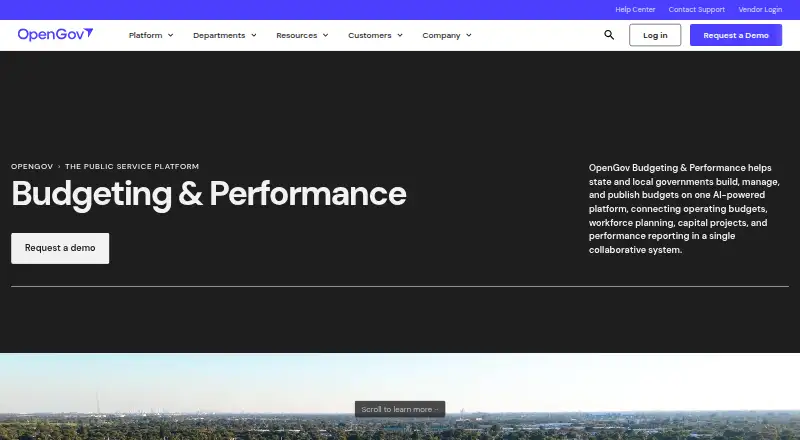
What OpenGov Budgeting & Performance is
OpenGov Budgeting & Performance is a cloud-based platform for state and local governments to build, manage, and publish budgets. It connects operating budgets, workforce planning, capital projects, and performance reporting in one collaborative system. Modules include Operating Budget, Workforce Planning, Capital Planning, Online Budget Book, Financial Reporting, and Performance Management. Teams can use approval workflows, scenario planning, actual-versus-budget views, multi-entity budgeting, and accounting integrations. Workforce Planning supports personnel decisions, forecasting, union negotiations, and personnel cost modeling. Capital Planning brings proposal collection, prioritization, and evaluation together, with associated reports, dashboards, and online project pages that teams can update. OG Assist answers plain-language questions about budget, workforce, and performance data, generates narratives, compares year-over-year changes, and explains variances. The online budget book tool creates digital budget books, capital plans, and strategic reports. OpenGov says Budgeting & Performance and Financial Management share a platform, connecting budget data and actuals without integrations or manual reconciliation. Performance Management is an add-on. Pricing is on request.
Who it suits
OpenGov Budgeting & Performance suits cities, counties, special districts, utilities, and regional authorities managing budget cycles. It may fit teams coordinating operating, workforce, capital, and performance planning in one system.
What it does well
- Connects operating budgets, workforce, capital, and performance planning
- Supports scenario planning and actual-versus-budget views
- OG Assist can explain variances and compare year-over-year changes
- Online budget books use live budget and performance data
- Offers onboarding and support through budget cycles
What to know first
- Pricing is available on request
- Performance Management is an add-on
- Performance Management access requires contacting Customer Success
Limits
Performance Management is available as an add-on, and customers should contact their Customer Success team for access.
Getting started
- Visit the OpenGov Budgeting & Performance product page.
- Request a demo from OpenGov.
- Discuss pricing and the modules needed by your organization.
- Arrange onboarding support for the budget cycle.
OpenGov Budgeting & Performance is a cloud platform for public-sector budgeting, workforce and capital planning, performance reporting, and public budget publication. It fits cities, counties, special districts, utilities, and regional authorities coordinating a complicated budget cycle across departments. The strongest case is a connected planning-to-publication workflow; the main drawbacks are custom pricing and the fact that Performance Management is an add-on.
Overview
The platform brings operating budgets, personnel decisions, capital proposals, financial reporting, performance data, and online publications into one collaborative system. That structure is useful when finance, human-resources, capital, and departmental teams need to work from the same cycle rather than exchange separate spreadsheets and reports.
OpenGov says Budgeting & Performance and Financial Management share a platform, linking budget data and actuals without integrations, data mapping, or manual reconciliation. That is a practical advantage for organizations adopting both products, although it does not by itself describe compatibility with other accounting systems. The product is cloud-deployed, offers web access and an API, and comes from a company founded in 2012 and headquartered in San Francisco.
Key features
Connected budget-cycle planning
Operating Budget, Workforce Planning, Capital Planning, Financial Reporting, Online Budget Book, and Performance Management cover the main stages from proposal to public reporting. Approval workflows help formalize review, while scenario planning supports comparisons before decisions are finalized. Actual-versus-budget tracking gives teams a direct way to monitor performance, and multi-entity budgeting suits organizations managing several departments, funds, or related entities. Accounting integrations broaden its usefulness where the finance system is not OpenGov Financial Management.
Workforce and capital decisions
Workforce Planning is aimed at forecasting personnel costs, modeling staffing decisions, and preparing for union negotiations. It is more relevant to governments whose largest budget pressure is people than to teams seeking only a basic expense plan. Capital Planning collects, prioritizes, and evaluates proposals in one place, then updates related reports, dashboards, and project pages. That linkage can reduce the gap between selecting projects and explaining them publicly.
AI assistance and publication
OG Assist answers plain-language questions about budget, workforce, and performance data, creates narrative text, compares year-over-year changes, and explains variances. Those capabilities can speed analysis and draft communication, but they complement rather than replace financial judgment. Online Budget Book publishes digital budgets, capital plans, and strategic reports using live budget and performance data, visualizations, narrative, video, and community feedback tools. It is a stronger fit for governments that must turn working documents into public-facing material.
Support and security
OpenGov describes comprehensive onboarding and continuing assistance through budget cycles; workforce-planning customers also receive dedicated account managers and training sessions. Its Trust Center cites SOC 2 Type 2, SOC 3, AZ RAMP, TX-RAMP, and GovRAMP resources, along with annual SOC 2 Type 2 examinations and annual third-party penetration testing. These assurances matter to public-sector buyers evaluating governance requirements, though each organization should confirm the certifications and controls applicable to its deployment.
Pricing
OpenGov uses paid, custom pricing. The product page directs prospective customers to request a demo rather than publishing a price, so it is suited to organizations prepared for a sales-led evaluation and formal quote. Performance Management is an add-on, meaning the base purchase does not automatically include that module; customers must contact OpenGov's Customer Success team for access. No seat, usage, renewal, or trial terms are stated.
Platforms
The product runs in the cloud, is accessible on the web, and has a Budgeting & Performance API in OpenGov's developer catalog. That combination suits browser-first government teams and organizations planning developer-led connections, while the API listing alone does not establish particular endpoints or integration coverage.
Who it's for
Choose it when a city, county, special district, utility, or regional authority needs one process for operating, workforce, capital, performance, and public budget work. It is especially compelling for organizations already using OpenGov Financial Management and for teams that need multi-entity planning, formal approvals, and public-facing budget books. It is less suitable for a buyer seeking a transparent, self-service price or a narrowly focused budgeting tool without optional modules.
Pros and cons
- Pro: One system spans operating, workforce, capital, reporting, and publication, reducing handoffs across a government budget cycle.
- Pro: Native connection to OpenGov Financial Management can avoid manual reconciliation between budgets and actuals.
- Pro: Scenario planning, approvals, multi-entity budgeting, and accounting integrations support structured public-sector processes.
- Pro: Live-data online budget books add visualizations, narrative, video, and community feedback to public reporting.
- Con: Pricing is custom and requires a demo, making comparisons and early budgeting difficult.
- Con: Performance Management costs extra and requires separate access through Customer Success.
- Con: The breadth may be unnecessary for organizations that only need basic budget preparation.
Alternatives
For a free web budgeting option, Bajet is the simpler choice: its Home Horizon plan costs nothing, but it does not offer a free trial. Choose ClearGov Budget Cycle when quote-based pricing with no per-seat fees and included support and updates is preferable.
Cube fits buyers wanting unlimited dimensions, users, and dashboards on its listed Bronze plan. For public organizations seeking configurable tiers, dedicated guidance, or strategic support, compare Euna Budget. OpenGov Accounts Payable is the related choice when the requirement is accounts-payable work rather than budgeting and performance.
Questica Budget is another paid budgeting option for public organizations. Choose Unit4 FP&A when you want a paid FP&A product with pricing provided on request and no public plan tiers or usage limits. Vena is the alternative when its Professional or Complete platform packages and web/Windows support match your requirements.
Browse Budgeting Software or Financial Planning & Analysis Software for a wider comparison.
Verdict
OpenGov Budgeting & Performance is a strong choice for government organizations that want coordinated operating, workforce, capital, performance, and public-budget workflows, particularly alongside OpenGov Financial Management. Choose it for that connected public-sector scope and ongoing implementation support; look elsewhere if transparent pricing, a standalone performance module, or a smaller budgeting footprint matters more.
Verdict
OpenGov Budgeting & Performance combines budget planning, publication, and performance tools for government organizations. Prospective customers should note that Performance Management is an add-on and request pricing information.
Questions
How is the product priced?
Pricing is available on request; the product page directs prospective customers to request a demo.
Which organizations does it serve?
OpenGov lists cities, counties, special districts, utilities and regional authorities of all sizes.
Is Performance Management included?
Performance Management is available as an add-on. Customers should contact their Customer Success team for access.
Does it connect to accounting systems?
Accounting integrations are listed. OpenGov also says Budgeting & Performance and Financial Management share a platform, connecting budget data and actuals natively.
Is there an API?
OpenGov lists a Budgeting & Performance API in its developer API catalog.
What support is available?
OpenGov describes onboarding support and assistance through budget cycles. Workforce Planning customers receive dedicated account managers and training sessions.
Facts from OpenGov Budgeting & Performance's own pages
- Accounting integrations
- Yes · opengov.com, 22 Sept 2026
- Actual vs budget
- Yes · opengov.com, 22 Sept 2026
- AI assistant
- OG Assist can answer plain-language questions about budget, workforce, and performance data, generate narratives, compare year-over-year changes, and explain variances. · opengov.com, 7 Oct 2026
- API
- OpenGov lists a Budgeting & Performance API in its developer API catalog. · developer.opengov.com, 7 Oct 2026
- Approval workflows
- Yes · opengov.com, 22 Sept 2026
- Budget cycle
- The product connects operating budgets, workforce planning, capital projects, and performance reporting in one collaborative system. · opengov.com, 7 Oct 2026
- Budget cycle modules
- The platform includes operating budget, workforce planning, capital planning, online budget book, financial reporting, and performance management modules. · opengov.com, 7 Oct 2026
- Budget publication
- The online budget book tool publishes digital budget books, capital plans, and strategic reports. · opengov.com, 7 Oct 2026
- Capital planning
- Capital Planning lets teams collect, prioritize, and evaluate proposals in one system and update related reports, dashboards, and online project pages. · opengov.com, 7 Oct 2026
- Company
- OpenGov describes its platform as serving cities, counties, and state agencies and says it started with cloud-based software. · opengov.com, 7 Oct 2026
- Deployment
- cloud · opengov.com, 22 Sept 2026
- Financial connection
- OpenGov says Budgeting & Performance and Financial Management run on the same platform, natively connecting budget data and actuals without integrations, data mapping, or manual reconciliation. · opengov.com, 7 Oct 2026
- Financial data connection
- OpenGov says Budgeting & Performance and Financial Management share a platform, so budget data and actuals are natively connected without integrations or manual reconciliation. · opengov.com, 7 Oct 2026
- Founded
- 2012 · opengov.com, 4 Oct 2026
- Headquarters
- San Francisco, California, United States · opengov.com, 4 Oct 2026
- Implementation support
- OpenGov says it offers comprehensive onboarding support and support from onboarding through every budget cycle. · opengov.com, 7 Oct 2026
- Modules
- Listed modules include Performance Management, Operating Budget, Workforce Planning, Capital Planning, Online Budget Book, and Financial Reporting. · opengov.com, 7 Oct 2026
- Multi-entity budgeting
- Yes · opengov.com, 22 Sept 2026
- Notable availability limit
- Performance Management is available as an add-on, and OpenGov says customers should contact their Customer Success team for access. · opengov.com, 7 Oct 2026
- Pricing
- The product page directs prospective customers to request a demo and does not display a price. · opengov.com, 7 Oct 2026
- Publications
- The online budget book tool creates interactive publications using live budget and performance data, with visualizations, narrative text, video, and community feedback tools. · opengov.com, 7 Oct 2026
- Purpose
- OpenGov Budgeting & Performance helps state and local governments build, manage, and publish budgets on an AI-powered platform. · opengov.com, 7 Oct 2026
- Scenario planning
- Yes · opengov.com, 22 Sept 2026
- Security
- OpenGov's security page states that its application layer operates under a SOC 2 Type II program and that data is encrypted with TLS 1.2+ in transit and AES-256 at rest. · opengov.com, 7 Oct 2026
Where OpenGov Budgeting & Performance stands on Freedom251
- Financial Planning & Analysis Software#66 of 91
- Budgeting apps#32 of 39
- Budgeting Software#33 of 36