Freedom251 › Computer-Assisted Translation Software
Open TLC
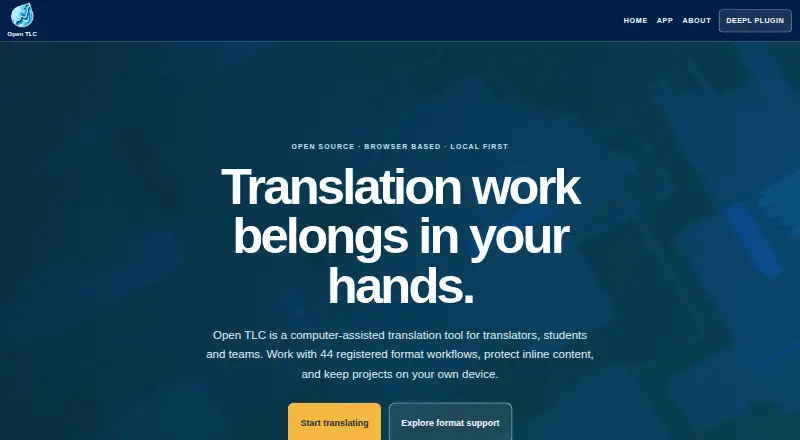
What Open TLC is
Open TLC is a free, open-source computer-assisted translation tool that runs in a web browser. It is designed for professional translators, learners, and teams, with translation memory, terminology management, and quality checks. It lists 44 format workflows spanning Office documents, localization and publishing files, subtitles, and CAT project files. Its format adapters check files and preserve inline codes, placeholders, and structural metadata during translation and export.
Projects stay in IndexedDB in the current device and browser profile; the application says project content is not sent to an Open TLC storage server. Image OCR and audio or video transcription also run in the browser, without uploading source media, though model files may be downloaded and cached. Projects can be exported as Open TLC JSON or XLIFF for transfer between browsers or devices. Open TLC supports XLIFF 1.2, 2.0, and 2.1, plus TMX, TBX, and SRX exchange. It also lists compatibility with several established CAT formats and return packages. The project began as a master's thesis at Anhalt University of Applied Sciences in Germany and welcomes contributions such as code, documentation, and interoperability results.
Who it suits
Open TLC suits translators and translation teams who want browser-based CAT tools, format safeguards, and translation memory and terminology features. It also fits learners who need to work with supported translation files and keep project data in their current browser profile.
What it does well
- Free and open source.
- 44 registered format workflows across document and CAT file types.
- Preserves inline codes, placeholders, and structural metadata.
- OCR and media transcription run locally in the browser.
- Projects can move between devices as JSON or XLIFF.
What to know first
- Projects are stored in the current device and browser profile.
- ZIP import requires a validated project manifest and safe paths.
- Translated PDFs are flattened and may need visual review.
Limits
The free plan is the product's stated pricing model. Generic ZIP import is limited to packages with a validated opentlc-project.json manifest and safe member paths; translated PDFs are flattened and may need visual review for complex fonts, transparent artwork, or scanned pages.
Getting started
- Open https://opentlc.org/ in a web browser.
- Start a project using a supported format workflow.
- Use a supported exchange format such as XLIFF, TMX, TBX, or SRX when needed.
- Export the project as Open TLC JSON or XLIFF to move it to another browser or device.
Verdict
Choose Open TLC if you want a free, open-source browser CAT tool with broad file workflows and local project handling. Review translated PDFs visually when fonts, transparency, or scanned pages are complex, and check ZIP packages against its manifest and path requirements.
Questions
How much does Open TLC cost?
Open TLC is free, and its pricing note identifies a free plan.
Is Open TLC open source?
Yes. The project describes it as a free and open-source web-based CAT tool.
Which platform does it support?
Open TLC runs on the web in a browser.
Where are projects stored?
Projects are stored in IndexedDB in the current device and browser profile. Open TLC says it does not send project content to its storage server.
Which translation formats can I exchange?
It imports and exports XLIFF 1.2, 2.0, and 2.1, and lists TMX, TBX, and SRX exchange support.
Who created Open TLC?
It began as a master's thesis project at Anhalt University of Applied Sciences in Germany.
Facts from Open TLC's own pages
- CAT exchange
- Open TLC imports and exports XLIFF 1.2, 2.0, and 2.1, and lists TMX, TBX, and SRX exchange support. · opentlc.org, 9 Oct 2026
- Format workflows
- The editor has 44 registered format workflows and uses format-specific adapters to extract, validate and export files. · opentlc.org, 9 Oct 2026
- Free and open source
- The project describes Open TLC as a free and open-source web-based CAT tool. · github.com, 9 Oct 2026
- Integrations
- The site lists compatibility with SDLXLIFF, memoQ XLIFF, Phrase MXLIFF, WorldServer WsXLIFF, WPML, and CAT return packages for Trados, WorldServer, memoQ, Transit, TIPP, and COTI. · opentlc.org, 9 Oct 2026
- Local-first
- Project data is stored in IndexedDB in the current device and browser profile, and the application does not send project content to an Open TLC storage server. · opentlc.org, 9 Oct 2026
- Local media processing
- Image OCR and audio or video transcription run on-device; the page says source media is not uploaded for these workflows. · opentlc.org, 9 Oct 2026
- Local storage
- Projects are stored in IndexedDB in the current device and browser profile; the application says it does not send project content to an Open TLC storage server. · opentlc.org, 9 Oct 2026
- Notable limit
- Generic ZIP import is available only for packages with a validated opentlc-project.json manifest and safe member paths. · opentlc.org, 9 Oct 2026
- OCR and transcription
- Image OCR and audio/video transcription run locally in the browser; the site says source media is not uploaded, though model files may be downloaded and cached. · opentlc.org, 9 Oct 2026
- Origin
- Open TLC began as a master's thesis project at Anhalt University of Applied Sciences in Germany. · opentlc.org, 9 Oct 2026
- PDF limit
- Translated PDFs are flattened, and complex fonts, transparent artwork, or scanned pages may need visual review. · opentlc.org, 9 Oct 2026
- Portable projects
- Projects can be saved as Open TLC JSON or XLIFF and exported from one browser or device for import into another. · opentlc.org, 9 Oct 2026
- Product
- Open TLC is a browser-based, open-source computer-assisted translation tool for professional translators, learners and teams. · opentlc.org, 9 Oct 2026
- Project portability
- Projects can be saved in a versioned Open TLC JSON format or exported as XLIFF, then moved to another browser or device by exporting and importing the project file. · opentlc.org, 9 Oct 2026
- Storage limitation
- Browser project data can be lost through site-data clearing, profile changes, device failure or browser maintenance, and the page recommends regular exports for backup. · opentlc.org, 9 Oct 2026
- Support
- The project welcomes contributions including code, sanitized fixtures, interoperability results, documentation, and issue reports. · opentlc.org, 9 Oct 2026
- Supported content
- Supported formats include Office documents, software localization files, publishing formats, CAT exchange files, subtitles, images for local OCR, and audio or video for local transcription. · opentlc.org, 9 Oct 2026
- Supported formats
- The site lists 44 registered format workflows, including Office documents, localization files, publishing formats, subtitles, and CAT project files. · opentlc.org, 9 Oct 2026
- Supported operating systems
- The page says browser-based adapters work consistently across operating systems. · opentlc.org, 9 Oct 2026
- Translation safeguards
- Format adapters validate files and protect inline codes, placeholders, and structural metadata during translation and export. · opentlc.org, 9 Oct 2026