Open-Testing.AI
What Open-Testing.AI is
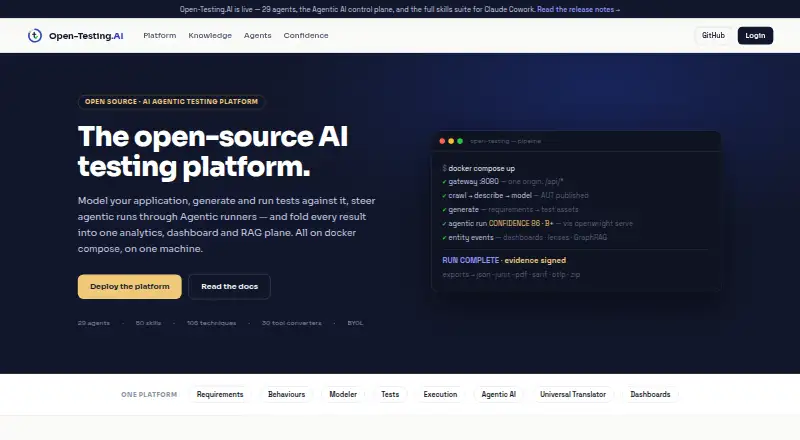
Open-Testing.AI is an open-source platform for modeling applications, generating and running tests, and analyzing results. It runs through Docker Compose on one machine, with services available behind a single gateway. Teams can import requirements and generate ISO-29119 test assets linked back to those requirements.
Its control plane dispatches steered runs for accessibility, persona-based, exploratory, and regression testing through registered runners. A Universal Translator converts suites across more than 30 frameworks, including Appium, Playwright, Selenium, Cypress, TOSCA, and UFT. The platform uses LiteLLM for GraphRAG-backed generation and Kafka for entity events, and provides an MCP surface for agent tools.
Run events feed dashboards, lenses, GraphRAG, and an assistant; an Entity Query DSL supports queries. Results can be exported as JSON, JUnit, PDF, SARIF, OTLP, or a signed ZIP, and failed runs retain their artifacts. Access controls include governed identities, space-scoped authorization, JWT authentication, and a full audit log. The platform also lists BYOL and provides Claude Cowork skills for requirements validation, test design, planning, coverage, reporting, management, and framework conversion.
Who it suits
Open-Testing.AI suits teams that want to generate, execute, and analyze tests in a self-hosted setup. It may also suit teams working across multiple testing frameworks or needing traceable requirements, governed access, and exportable run evidence.
What it does well
- Runs on one machine through Docker Compose.
- Generates ISO-29119 test assets linked to requirements.
- Converts test suites across more than 30 frameworks.
- Failed runs retain their artifacts.
- Exports results in JSON, JUnit, PDF, SARIF, OTLP, or signed ZIP formats.
- Includes space-scoped authorization, JWT authentication, and a full audit log.
What to know first
- Deployment uses Docker Compose on one machine.
- BYOL is listed among the platform attributes.
- Testing runs go through registered runners.
Plans
| Plan | Billed and limits | Price |
|---|---|---|
| Open-Testing.AI | Open-source · BYOL · Docker Compose | Free |
As open-testing.ai lists them, read 9 Oct 2026. The maker's own page has the final word.
Getting started
- Open the project website.
- Prepare a machine for a Docker Compose deployment.
- Run the platform with Docker Compose.
- Use the gateway to access its services.
- Register runners for steered testing runs.
Verdict
Choose Open-Testing.AI if you want an open-source platform that combines requirement-linked test generation, steered runs, framework conversion, and result analysis. Its deployment is based on Docker Compose, and BYOL is part of its listed attributes.
Questions
How much does Open-Testing.AI cost?
The listed plan is free. The plan describes the platform as open source and BYOL.
How is the platform deployed?
It runs with Docker Compose on one machine and exposes services behind a single gateway.
Which testing frameworks does it support?
Its Universal Translator converts suites across more than 30 frameworks, including Appium, Playwright, Selenium, Cypress, TOSCA, and UFT.
What test scopes does it cover?
Its listed scopes include web application, accessibility, persona, exploratory, and regression testing.
What formats can results be exported in?
Runs can be exported as JSON, JUnit, PDF, SARIF, OTLP, or a signed ZIP.
What access controls does it provide?
The platform states that it supports governed identities, space-scoped authorization, JWT authentication, and a full audit log.
Facts from Open-Testing.AI's own pages
- Access controls
- The site states that the platform supports governed identities, space-scoped authorization, JWT authentication, and a full audit log. · open-testing.ai, 9 Oct 2026
- Agentic testing
- Its control plane dispatches steered runs for WCAG, personas, exploratory testing, and regression baselines through registered runners. · open-testing.ai, 9 Oct 2026
- Analytics
- Run events feed dashboards, lenses, GraphRAG, and an assistant, with an Entity Query DSL for queries. · open-testing.ai, 9 Oct 2026
- BYOL
- The site lists BYOL among the platform’s headline attributes. · open-testing.ai, 9 Oct 2026
- Deployment
- The platform runs with Docker Compose on one machine and exposes services behind a single gateway. · open-testing.ai, 9 Oct 2026
- Evidence exports
- Runs can be exported as JSON, JUnit, PDF, SARIF, OTLP, or a signed ZIP. · open-testing.ai, 9 Oct 2026
- Failure artifacts
- The site says failed runs retain their artifacts. · open-testing.ai, 9 Oct 2026
- Framework conversion
- Its Universal Translator converts suites across more than 30 frameworks, including Appium, Playwright, Selenium, Cypress, TOSCA, and UFT. · open-testing.ai, 9 Oct 2026
- Integrations
- The platform uses LiteLLM for GraphRAG-backed generation, Kafka for entity events, and offers an MCP surface for agent tools. · open-testing.ai, 9 Oct 2026
- Purpose
- Open-Testing.AI describes itself as an open-source AI testing platform for modeling applications, generating and running tests, and analyzing results. · open-testing.ai, 9 Oct 2026
- Skills
- The Claude Cowork skills suite covers requirements validation, test design and creation, planning, coverage, reporting, management, and framework conversion. · open-testing.ai, 9 Oct 2026
- Test generation
- It imports requirements and generates ISO-29119 test assets with behavior-to-requirement traceability. · open-testing.ai, 9 Oct 2026
Where Open-Testing.AI stands on Freedom251
- Ai Code Testing#8 of 25
- AI software testing tools#13 of 34
- AI Software Testing Tools#14 of 34