Freedom251 › Database Vulnerability Scanners

Onam Database Security
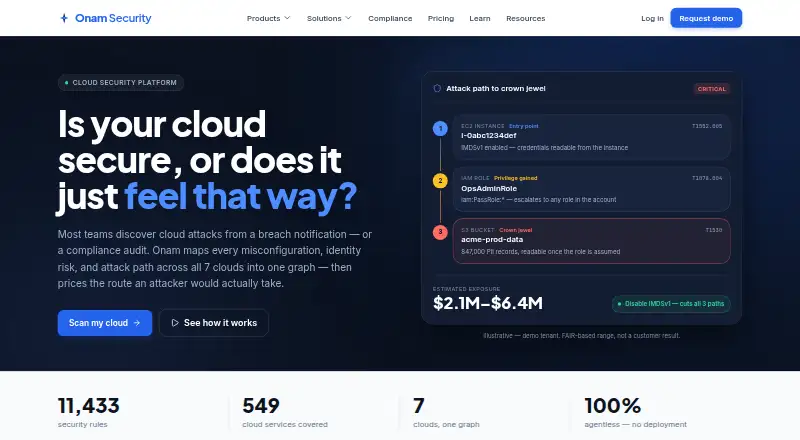
What Onam Database Security is
Onam Database Security assesses managed and self-hosted databases against cloud posture rules and CIS benchmarks for database engines. It discovers database resources across AWS, Azure, GCP, OCI, IBM Cloud, Alibaba, and Kubernetes through read-only APIs. Listed services include RDS, Aurora, Azure SQL, Cloud SQL, DynamoDB, Redshift, and OCI DB Systems. Checks cover encryption, public access, backup retention, deletion protection, audit settings, exposed snapshots, and privileged grants. Findings combine data classification with identity context to highlight sensitive databases and the principals able to access them. Cloud checks use control-plane APIs; optional CIS engine checks require a customer-provisioned read-only database account. Onam maps findings to 78 frameworks and offers PDF and CSV auditor exports with linked evidence. Free and Pro are SaaS plans; Enterprise also offers on-premises deployment. Free includes one cloud account and up to 500 resources. Pro is $22 a month, billed per resource, with a platform fee plus $22 per resource.
Who it suits
It suits teams that need to assess database posture across cloud providers and self-hosted environments. Its framework mappings, linked auditor exports, and identity context may help security and compliance teams review database risk.
What it does well
- Read-only APIs discover resources across seven named providers and Kubernetes.
- Checks include encryption, backups, audit settings, and privileged grants.
- Findings combine data classification and identity context.
- Maps findings to 78 frameworks with linked auditor evidence.
- Free plan includes CIS coverage and up to 500 resources.
What to know first
- Free plan is limited to one cloud account and 500 resources.
- Pro pricing includes a platform fee plus $22 per resource monthly.
- Engine-level CIS checks require a customer-provisioned read-only account.
- Free plan has a 30-day finding history.
Limits
Free is limited to one cloud account, up to 500 resources, core CSPM rules for Critical and High findings, and 30-day finding history. Pro is $22 a month billed per resource, with a platform fee plus $22 per resource; its listed history is one year.
Plans
| Plan | Billed and limits | Price |
|---|---|---|
| Free | forever · 1 cloud account · Up to 500 resources · Core CSPM rules (Critical & High) · CIS benchmark coverage · 30-day finding history · Community support | Free |
| Pro | per resource / month; platform fee plus $22 per resource, billed monthly · Unlimited cloud accounts · All 29 engines · All 78 compliance frameworks · 1-year finding history · Email support (< 24h) | $22 a month |
| Enterprise | annual contract · Everything in Pro · Multi-tenant support · SSO / SAML 2.0 · On-premises deployment option · Contractual 99.9% uptime SLA · Priority support (< 4h) | On request |
As onamsecurity.com lists them, read 29 Sept 2026. The maker's own page has the final word.
Getting started
- Open the Onam Database Security website.
- Choose the Free plan or review the listed 14-day trial and paid plans.
- Connect cloud resources through read-only APIs for cloud posture checks.
- For optional engine-level CIS evaluation, provision a read-only database account.
- Use the findings and framework mappings, or export auditor evidence as PDF or CSV.
Onam Database Security is a database posture and benchmark service for teams managing cloud and self-hosted database estates. It is best suited to security teams that need configuration checks alongside data sensitivity and identity context. Its broad coverage is a strong fit for cross-cloud reviews, though per-resource Pro billing deserves scrutiny for larger estates.
Overview
Onam discovers database resources across AWS, Azure, GCP, OCI, IBM Cloud, Alibaba and Kubernetes through read-only APIs. It covers RDS, Aurora, Azure SQL, Cloud SQL, DynamoDB, Redshift, OCI DB Systems and other databases. Cloud posture checks use control-plane APIs, while optional CIS engine assessments require a customer-provisioned read-only database account. Teams can therefore run cloud configuration checks without supplying database credentials, but engine-level coverage requires additional setup.
Findings combine with data classification and identity context, helping teams prioritize sensitive databases and identify principals with access. Checks cover encryption, public accessibility, backup retention, deletion protection, audit configuration, snapshot exposure and privileged grants. Onam says it stores credential references rather than plaintext cloud credentials and encrypts stored cloud configurations and findings with AES-256 at rest.
Key features
CIS benchmarks cover PostgreSQL, MySQL, MariaDB, MSSQL, Oracle, IBM Db2, MongoDB and Cassandra. Onam also maps findings to 78 compliance frameworks and provides PDF and CSV auditor exports with linked evidence. This combination can help teams connect technical findings to compliance reviews, rather than treating benchmark results as an isolated checklist.
The Trust Center lists SOC 2 Type II, ISO 27001:2022, ISO 27017, PCI DSS v4.0 and CSA STAR Level 1 as achieved, and GDPR as compliant. These credentials may matter to organizations evaluating a security vendor, though they do not replace an assessment of its fit for a particular environment.
Pricing
Free costs nothing, billed forever. It includes one cloud account, up to 500 resources, core CSPM rules for Critical and High findings, CIS benchmark coverage, 30-day finding history and community support. That is a useful starting point for a small estate, but the account and resource caps and shorter history constrain ongoing reviews at scale.
Pro costs $22 a month, billed per resource per month: a platform fee plus $22 per resource, billed monthly. It removes the cloud-account limit and adds all 29 engines, all 78 compliance frameworks, one-year finding history and email support with a response time under 24 hours. Email and Slack notifications and REST API access are also listed for Pro. The per-resource charge can make broader coverage expensive as an estate grows; buyers should compare the fee against the number of resources they intend to monitor.
Enterprise uses an annual contract with custom pricing. It includes everything in Pro, multi-tenant support, SSO / SAML 2.0, an on-premises deployment option, a contractual 99.9% uptime SLA and priority support under four hours plus a CSM. Webhooks, SIEM and a Terraform provider are also listed for Enterprise. This is the tier for organizations needing those deployment and operational provisions, but it is not a priced alternative to Pro.
A 14-day trial is available. Free and Pro use SaaS deployment; Enterprise can be deployed as SaaS or on-premises.
Platforms
Onam supports API, self-hosted and web platforms. Its cloud database coverage and agentless scanning approach suit teams reviewing distributed resources without describing an installed scanning agent; optional engine-level assessment still uses a customer-provisioned read-only account.
Who it's for
Onam is a strong candidate for security teams overseeing databases across cloud providers that want posture checks, engine benchmarks, compliance mapping and access context in one review. It is less compelling for a small deployment that exceeds Free’s caps only slightly, or for a large estate where per-resource Pro charges outweigh the value of the combined view.
Pros and cons
- Pros: Broad cloud discovery and database coverage help teams review mixed-provider estates in one service.
- Pros: Joining findings with classification and identity context makes it easier to prioritize sensitive databases and understand access.
- Pros: Framework mappings and evidence-linked PDF and CSV exports support compliance and audit work.
- Cons: Free is capped at one cloud account and 500 resources, with only 30 days of finding history.
- Cons: Pro’s platform fee plus $22 per resource per month can become a material cost for large inventories.
- Cons: Optional CIS engine assessments require the customer to provision a read-only database account.
Alternatives
Database Vulnerability Scanners is the category list to consult when comparing database security tools more broadly. Choose Defensia Database Security if a free Linux, self-hosted or web option with a one-server cap, 2,000 events per month, three days of log retention and monitor mode is a closer fit. Choose Oracle Cloud Infrastructure Secret Management for OCI secret management rather than database posture review. Qualys External Attack Surface Management offers a 30-day no-cost CSAM with EASM trial, so it is worth considering when that focus matches the need. DBX offers free unlimited schema introspection, topology and score viewing, finding counts and severity, and local analysis; it may suit a schema-analysis task better. Omega DB Scanner Standalone is a free Windows scanner for Oracle 10g, 11g and 12c traditional auditing, a narrower fit for those versions. Trellix Data Loss Prevention is an alternative for enterprise DLP across endpoints, email, web, networks and storage, managed on-premises or as SaaS. Banyan Cloud DSPM is another paid web-based option. GuardOne is another paid web option.
Verdict
Choose Onam if your team needs to assess databases across multiple clouds and connect configuration and benchmark findings to data sensitivity, identity access and compliance evidence. Its breadth and contextual findings are the clearest reasons to choose it. Look elsewhere if you need a low-cost option for a large resource estate or do not need its combined posture and access view.
Verdict
Onam brings cloud posture checks, engine benchmarks, and access context into database security reviews. The Free plan is limited in account count, resource volume, and finding history, while Pro pricing is per resource.
Questions
What does Onam Database Security cost?
The Free plan costs nothing. Pro is $22 a month, billed per resource per month, with a platform fee plus $22 per resource. Enterprise is billed under an annual contract, with price not listed.
Does it have a free plan or trial?
Yes. Free is listed as a plan, and a 14-day trial is listed.
Which database engines are covered by CIS benchmarks?
The listed engines are PostgreSQL, MySQL, MariaDB, MSSQL, Oracle, IBM Db2, MongoDB, and Cassandra.
Can Onam be deployed on-premises?
Enterprise offers SaaS or on-premises deployment. Free and Pro use SaaS deployment.
What integrations are listed?
Email and Slack notifications and REST API access are listed for Pro. Enterprise adds webhooks, SIEM, and a Terraform provider.
How does it connect to databases and cloud resources?
Cloud posture checks use cloud control-plane APIs. Optional engine-level CIS evaluation uses a customer-provisioned read-only database account.
Facts from Onam Database Security's own pages
- Certifications
- The Trust Center lists SOC 2 Type II, ISO 27001:2022, ISO 27017, PCI DSS v4.0, and CSA STAR Level 1 as achieved, and GDPR as compliant. · onamsecurity.com, 29 Sept 2026
- Checks
- Checks include encryption, public accessibility, backup retention, deletion protection, audit configuration, snapshot exposure, and privileged database grants. · onamsecurity.com, 29 Sept 2026
- Cloud providers
- Database resources are discovered across AWS, Azure, GCP, OCI, IBM Cloud, Alibaba, and Kubernetes through read-only APIs. · onamsecurity.com, 29 Sept 2026
- Compliance features
- Onam maps findings to 78 frameworks and provides PDF and CSV auditor exports with linked evidence. · onamsecurity.com, 29 Sept 2026
- Connection model
- Cloud posture checks use cloud control-plane APIs; optional engine-level CIS evaluation uses a read-only database account provisioned by the customer. · onamsecurity.com, 29 Sept 2026
- Database coverage
- The page lists RDS, Aurora, Azure SQL, Cloud SQL, DynamoDB, Redshift, OCI DB Systems, and other databases. · onamsecurity.com, 29 Sept 2026
- Deployment and limits
- The pricing comparison lists SaaS deployment for Free and Pro, and SaaS or on-premises deployment for Enterprise; Free is limited to one cloud account and up to 500 resources. · onamsecurity.com, 29 Sept 2026
- Engine benchmarks
- CIS benchmarks cover PostgreSQL, MySQL, MariaDB, MSSQL, Oracle, IBM Db2, MongoDB, and Cassandra. · onamsecurity.com, 29 Sept 2026
- Integrations
- The pricing page lists email and Slack notifications and REST API access for Pro; Enterprise adds webhooks, SIEM, and a Terraform provider. · onamsecurity.com, 29 Sept 2026
- Product purpose
- Onam Database Security evaluates managed and self-hosted databases across an estate against cloud posture rules and CIS engine-level benchmarks. · onamsecurity.com, 29 Sept 2026
- Risk findings
- Database findings are joined with DSPM data classification and CIEM identity context to prioritize sensitive databases and show which principals can access them. · onamsecurity.com, 29 Sept 2026
- Security posture
- Onam says it stores credential references rather than plaintext cloud credentials and encrypts stored cloud resource configurations and findings with AES-256 at rest. · onamsecurity.com, 29 Sept 2026
- Support
- The pricing page lists community support for Free, email support with a response time under 24 hours for Pro, and priority support under four hours plus a CSM for Enterprise. · onamsecurity.com, 29 Sept 2026
Where Onam Database Security stands on Freedom251
- Database Vulnerability Scanners#5 of 27