Freedom251 › Data Privacy Management Software
Nonym
What Nonym is
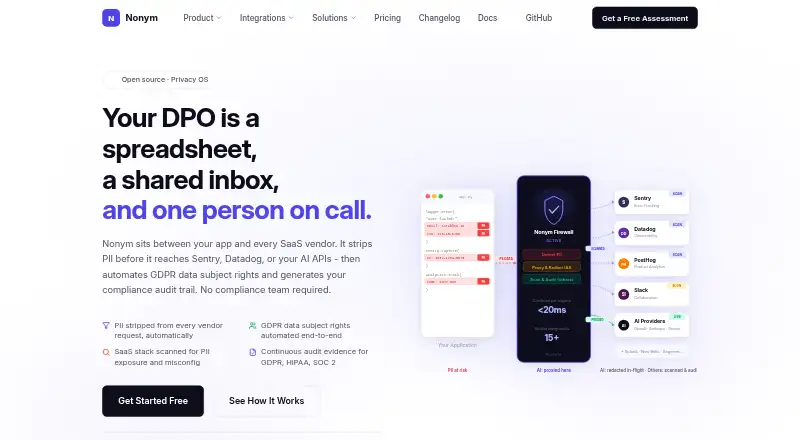
Nonym is a privacy layer between an app and SaaS services, designed to remove personally identifiable information before it reaches providers and support data rights and compliance audit trails. Its AI Proxy uses named entity recognition to find items such as names, email addresses, phone numbers, postal addresses, SSNs, payment card details and API keys. It replaces detected values with structured tokens before sending a prompt, then restores those values in the response before returning it to the app. The proxy supports OpenAI, Anthropic, Google AI and OpenAI-compatible APIs, including streaming. Nonym states processing adds under 20ms overhead. Request logs can record detection counts, PII types and confidence scores; a full audit trail is available on paid plans. Managed Cloud token mappings are held in memory for the request and not written to disk. The service supports API, self-hosted and web use, with private VPC and air-gapped options for Enterprise. Community is free for non-commercial self-hosting. Cloud costs $49/mo plus $0.50 per 10K requests; Self-Host License is $99/mo. Enterprise pricing is custom, starting around $2,500/mo.
Who it suits
Nonym is aimed at security and compliance teams, engineers, and CTOs or founders working with SaaS or AI providers. Its self-hosted and Enterprise deployment options may suit organizations with specific infrastructure needs.
What it does well
- Replaces detected PII with tokens before provider requests.
- Supports streaming with OpenAI-compatible APIs.
- Cloud token mappings are held in memory for each request.
- Enterprise offers private VPC and air-gapped deployment.
What to know first
- Community self-hosting is non-commercial only.
- Cloud adds $0.50 per 10K requests.
- Full audit trails are listed for paid plans.
- Questionnaire Automation is in active development.
Limits
Community permits non-commercial self-hosting only. Cloud costs $49 per month plus $0.50 per 10K requests, and full audit trails are listed for paid plans.
Plans
| Plan | Billed and limits | Price |
|---|---|---|
| Community | Free · Non-commercial self-hosting · Community support only | Free |
| Enterprise | Custom pricing; starting ~$2,500/month · Tailored to volume and compliance needs · Dedicated CSM + 4h SLA support | $2,500 |
| Cloud | $49 / month + $0.50 per 10K requests · 90-day audit log retention · Email support: 48h response | $49 a month |
| Self-Host License | $99 / month · No per-request charges · Email support: 48h response | $99 a month |
As nonym.io lists them, read 3 Oct 2026. The maker's own page has the final word.
Getting started
- Visit https://nonym.io/.
- Choose Community for non-commercial self-hosting, Cloud, Self-Host License or Enterprise.
- For commercial self-hosting, select the Self-Host License.
- Connect the AI Proxy to OpenAI, Anthropic, Google AI or an OpenAI-compatible API.
- Select a deployment option such as Enterprise private VPC or air-gapped deployment if required.
Nonym is an AI privacy proxy and broader privacy-management platform for teams handling personal data in applications. It suits security and compliance groups, engineers, and CTOs or founders who want to keep existing AI integrations while reducing PII exposure. The key decision is whether its tokenising proxy and governance tools justify request-based Cloud pricing or a larger self-hosted commitment.
Overview
Nonym sits between an application and external SaaS or AI providers. Its AI Proxy detects personal information, replaces it with structured tokens before a request leaves the app, and restores the original values in the response. That design can limit what a provider receives without forcing the application to work with anonymised output.
Beyond proxying, Nonym provides data inventory, automated data discovery, data-subject access-request management, retention management, and regulatory workflows. Its stated framework coverage includes GDPR, HIPAA, the EU AI Act, SOC 2, PIPEDA, and PCI DSS. Those functions make it more suitable for an organisation building a privacy programme than for a developer seeking only a lightweight prompt scrubber; framework coverage does not by itself constitute certification.
Key features
PII detection and reversible anonymisation
Named entity recognition looks for emails, names, Social Security numbers, credit-card numbers, phone numbers, API keys, and addresses. Structured token replacement protects those values in the outbound prompt, while restoration preserves the context returned to the application. This is a practical fit for AI features that must process sensitive records, although teams remain responsible for their wider data-handling controls.
Provider support and performance
Live integrations cover OpenAI, Anthropic, and Google Gemini. The proxy also supports Google AI and any OpenAI-compatible API, with streaming responses. Nonym states that processing adds under 20ms of overhead and that streaming works without buffering or delay, which is better suited to interactive applications than a design that waits for complete responses.
Audit and security controls
Requests can be logged with detection counts, PII types, and confidence scores. A full audit trail is reserved for paid plans, so the free Community option is less useful where demonstrable traceability is a requirement. For managed Cloud, token mappings remain in memory for the request and are never written to disk, reducing persistent exposure during proxy operation.
Compliance workflow automation
Questionnaire Automation accepts PDF, DOCX, or plain-text uploads and drafts answers cited from Nonym compliance data. It is still in active development, so it is an emerging convenience rather than a reason to replace established review processes.
Pricing
Nonym uses a freemium model. The Community plan costs free, is for non-commercial self-hosting, and includes community support. It is appropriate for evaluation, personal projects, and organisations that can accept a non-commercial licence; it is not the commercial deployment option.
Cloud costs $49 a month, billed at $49 / month + $0.50 per 10K requests. It includes 90-day audit-log retention and email support with a 48-hour response. This is the accessible paid entry point for teams that prefer managed infrastructure, but high request volumes make the variable charge important to budget.
Self-Host License costs $99 a month, billed at $99 / month with no per-request charges. It permits commercial use on the customer’s own infrastructure and keeps support at a 48-hour email response. It fits predictable or substantial traffic and organisations that require infrastructure control, while adding operational responsibility.
Enterprise uses custom pricing, starting at ~$2,500/month. It is tailored to volume and compliance needs and adds a dedicated customer success manager with a four-hour SLA, plus private VPC and air-gapped deployment options. This tier is aimed at regulated or large-scale environments rather than cost-sensitive teams.
Platforms
Nonym is offered through an API, web interface, and self-hosted deployment. Its hybrid deployment model lets teams combine managed and customer-controlled infrastructure; Enterprise adds private-VPC and air-gapped choices.
Who it's for
Security and compliance teams can use the inventory, discovery, DSAR, retention, regulatory, and audit functions alongside AI controls. Engineers benefit from compatibility with existing OpenAI-compatible endpoints and streaming. CTOs and founders get a route to commercial self-hosting or managed Cloud without redesigning application responses. It is a weaker fit for a small project that only needs cookie consent or a basic privacy notice.
Pros and cons
Pros
- Reversible tokenisation limits PII sent to AI vendors while preserving application context.
- Support for major providers and OpenAI-compatible APIs reduces integration lock-in.
- Under-20ms stated overhead and unbuffered streaming suit interactive AI features.
- Commercial self-hosting and Enterprise air-gapped deployment address stricter infrastructure requirements.
- Privacy-management workflows extend beyond prompt filtering.
Cons
- Cloud adds $0.50 per 10K requests, making costs less predictable at scale.
- Community is restricted to non-commercial self-hosting and has only community support.
- Full audit trails are paid-plan features, limiting free-plan governance value.
- Questionnaire Automation remains in active development.
Alternatives
For consent and cookie management across mobile and web, DataShyre offers a free tier for up to 500 unique users and paid plans from $99 per month. DPDP.ai is a better match when a no-expiry cookie-consent free tier with 10,000 consents per month is the priority. Teams wanting inspectable open-source privacy engineering should consider Ethyca Fides. Osano Cookie Consent suits organisations focused on cookie consent and an open-source plugin. For a diagnostic compliance scan rather than an AI proxy, ComplyDP is the more direct choice. EasyDP, PrivacyEngine, and PrivacyEvo are alternatives for broader privacy-management needs with their own free or entry plans.
Verdict
Choose Nonym if your team needs to keep PII out of AI-provider requests while retaining application behaviour, audit context, and deployment flexibility. Its strongest case is a commercial, compliance-conscious AI workload that can justify Cloud usage charges or self-hosting. Look elsewhere if you need only consent management, a narrowly scoped compliance scan, or a free commercial deployment without infrastructure and plan constraints.
Verdict
Nonym focuses on masking PII in provider requests while restoring values in responses, with audit logging and multiple deployment options. Community use is limited to non-commercial self-hosting; Cloud and self-hosted paid plans have separate pricing.
Questions
Does Nonym have a free plan?
Yes. Community is free for non-commercial self-hosting and includes community support.
How much do Nonym's paid plans cost?
Cloud is $49 per month plus $0.50 per 10K requests. Self-Host License costs $99 per month, and Enterprise uses custom pricing starting around $2,500 per month.
Which AI providers does Nonym support?
The AI Proxy works with OpenAI, Anthropic, Google AI and any OpenAI-compatible API. Streaming responses are supported.
Can Nonym be self-hosted?
Yes. Community is for non-commercial self-hosting, and the Self-Host License allows commercial use on your own infrastructure. Enterprise also offers private VPC and air-gapped deployment options.
What information does the AI Proxy detect?
It uses named entity recognition to detect emails, names, SSNs, credit cards, phone numbers, API keys and addresses.
Is Questionnaire Automation available?
It accepts PDF, DOCX or plain text uploads and drafts cited answers from Nonym compliance data, but the feature is in active development.
Facts from Nonym's own pages
- Anonymization
- The AI Proxy replaces PII with structured tokens before sending a prompt and restores token values in the response before it reaches the app. · nonym.io, 3 Oct 2026
- Audit logging
- AI Proxy requests are logged with detection counts, PII types, and confidence scores; the page says a full audit trail is available on paid plans. · nonym.io, 3 Oct 2026
- Compatibility
- The AI Proxy says it works with OpenAI, Anthropic, Google AI, and any OpenAI-compatible API, with streaming responses supported. · nonym.io, 3 Oct 2026
- Deployment
- The Self-Host License allows commercial use on the customer’s own infrastructure, and Enterprise offers private VPC and air-gapped deployment options. · nonym.io, 3 Oct 2026
- Integrations
- The docs list OpenAI, Anthropic, and Google Gemini as live AI provider integrations, with Sentry, Rollbar, Bugsnag, Datadog, New Relic, Splunk, PostHog, Mixpanel, and Amplitude marked Q1 2026. · docs.nonym.io, 3 Oct 2026
- Intended users
- The homepage describes the platform for security and compliance teams, engineers, and CTOs or founders. · nonym.io, 3 Oct 2026
- Performance
- The AI Proxy page states that processing adds under 20ms overhead and that streaming responses are supported without buffering or delay. · nonym.io, 3 Oct 2026
- PII detection
- Its AI Proxy uses named entity recognition to detect PII such as emails, names, SSNs, credit cards, phone numbers, API keys, and addresses. · nonym.io, 3 Oct 2026
- Privacy framework
- The homepage says the platform covers GDPR, HIPAA, EU AI Act, SOC 2, PIPEDA, and PCI DSS. · nonym.io, 3 Oct 2026
- Product
- Nonym describes itself as a privacy layer between an app and SaaS vendors that strips PII before it reaches vendors and automates data subject rights and compliance audit trails. · nonym.io, 3 Oct 2026
- Questionnaire automation
- Questionnaire Automation accepts PDF, DOCX, or plain text uploads and drafts cited answers from Nonym compliance data, but the page says the feature is in active development. · nonym.io, 3 Oct 2026
- Security
- The pricing FAQ says token mappings on managed Cloud are held in memory only for the request and never written to disk. · nonym.io, 3 Oct 2026
- Support
- The pricing page lists community support for Community, email support with a 48-hour response for Cloud and Self-Host License, and a dedicated CSM with a 4-hour SLA for Enterprise. · nonym.io, 3 Oct 2026
Where Nonym stands on Freedom251
- Data Privacy Management Software#9 of 30