Freedom251 › Database Migration Tools
node-pg-migrate
What node-pg-migrate is
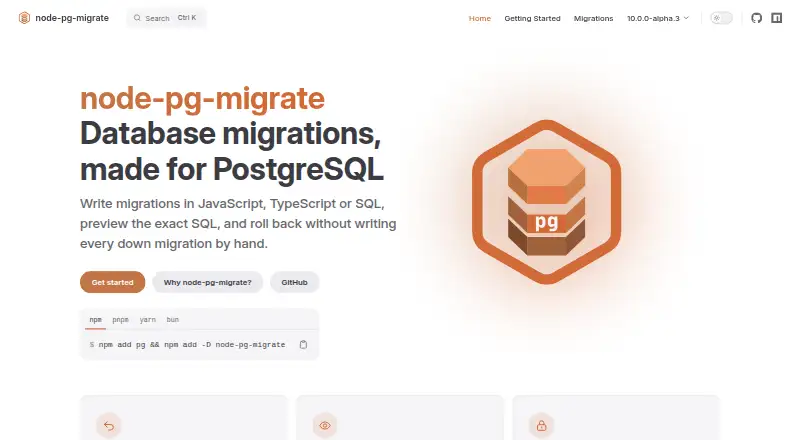
node-pg-migrate is a free, open-source tool for managing PostgreSQL database migrations. You can write migrations in JavaScript, TypeScript, or SQL, then run them from command-line commands or through a programmatic runner API. Its pgm API covers tables, indexes, functions, triggers, policies, roles, extensions, grants, and other PostgreSQL objects. Pending migrations run in one transaction by default under an advisory lock, while an order check rejects out-of-sequence migrations. The up --dry-run option prints the SQL a run would execute without applying it, using a read-only transaction. Reversible operations can provide inferred down migrations when a migration omits a down function. Installation is available through npm, pnpm, yarn, or bun and adds a runnable file to node_modules/.bin. Documented prerequisites are Node.js 22.12.0 or higher and PostgreSQL 14 or higher; lower PostgreSQL versions are not officially supported. The project targets PostgreSQL and has also been tested with CockroachDB. It is released under the MIT License and offers a self-hosted option.
Who it suits
It suits developers and teams managing PostgreSQL schema changes in JavaScript, TypeScript, or SQL. It is also suited to self-hosted deployments that need transaction, locking, dry-run, and rollback controls.
What it does well
- Supports JavaScript, TypeScript, and SQL migrations
- Dry runs print SQL without applying changes
- Pending migrations use transactions and advisory locks
- Rollback migrations can be inferred for reversible operations
- Covers many PostgreSQL database objects
What to know first
- Targets PostgreSQL rather than multiple database systems
- Requires Node.js 22.12.0 or higher
- PostgreSQL versions below 14 are unsupported
- The pg library may need separate installation
Verdict
node-pg-migrate provides a focused PostgreSQL migration workflow with several deployment safeguards. Its language options, dry runs, locking, and rollback support suit teams that meet the documented runtime and database requirements.
Facts from node-pg-migrate's own pages
- Automatic rollback
- Reversible operations can infer down migrations when a migration omits a down function. · salsita.github.io, 4 Oct 2026
- Database requirement
- The project documents PostgreSQL 14 or higher as a precondition; lower versions may work but are not officially supported. · salsita.github.io, 4 Oct 2026
- Database scope
- The project says it targets PostgreSQL and has also been tested with CockroachDB. · github.com, 11 Oct 2026
- Dependency
- The getting-started guide says to install the pg library if it is not already present. · salsita.github.io, 11 Oct 2026
- Deployment safeguards
- Pending migrations run in one transaction under an advisory lock, and an order check rejects out-of-sequence migrations. · salsita.github.io, 4 Oct 2026
- Distribution
- The project is released under the MIT License. · github.com, 11 Oct 2026
- Dry runs
- The CLI's up --dry-run prints the SQL without applying it and runs in a read-only transaction. · salsita.github.io, 4 Oct 2026
- Dry-run safety
- Dry runs use a read-only database transaction and apply none of the migration SQL. · salsita.github.io, 11 Oct 2026
- Execution
- Migrations can be run from the command line or through the programmatic runner API. · salsita.github.io, 11 Oct 2026
- Generated SQL
- The tool can print the SQL a real run would execute with the --dry-run option. · salsita.github.io, 11 Oct 2026
- Installation
- The package can be installed with npm, pnpm, yarn, or bun and adds a runnable file to node_modules/.bin. · salsita.github.io, 4 Oct 2026
- Interfaces
- Migrations can be run with CLI commands or through the programmatic runner API. · salsita.github.io, 4 Oct 2026
- License
- The project is released under the MIT License. · salsita.github.io, 4 Oct 2026
- Limit
- The project says it only targets PostgreSQL, rather than supporting multiple database systems. · salsita.github.io, 11 Oct 2026
- Maker
- The repository lists Salsita Software among the project's former maintainers. · github.com, 4 Oct 2026
- Maker background
- Salsita says it was founded in Prague in 2010 and lists its headquarters in Prague, Czechia. · salsita.ai, 4 Oct 2026
- Migration languages
- Migrations can be written in JavaScript, TypeScript, or SQL. · salsita.github.io, 11 Oct 2026
- PostgreSQL coverage
- The pgm API includes operations for database objects such as tables, indexes, functions, triggers, policies, roles, and extensions. · salsita.github.io, 11 Oct 2026
- PostgreSQL operations
- The pgm API includes operations for tables, indexes, functions, triggers, policies, roles, extensions, grants, and other PostgreSQL objects. · salsita.github.io, 4 Oct 2026
- Purpose
- node-pg-migrate manages database migrations for PostgreSQL from Node.js. · github.com, 11 Oct 2026
- Requirements
- The documented prerequisites are Node.js 22.12.0 or higher and PostgreSQL 14 or higher; lower PostgreSQL versions are not officially supported. · salsita.github.io, 11 Oct 2026
- Rollback
- Reversible operations can have their down migrations inferred when a migration omits down. · salsita.github.io, 11 Oct 2026
- Runtime requirement
- The project documents Node.js 22 or higher as a precondition. · salsita.github.io, 4 Oct 2026
- Support and contributions
- The repository welcomes contributors, and the documentation links to troubleshooting guidance. · github.com, 11 Oct 2026
Where node-pg-migrate stands on Freedom251
- Database Migration Tools#22 of 32