Freedom251 › Server Operating System
NetBSD
What NetBSD is
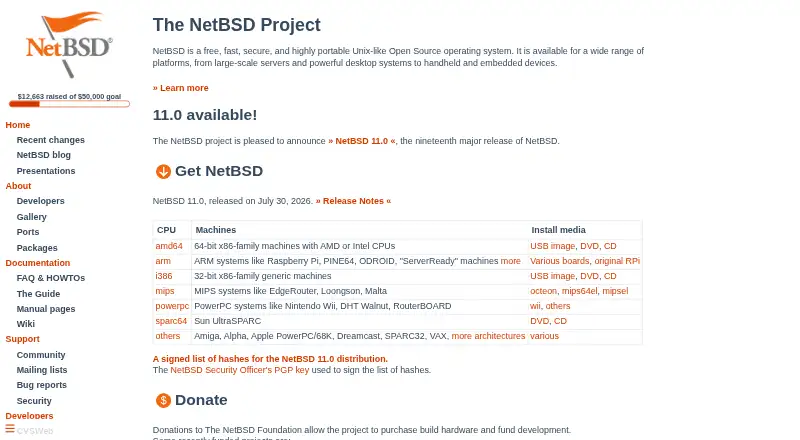
NetBSD is a free, open-source Unix-like operating system for servers, desktops, handheld and embedded devices, legacy hardware, and emulators. It provides an integrated system that professionals, hobbyists, and researchers can use and redistribute. The project began in 1993, and NetBSD 11.0 is the latest formal release listed in the supplied facts. Its supported architectures include amd64, arm, mips, powerpc, i386, sparc64, alpha, hppa, m68k, sh3, vax, and others. Package management includes pkgsrc, which builds software from source and installs binary packages, and pkgin, a user-friendly binary package manager. The sysinst utility handles installation and upgrades. NetBSD also includes ZFS, RAIDframe, disk encryption, Logical Volume Manager support, Xen, and the NVMM hypervisor. Listed security features include IPsec, NPF, Veriexec, kernel authorization, W^X, and ASLR. Formal release branches receive fixes while supported, and formal releases are supported for several years. Unsupported releases no longer get bug fixes, including security fixes. NetBSD-current is less tested than formal releases and is aimed at developers, experienced testers, and early adopters; the project advises avoiding it on production systems where possible. Documentation includes installation and administration guides, manual pages, FAQs, and HOWTOs.
Who it suits
NetBSD suits people who need a Unix-like operating system across varied hardware, including servers, desktops, embedded devices, and emulators. Release status matters for anyone relying on continued bug and security fixes.
What it does well
- Free and open source
- Runs on a wide range of hardware and architectures
- Includes pkgsrc, pkgin, and sysinst
- Includes storage, virtualization, and security features
- Documentation includes guides, manual pages, FAQs, and HOWTOs
What to know first
- Unsupported releases do not receive bug fixes
- NetBSD-current is less tested than formal releases
- The project advises against current on production systems
Limits
Supported formal releases receive fixes only while their branches remain supported, generally for several years. Older releases stop receiving bug fixes, including security fixes, and NetBSD-current receives less testing.
Plans
| Plan | Billed and limits | Price |
|---|---|---|
| NetBSD | Free and open-source operating system · available for a wide range of hardware platforms | Free |
As netbsd.org lists them, read 11 Oct 2026. The maker's own page has the final word.
Getting started
- Open the NetBSD website
- Choose a supported formal release and an image for your architecture
- Install NetBSD with the sysinst utility
- Configure packages with pkgsrc or pkgin
- Use the administration and installation documentation
Verdict
NetBSD offers broad hardware reach, package management, and an integrated Unix-like system. Choose a supported formal release when continued bug and security fixes are important.
Questions
Is NetBSD free?
Yes. NetBSD is a free, open-source operating system.
Which devices and architectures can run NetBSD?
It supports servers, desktops, embedded and handheld devices, legacy hardware, and emulators. Architectures include amd64, arm, mips, powerpc, i386, sparc64, alpha, hppa, m68k, sh3, vax, and others.
How are software packages managed?
pkgsrc builds software from source and installs binary packages. pkgin provides a user-friendly binary package manager.
Does NetBSD include virtualization?
Yes. It supports Xen and the native NVMM hypervisor, which provides hardware acceleration for QEMU.
How long are NetBSD releases supported?
Formal releases are supported for several years while their branches remain supported. Older unsupported releases receive no bug fixes, including security fixes.
Facts from NetBSD's own pages
- Default services
- The project says services default to their most secure settings and no services are enabled by default on new installations. · netbsd.org, 11 Oct 2026
- Development release limit
- NetBSD-current has less testing than formal releases and is aimed at developers, experienced testers, and early adopters; the project advises avoiding it on production systems where possible. · netbsd.org, 11 Oct 2026
- Documentation
- The official documentation site links to installation and administration guides, manual pages, FAQs, and HOWTOs. · netbsd.org, 11 Oct 2026
- Founded
- 1993 · netbsd.org, 28 Sept 2026
- Hardware reach
- NetBSD is available for platforms ranging from servers and desktop systems to handheld and embedded devices. · netbsd.org, 11 Oct 2026
- Latest release
- NetBSD 11.0 is the latest formal release listed on the releases page. · netbsd.org, 11 Oct 2026
- Package management
- pkgsrc is NetBSD’s package build and management system, and pkgin is a user-friendly binary package manager for pkgsrc. · netbsd.org, 11 Oct 2026
- Release support
- Formal releases provide a stable, supported platform for production, while older unsupported releases do not receive bug fixes, including security fixes. · netbsd.org, 11 Oct 2026
- Security features
- Listed security features include IPsec, the NPF firewall, Veriexec file integrity, kernel authorization, disk encryption, W^X, and userland and kernel ASLR. · netbsd.org, 11 Oct 2026
- Security response
- The Security Team, Security Alert Team, and Security Officer investigate, document, and update code in response to reported security issues. · netbsd.org, 11 Oct 2026
- Storage
- NetBSD includes ZFS, the RAIDframe software RAID system, cgd disk encryption, and Logical Volume Manager support. · netbsd.org, 11 Oct 2026
- Virtualization
- NetBSD supports Xen and its native NVMM hypervisor, which provides hardware acceleration for QEMU. · netbsd.org, 11 Oct 2026
- What it does
- It provides an integrated UNIX-like system for professionals, hobbyists, and researchers to use and redistribute. · netbsd.org, 11 Oct 2026
- What it is
- NetBSD is a free, fast, secure, highly portable Unix-like open-source operating system. · netbsd.org, 11 Oct 2026
Where NetBSD stands on Freedom251
- Server Operating System#9 of 29
- Operating Systems#26 of 42