Freedom251 › Minecraft Mod Development Tools
Neo-Loom
What Neo-Loom is
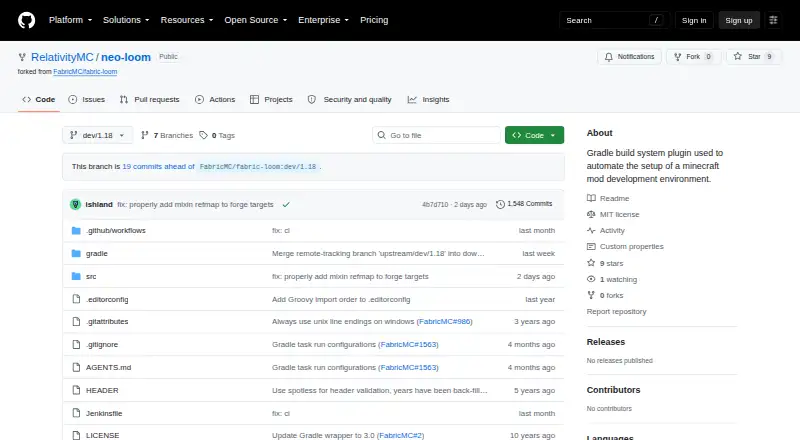
Neo-Loom is a free Gradle plugin for setting up Minecraft mod development environments with NeoForge and MinecraftForge. It is a fork of Fabric Loom and is heavily based on Architectury Loom. The README lists implemented support for NeoForge 1.21+ and MinecraftForge 1.20.1+.
The plugin supports dependency management and both client and server project scope, including dedicated server support. Developers can package artifacts with Jar-in-Jar, convert ClassTweaker or AccessWidener files to AccessTransformer format, and publish or consume ModDevGradle-compatible Access Transformers and Interface Injections. Devlaunch is also listed as implemented.
The README documents run configurations for NeoForge and MinecraftForge, including server data, client data, and game test server environments. It shows Gradle setup using the Fabric and RelativityMC Maven repositories and the Gradle Plugin Portal, and provides plugin IDs for applying Neo-Loom. The repository identifies the project as MIT licensed and points users to a Discord server for support. Work listed as to-do includes JUnit, production launch tasks, and split-source, client-only, and server-only setups for (Neo)Forge.
Who it suits
Neo-Loom suits Minecraft mod developers building projects for NeoForge or MinecraftForge who want Gradle setup and support for both client and server environments. It is relevant to teams using Jar-in-Jar packaging or ModDevGradle-compatible access transformers and interface injections.
What it does well
- Free Gradle plugin for Minecraft mod development.
- Supports NeoForge and MinecraftForge projects.
- Includes Jar-in-Jar packaging support.
- Converts ClassTweaker or AccessWidener files to AccessTransformer format.
- Supports dedicated server environments.
What to know first
- JUnit remains on the project’s to-do list.
- Production launch tasks are listed as to-do.
- Split-source and client-only/server-only setups remain to-do.
Getting started
- Open the Neo-Loom GitHub repository.
- Add the Fabric and RelativityMC Maven repositories and Gradle Plugin Portal as shown in the README.
- Apply one of the Gradle plugin IDs listed in the README.
- Configure the documented NeoForge or MinecraftForge run environments for your project.
Verdict
Choose Neo-Loom for Minecraft mod projects using NeoForge or MinecraftForge when you need its Gradle tooling, packaging, and access conversion support. Look elsewhere if your workflow depends on JUnit, production launch tasks, or the listed split-source and loader-specific setups.
Questions
Does Neo-Loom cost anything?
Neo-Loom is free.
Which mod loaders does it support?
It supports NeoForge and MinecraftForge. The README lists NeoForge 1.21+ and MinecraftForge 1.20.1+ as currently implemented.
What license does Neo-Loom use?
The repository identifies its license as MIT.
Does it support dedicated servers?
Yes. Dedicated server support is listed, and the README documents server run configurations for NeoForge and MinecraftForge.
What work is still listed as to-do?
The README lists JUnit, production launch tasks, and split-source, client-only, and server-only setups for (Neo)Forge.
Where can developers get support?
The project README invites users to reach out through its Discord server.
Facts from Neo-Loom's own pages
- Access conversion
- It supports converting ClassTweaker or AccessWidener files to AccessTransformer format. · github.com, 7 Oct 2026
- Build setup
- The README shows Gradle plugin setup using the Fabric and RelativityMC Maven repositories and the Gradle Plugin Portal. · github.com, 7 Oct 2026
- Current limitations
- The README lists JUnit, production launch tasks, and split-source, client-only, and server-only setups for (Neo)Forge as to-dos. · github.com, 7 Oct 2026
- Devlaunch
- Devlaunch is listed as currently implemented. · github.com, 7 Oct 2026
- Distribution
- The README directs users to add the RelativityMC Maven repository and shows Gradle plugin IDs for using Neo Loom. · github.com, 7 Oct 2026
- Forge configuration
- The README documents run configurations for NeoForge and MinecraftForge, including server data, client data, and game test server environments. · github.com, 7 Oct 2026
- Intended users
- The README describes the plugin as a tool for Minecraft mod development, with support for NeoForge and MinecraftForge projects. · github.com, 7 Oct 2026
- Jar-in-Jar
- Jar-in-Jar support is listed as currently implemented. · github.com, 7 Oct 2026
- License
- The repository identifies its license as MIT. · github.com, 7 Oct 2026
- Maintainer profile
- The RelativityMC GitHub organization links to a Discord server and does not display public organization members. · github.com, 7 Oct 2026
- ModDevGradle
- It supports publishing and consuming ModDevGradle-compatible Access Transformers and Interface Injections. · github.com, 7 Oct 2026
- ModDevGradle compatibility
- It supports publishing and consuming ModDevGradle-compatible Access Transformers and Interface Injections. · github.com, 7 Oct 2026
- Packaging
- Neo Loom supports Jar-in-Jar. · github.com, 7 Oct 2026
- Planned work
- The listed to-dos include JUnit, production launch tasks, and split source, client-only, and server-only setups for (Neo)Forge. · github.com, 7 Oct 2026
- Purpose
- Neo Loom is a Gradle plugin for setting up Minecraft mod development environments. · github.com, 7 Oct 2026
- Support
- The project README invites users to reach out through its Discord server. · github.com, 7 Oct 2026
- Supported versions
- The README lists NeoForge 1.21+ and MinecraftForge 1.20.1+ as currently implemented. · github.com, 7 Oct 2026
- Toolchain
- It is a fork of Fabric Loom that supports the NeoForge and MinecraftForge modding toolchain and is heavily based on Architectury Loom. · github.com, 7 Oct 2026
Where Neo-Loom stands on Freedom251
- Minecraft Mod Development Tools#29 of 35