Freedom251 › Network Automation Software
NAPALM
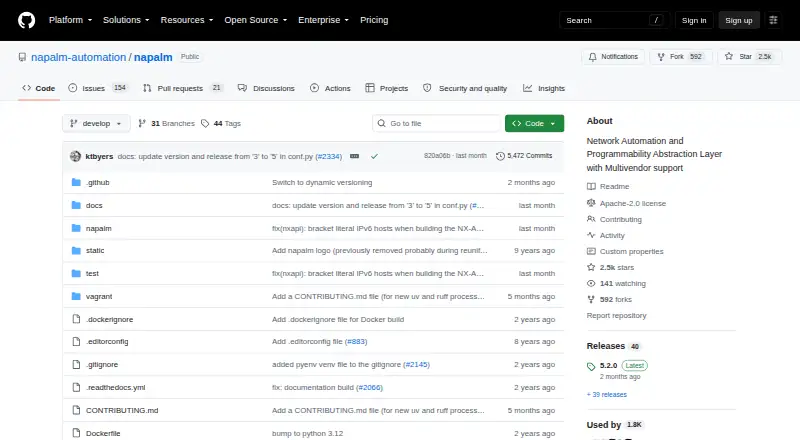
What NAPALM is
NAPALM is a free Python library for working with network devices from different vendors through a unified API. Its methods connect to devices, manipulate configurations, and retrieve data. Core drivers are listed for Arista EOS, Cisco IOS, Cisco IOS-XR, Cisco NX-OS, and Juniper JunOS, with community-driven drivers also available. Documented configuration operations include replace, merge, compare, commit-confirm, and rollback, though availability depends on the platform. Getters can retrieve device facts, configurations, interfaces, BGP neighbors, and environment data, with support varying by driver. NAPALM can compare live device state against expectations defined in YAML and produce a compliance report. The project identifies integrations with Ansible, SaltStack, and StackStorm. Installation is documented with pip install napalm, and NAPALM 5.1.0 and later supports Python 3.9 and later. The project is self-hosted and licensed under Apache-2.0. Its documentation advises checking platform-specific caveats before use.
Who it suits
NAPALM suits people using Python or automation frameworks to automate and validate network devices across vendors. It may fit teams whose target platforms and desired operations are covered by the available drivers.
What it does well
- Unified API for multiple device vendors.
- Supports configuration changes and retrieval.
- Can produce YAML-based compliance reports.
- Integrates with Ansible, SaltStack, and StackStorm.
- Free and licensed under Apache-2.0.
What to know first
- Operation and getter support varies by platform and driver.
- Requires Python 3.9 or later for version 5.1.0 and later.
- Platform-specific caveats require review.
- No free trial is listed.
Limits
NAPALM has no paid plan listed. Its configuration operations and data retrieval support vary by platform and driver.
Plans
| Plan | Billed and limits | Price |
|---|---|---|
| NAPALM | Open-source Python library · install with pip · device and driver support varies | Free |
As github.com lists them, read 4 Oct 2026. The maker's own page has the final word.
Getting started
- Open the NAPALM project website on GitHub
- Install the library with pip install napalm
- Use Python 3.9 or later with NAPALM 5.1.0 or later
- Review the platform-specific caveats and driver support for your devices
Verdict
NAPALM brings device configuration, data retrieval, and validation into a Python library with core and community drivers. Check platform-specific support and caveats before relying on a particular operation.
Questions
How much does NAPALM cost?
The listed plan is free.
Is there a free plan or trial?
NAPALM has a free plan. No free trial is listed.
Which platforms does it support?
The documented core drivers cover Arista EOS, Cisco IOS, Cisco IOS-XR, Cisco NX-OS, and Juniper JunOS. Community-driven drivers are also supported, and availability varies.
Does NAPALM integrate with automation tools?
The project README identifies integrations with Ansible, SaltStack, and StackStorm.
Is NAPALM open source, and who makes it?
The repository identifies an Apache-2.0 license. The project is hosted at the napalm-automation/napalm GitHub repository.
How do I install it, and what Python version is required?
The project documents installation with pip install napalm, which includes currently available core drivers. NAPALM 5.1.0 and later supports Python 3.9 and later.
Facts from NAPALM's own pages
- Community drivers
- NAPALM also supports community-driven drivers in addition to its core drivers. · napalm.readthedocs.io, 4 Oct 2026
- Configuration and data
- The library provides methods to connect to devices, manipulate configurations, and retrieve data. · github.com, 4 Oct 2026
- Configuration operations
- The documented configuration methods include replace, merge, compare, commit-confirm, and rollback, with availability varying by platform. · napalm.readthedocs.io, 4 Oct 2026
- Core device support
- The documentation lists core drivers for Arista EOS, Cisco IOS, Cisco IOS-XR, Cisco NX-OS, and Juniper JunOS. · napalm.readthedocs.io, 4 Oct 2026
- Data retrieval
- Documented getters retrieve information such as device facts, configuration, interfaces, BGP neighbors, and environment data, with support varying by driver. · napalm.readthedocs.io, 4 Oct 2026
- Deployment validation
- NAPALM can compare live device state with YAML-defined expectations and produce a compliance report. · napalm.readthedocs.io, 4 Oct 2026
- Installation
- The project documents installation with pip install napalm and states that the package includes all currently available core drivers. · napalm.readthedocs.io, 4 Oct 2026
- Integrations
- The project README identifies integrations with Ansible, SaltStack, and StackStorm. · github.com, 4 Oct 2026
- Intended users
- NAPALM is aimed at people automating and validating network devices across multiple vendors through Python and automation frameworks. · napalm.readthedocs.io, 4 Oct 2026
- License
- The GitHub repository identifies the project license as Apache-2.0. · github.com, 4 Oct 2026
- Platform caveats
- The device support documentation warns users to review platform-specific caveats before using the library. · napalm.readthedocs.io, 4 Oct 2026
- Purpose
- NAPALM is a Python library for interacting with network devices from different vendors through a unified API. · github.com, 4 Oct 2026
- Runtime requirement
- The repository README states that NAPALM 5.1.0 and later supports Python 3.9 and later. · github.com, 4 Oct 2026
- Security policy
- GitHub reports that the project has not set up a SECURITY.md file and has no published security advisories. · github.com, 4 Oct 2026
- Support
- The README points users to the napalm channel on the network.toCode() Slack team for help. · github.com, 4 Oct 2026
Where NAPALM stands on Freedom251
- Network Automation Software#6 of 29