Freedom251 › Network Automation Software
Cisco pyATS
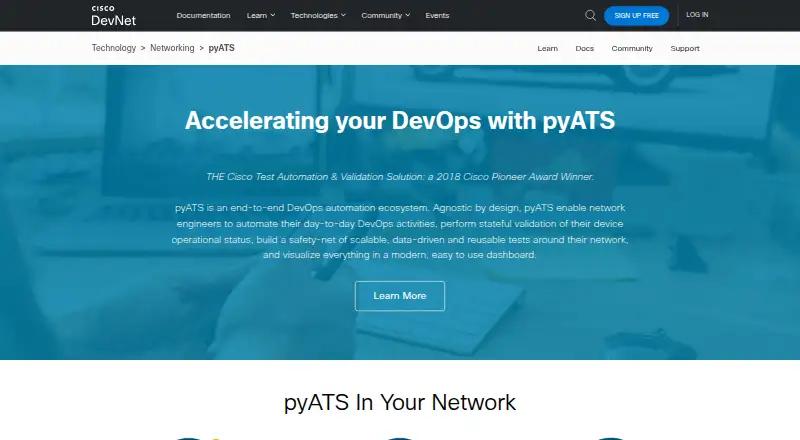
What Cisco pyATS is
Cisco pyATS is a Python framework for testing, automating, and validating networks. It supports sanity, feature, solution, system, and scale tests, with reusable data-driven tests that can grow from simple cases to complex asynchronous suites. Genie libraries provide device connectivity, parsers, APIs, platform-independent feature models, reusable test cases, and a YAML-based test runner. Built-in libraries cover Cisco IOS, IOS XE, IOS XR, NX-OS, and ASA; plugins and extensions can add other platforms. Devices can connect over CLI, NETCONF, or RESTCONF. XPRESSO manages test suites, environments, testbeds, resources, live test views, and archived results, with comparisons and analytics. It also supports on-demand, bundled, and scheduled runs using Jenkins and Docker backends. Cisco documents community integrations with Ansible and out-of-the-box RobotFramework support. pyATS is free under the Apache 2.0 license, and more than 75% of its codebase is open source on GitHub. It runs on Linux and macOS and can be self-hosted.
Who it suits
It suits network teams that need to automate testing and verification across Cisco devices or extend coverage with plugins. Self-hosted deployment and XPRESSO’s test management tools may fit teams managing recurring test suites.
What it does well
- Free under the Apache 2.0 license.
- Reusable tests support asynchronous test suites.
- Connects over CLI, NETCONF, or RESTCONF.
- XPRESSO supports scheduled runs with Jenkins and Docker.
- Cisco device libraries cover five listed product families.
What to know first
- Listed platforms are Linux and macOS.
- Email support is best-effort, not a stated SLA.
Plans
| Plan | Billed and limits | Price |
|---|---|---|
| pyATS | Free of charge · Apache 2.0 license | Free |
As developer.cisco.com lists them, read 29 Sept 2026. The maker's own page has the final word.
Getting started
- Visit the Cisco pyATS website.
- Use a Linux or macOS environment for self-hosted deployment.
- Choose the Apache 2.0 licensed free plan.
- Connect supported devices through CLI, NETCONF, or RESTCONF.
Cisco pyATS is a Python framework for network testing, automation and validation. It is best suited to network teams building repeatable checks, particularly for Cisco devices. Its breadth of testing and free Apache 2.0 license are compelling, provided your team can host and extend the framework as needed.
Overview
pyATS supports sanity, feature, solution, system and scale testing, from straightforward data-driven checks to complex asynchronous suites. That range makes it useful for teams embedding validation into network workflows; it is a narrower fit for those seeking general-purpose software testing.
The framework is free under Apache 2.0, with more than 75% of its codebase open source on GitHub. It is self-hosted, so teams avoid a software subscription but take responsibility for operating the environment. Cisco’s development team offers best-effort email support and usually responds within a day. Teams that need dedicated support or SLAs can inquire with Cisco.
Key features
Reusable tests and device connectivity
Genie provides device connectivity, parsers, APIs, platform-agnostic feature models, reusable test cases and a YAML-driven test runner. Connections can use CLI, NETCONF or RESTCONF. Built-in libraries cover Cisco IOS, IOS XE, IOS XR, NX-OS and ASA, and plugins or extensions can add platforms. This is a strong foundation for Cisco networks, but teams with other vendors should plan to extend the framework rather than expect equivalent built-in coverage.
Suite management and execution
XPRESSO manages test suites, environments, testbeds and resources, with live test views and archived results that can be compared and analyzed. It supports on-demand, bundled and scheduled execution through Jenkins and Docker backends. These controls can help teams coordinate repeat runs and review outcomes, though they come with the operational work of a self-hosted setup.
Integration and safeguards
Cisco documents community integrations with Ansible and out-of-the-box RobotFramework support, giving teams options to connect pyATS with broader automation workflows. The August 2026 release added credential redaction to help protect sensitive values in logs and reports. Cisco says information shared in support logs will not be shared outside the support team without explicit approval.
Pricing
pyATS costs nothing, with no paid plan described. The free plan includes the Apache 2.0-licensed framework, making it suitable for teams that can self-host and maintain their testing environment. There is no software charge to trade against feature or seat caps in the plan; the practical cost is the work of operating the deployment. For support beyond best-effort email, teams can ask Cisco about dedicated support and SLAs.
Platforms
pyATS is available for Linux and macOS and is self-hosted. Its built-in network-device libraries cover Cisco IOS, IOS XE, IOS XR, NX-OS and ASA, with connections over CLI, NETCONF or RESTCONF. Plugins and extensions can add further platforms, but teams should assess that extension work against their own device mix.
Who it's for
pyATS is a good fit for network engineering and operations teams that want reusable validation across Cisco devices and need test-suite management, scheduling or integration with Jenkins, Docker, Ansible or RobotFramework. It is less suitable for teams that want a hosted service, need broad non-Cisco support out of the box, or do not have the capacity to maintain a self-hosted Python framework.
Pros and cons
- Pros: Reusable data-driven tests span simple checks through complex asynchronous suites, helping teams standardize validation.
- Pros: Genie combines device access and reusable test tooling, while XPRESSO adds suite management, scheduling and result comparisons.
- Pros: Free Apache 2.0 licensing avoids a software fee and permits access to an open-source codebase.
- Cons: Self-hosting places deployment and maintenance responsibility on the team.
- Cons: Built-in device libraries center on Cisco platforms; other coverage may require plugins or extensions.
- Cons: Support is best-effort email rather than a stated guaranteed service level, unless separate support is arranged.
Alternatives
Network Automation Software and Network Testing Software are useful starting points for comparing tools across those categories.
- ManageEngine Network Configuration Manager may suit teams that want a network configuration management product with a free edition capped at 2 devices or a paid Professional Edition at $238 a year.
- Containerlab is worth considering for teams that want a free option requiring a Linux server or VM, Docker and sudo privileges for some operations.
- ONOS is another free Apache License 2.0 option for readers seeking an open-source platform.
- Nautobot may fit teams exploring self-managed network workflows through its free Community plan, intended for exploration, initial workflows and limited production deployments.
- ONAP is a free open-source software platform for readers considering that approach.
- OpenDaylight offers a free open-source SDN platform distributed as a tar or zip download or as Docker images.
- Arista NG Firewall is a web-based alternative with a free plan for basic security and connectivity features, subject to limited capabilities.
- NAPALM is a free open-source Python library installed with pip; device and driver support varies, so it may suit teams seeking a library rather than pyATS’s broader test-suite management approach.
Verdict
Choose Cisco pyATS if your team needs reusable network validation, especially across Cisco devices, and can operate a self-hosted framework. Its combination of test tooling, Genie libraries and XPRESSO management carries no software fee; look elsewhere if you need a hosted service, guaranteed support or broad non-Cisco coverage without extension work.
Verdict
Cisco pyATS combines reusable network tests, device libraries, and test-suite management in a free framework. Teams should account for its listed Linux and macOS platforms and best-effort email support.
Questions
How much does Cisco pyATS cost?
The listed plan is free of charge at 0.00 USD under the Apache 2.0 license.
Is pyATS open source?
It is available under Apache 2.0, and Cisco says more than 75% of its codebase is open source on GitHub.
Which platforms does it support?
It runs on Linux and macOS and supports self-hosted deployment.
Which network devices can it test?
Built-in libraries support Cisco IOS, IOS XE, IOS XR, NX-OS, and ASA. Plugins and extensions can add other platforms.
How can pyATS connect to devices?
Connections can use CLI, NETCONF, or RESTCONF.
What support is available?
The development team provides best-effort email support and usually responds within a day. Cisco invites inquiries about dedicated support and SLAs.
Facts from Cisco pyATS's own pages
- Company history
- Cisco states it was founded in 1984 and is headquartered in San Jose, California. · cisco.com, 29 Sept 2026
- Connection protocols
- Device connections can use CLI, NETCONF, or RESTCONF. · developer.cisco.com, 29 Sept 2026
- Dashboard
- XPRESSO manages test suites, environments, testbeds, resources, live test views, and archived results with comparisons and analytics. · developer.cisco.com, 29 Sept 2026
- Execution integrations
- XPRESSO supports on-demand, bundled, and scheduled execution using Jenkins and Docker backends. · developer.cisco.com, 29 Sept 2026
- Founded
- 2014 · developer.cisco.com, 28 Sept 2026
- Framework integrations
- Cisco documents community integrations with Ansible and out-of-the-box RobotFramework support. · developer.cisco.com, 29 Sept 2026
- Genie libraries
- Genie provides device connectivity, parsers, APIs, platform-agnostic feature models, reusable test cases, and a YAML-driven test runner. · developer.cisco.com, 29 Sept 2026
- License and code
- Cisco says pyATS is free under Apache 2.0 and that more than 75% of its codebase is open source on GitHub. · developer.cisco.com, 29 Sept 2026
- Network devices
- Built-in libraries support Cisco IOS, IOS XE, IOS XR, NX-OS, and ASA, with additional platforms possible through plugins and extensions. · developer.cisco.com, 29 Sept 2026
- Purpose
- Cisco pyATS is a Python framework for network testing, automation, and validation. · developer.cisco.com, 29 Sept 2026
- Recent security change
- The August 2026 release added credential redaction to help protect sensitive values in logs and reports. · developer.cisco.com, 29 Sept 2026
- Reusable tests
- The framework supports data-driven reusable tests that can scale from simple cases to complex asynchronous test suites. · developer.cisco.com, 29 Sept 2026
- Support
- The development team provides best-effort email support and usually responds within a day; Cisco invites inquiries about dedicated support and SLAs. · developer.cisco.com, 29 Sept 2026
- Support data
- Cisco says information provided in logs for support will not be shared outside the support team without explicit approval. · developer.cisco.com, 29 Sept 2026
- Testing
- It supports sanity, feature, solution, system, and scale test and verification automation. · developer.cisco.com, 29 Sept 2026
Where Cisco pyATS stands on Freedom251
- Network Automation Software#3 of 29
- Network Testing Software#4 of 33