Freedom251 › Music Theory Software
MyMusicTheory
What MyMusicTheory is
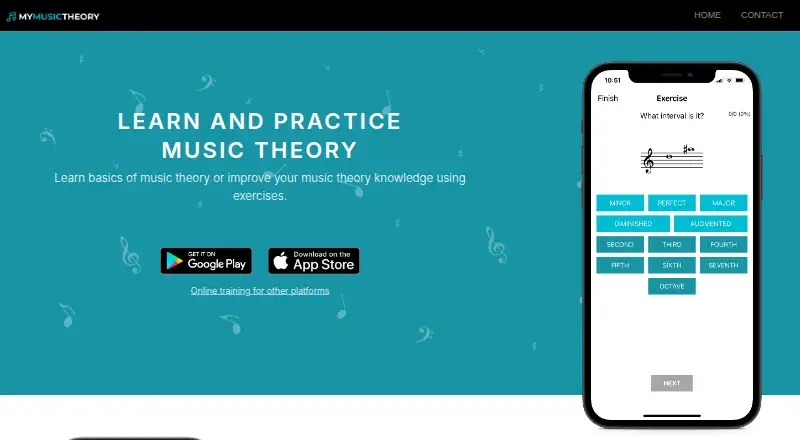
MyMusicTheory offers exercises for learning music theory and improving sight reading. Practice topics include notes, scales, intervals, chords, rhythm and key signatures, and users can build custom exercises by choosing chords, scales and intervals to work on. Progress views cover day, week or month, with reports highlighting areas of weakness. Advanced exercises add seventh and extended chords, scale modes, compound intervals and multiple clefs. The free plan includes more than 100 exercises. MyMusicTheory is listed for Android, iOS and macOS. The iOS app is a free download with in-app purchases, including a Premium Upgrade listed at $8.99; the Android listing notes ads and in-app purchases. The app listing says it can help prepare for ABRSM Levels 1–5, but does not cover all syllabus topics. Apple lists location, identifiers and usage data as information that may be used to track users across apps and websites owned by other companies. MyMusicTheory is associated with Nitra, Slovakia, and Google Play lists myrApps s.r.o. as the Android developer.
Who it suits
MyMusicTheory suits learners who want structured theory and sight-reading practice, including people preparing for ABRSM Levels 1–5. It may also suit learners who want to focus exercises on selected chords, scales or intervals.
What it does well
- Free plan includes more than 100 exercises.
- Custom exercises target selected chords, scales and intervals.
- Progress reports highlight weaker areas.
- Advanced exercises cover modes and extended chords.
What to know first
- ABRSM preparation does not cover every syllabus topic.
- Android app contains ads and in-app purchases.
- Apple lists data that may track users across other companies’ apps.
Limits
The free plan includes more than 100 exercises. The app listing says ABRSM preparation support covers Levels 1–5 but not every syllabus topic.
Plans
| Plan | Billed and limits | Price |
|---|---|---|
| Free | More than 100 free exercises | Free |
As mymusictheory.org lists them, read 2 Oct 2026. The maker's own page has the final word.
Getting started
- Visit https://www.mymusictheory.org/.
- Choose the free plan, which includes more than 100 exercises.
- Use the Android or iOS app, or access it on macOS.
- Create exercises by selecting chords, scales, or intervals to practice.
MyMusicTheory is an exercise-led app for building music-theory knowledge and sight-reading skills. It suits independent learners who want to target particular topics and monitor weak areas; its broad practice range is less suitable as a stand-alone exam course.
Overview
The app organizes interactive work around notes, scales, intervals, chords, rhythm and key signatures. It also reaches into more demanding material: seventh and extended chords, scale modes, compound intervals and multiple clefs. That progression gives beginners a route into core notation while leaving experienced students room to keep drilling, although the emphasis is repeated practice rather than lessons that explain every concept in depth.
MyMusicTheory can support preparation for ABRSM Levels 1–5, but it does not cover every topic in those syllabuses. Candidates should therefore use it to reinforce selected skills alongside a complete ABRSM resource, not rely on it as their sole preparation.
Key features
Custom exercises
Practice can be built from the chords, scales and intervals a user chooses. This is valuable when a student needs concentrated work on a troublesome area or wants to avoid spending time on material already mastered. It also makes the app practical for teachers or self-directed learners following a separate study plan, though it puts responsibility for choosing an effective sequence on the learner.
Progress reports
Reports can be viewed by day, week or month and show areas of weakness. Those time views make it easier to spot inconsistent practice and decide what to revisit, rather than relying on memory or a single score. Learners who prefer a prescribed curriculum may find the self-management less useful.
Tools and practice formats
Advanced notation tools, harmony tools and rhythm practice cover the main skills expected from a theory drill platform. The combination of selectable content and reporting is stronger for focused revision than for passive reference reading.
Pricing
The Free plan costs nothing and includes more than 100 free exercises. That is enough to sample the core workflow and establish a regular routine without a payment, but it does not make every part of the app permanently free. The Android app contains ads and in-app purchases, while the iPhone and iPad version is a free download with in-app purchases.
The App Store shows a Premium Upgrade for $8.99. This is the paid route for learners who want to move beyond the free offering; the published plan information does not define a recurring term, seat count or usage quota, so the practical difference from the free exercise set should be checked in the relevant store before buying.
Platforms
MyMusicTheory is available on Android, iOS and macOS. The cross-platform choice works well for learners who switch between a phone or tablet for short drills and a Mac for longer sessions. Android users should account for advertising, and Apple identifies location, identifiers and usage data as data that may be used to track users across other companies’ apps and websites.
Who it's for
This is a good fit for music students who already know what they need to practise, such as intervals before an exam, rhythm accuracy or chord recognition. Custom sets and weakness reports give disciplined self-learners useful control, and the advanced topics can support progression beyond introductory theory.
It is a weaker choice for someone seeking a complete, guided ABRSM curriculum, because Levels 1–5 are only partially covered. Learners who dislike advertising on Android or who want a fully defined subscription and feature breakdown may also prefer a service with clearer plan boundaries.
Pros and cons
Pros
- Focused practice: selecting chords, scales and intervals lets learners target specific gaps instead of following only a fixed drill sequence.
- Useful progression: material extends from notes and key signatures to modes, extended chords, compound intervals and multiple clefs.
- Actionable tracking: daily, weekly and monthly reports highlight weaknesses and help structure independent revision.
- Low-cost entry: more than 100 free exercises are available at no charge.
Cons
- Incomplete ABRSM coverage: it cannot replace a full syllabus resource for Levels 1–5 candidates.
- Store-based upsell: Android includes ads and in-app purchases, while premium access is sold separately from the free download.
- Privacy consideration: Apple identifies location, identifiers and usage data as potentially used for cross-company tracking.
Alternatives
Choose Harmonia if you want practice across Android, iOS, macOS, web and Windows, with a free practice tier and a classroom option priced at 20.95 for up to four weeks.
note-noodle is the better fit for ear-training limits, Play Along uploads and access to its first four lessons without an account.
Pick music21 for a free, BSD-licensed toolkit on Linux, macOS, web and Windows rather than an exercise-focused mobile app.
ChordIQ is an alternative freemium option on Android, iOS and macOS.
Use Music Master for free website lessons and practice questions without an account.
Musicca suits learners wanting all content free forever, with an account to unlock everything and remove ads.
Choose Study Music Theory for a full course and eight trainers without ads or paywalls.
Teoria provides free website content with optional sign-in.
For a broader directory of comparable tools, browse Music Theory Software.
Verdict
MyMusicTheory is a strong choice for self-directed learners who want customizable theory and sight-reading drills, meaningful progress reports and advanced topics in one app. Its main reason to look elsewhere is equally clear: ABRSM coverage is incomplete, and Android advertising, in-app purchases and Apple’s stated tracking categories may matter to users seeking a fully comprehensive or privacy-focused study tool.
Verdict
MyMusicTheory offers topic-based exercises, progress reports and advanced material across Android, iOS and macOS. Learners should note the listed ABRSM coverage limit and the app’s in-app purchases.
Questions
Is MyMusicTheory free?
Yes. Its free plan includes more than 100 exercises.
What does the iOS app cost?
The App Store offers it as a free download with in-app purchases. A Premium Upgrade is listed for $8.99.
Which platforms are supported?
MyMusicTheory is available on Android, iOS, and macOS.
Can it help with ABRSM preparation?
The app listing says it can help prepare users for ABRSM Levels 1–5, but does not cover all syllabus topics.
Who makes the Android app?
Google Play identifies myrApps s.r.o. as its developer.
What data may be used to track users?
Apple lists location, identifiers, and usage data as information that may be used to track users across apps and websites owned by other companies.
Facts from MyMusicTheory's own pages
- ABRSM preparation
- The app listing says it can help prepare users for ABRSM Levels 1–5 but does not cover all syllabus topics. · play.google.com, 2 Oct 2026
- Advanced content
- Advanced exercises include seventh and extended chords, scale modes, compound intervals, and multiple clefs. · mymusictheory.org, 2 Oct 2026
- Android app
- The Google Play listing identifies myrApps s.r.o. as the developer and says the app contains ads and in-app purchases. · play.google.com, 2 Oct 2026
- Custom exercises
- Users can create exercises by selecting the chords, scales, and intervals they want to practice. · mymusictheory.org, 2 Oct 2026
- Data practices
- Apple lists location, identifiers, and usage data as data that may be used to track users across apps and websites owned by other companies. · apps.apple.com, 2 Oct 2026
- Developer location
- Google Play lists myrApps s.r.o. at an address in Nitra, Slovakia. · play.google.com, 2 Oct 2026
- Headquarters
- Nitra, Slovakia · mymusictheory.org, 28 Sept 2026
- iOS app
- The App Store listing offers MyMusicTheory for iPhone and iPad as a free download with in-app purchases. · apps.apple.com, 2 Oct 2026
- Progress tracking
- Progress can be viewed by day, week, or month, with detailed reports about areas of weakness. · mymusictheory.org, 2 Oct 2026
- Purchase price
- The App Store listing shows a Premium Upgrade for $8.99. · apps.apple.com, 2 Oct 2026
- Purpose
- MyMusicTheory offers exercises to help users learn music theory and improve sight reading. · mymusictheory.org, 2 Oct 2026
- Support
- Google Play lists [email protected] as the app support email. · play.google.com, 2 Oct 2026
- Topics
- The exercises cover notes, scales, intervals, chords, rhythm, and key signatures. · mymusictheory.org, 2 Oct 2026
Where MyMusicTheory stands on Freedom251
- Music Theory Software#9 of 27