Freedom251 › Server Monitoring
Monitorix
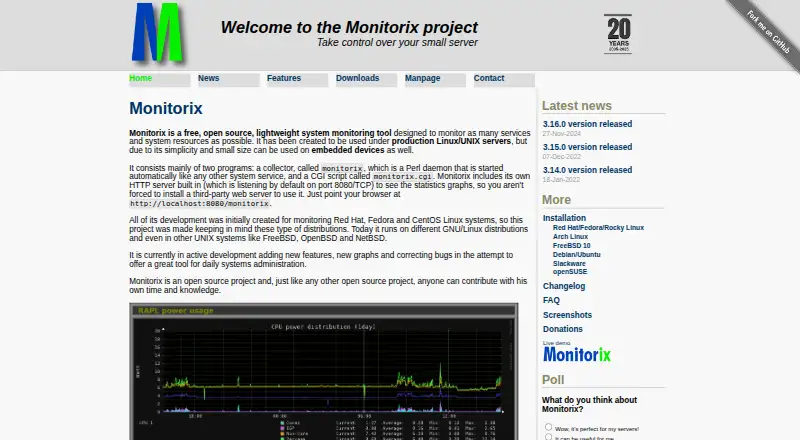
What Monitorix is
Monitorix is a free, self-hosted monitoring tool for production Linux and UNIX servers, and can also be used on embedded devices. It tracks system resources and services through a Perl daemon collector and CGI script, with a built-in HTTP server that listens on port 8080/TCP by default. Supported systems include GNU/Linux, FreeBSD, OpenBSD, and NetBSD.
Its system statistics cover load, active processes, memory allocation, entropy, uptime, and kernel usage across the system and per processor. Hardware graphs can include CPU, GPU, disk, NVMe, IPMI, and ambient sensor readings; alerts are available for several sensor types. Service modules cover Apache, Nginx, MySQL, PostgreSQL, MongoDB, Redis, mail and DNS servers, and UPS software. Multihost monitoring handles an unlimited number of remote servers, with graphs viewed separately or together.
Statistics are available by hour, day, week, month, or year. Users can receive email reports containing all graphs and configure how long historical data is retained. Graphs can be generated as PNG or SVG, and statistics are also available as plain text tables. The built-in server supports basic authentication, IP restrictions, and configurable bind address and port. Monitorix is licensed under GNU GPL version 2, which permits commercial use.
Who it suits
Monitorix suits system administrators managing production Linux or UNIX servers who need resource, hardware, and service statistics. Its multihost support and ability to run on embedded devices also suit administrators overseeing remote servers or smaller embedded systems.
What it does well
- Tracks system and per-processor kernel usage alongside core system statistics.
- Graphs CPU, GPU, disk, NVMe, IPMI, and ambient sensor readings.
- Monitors an unlimited number of remote servers with Multihost.
- Offers hourly through yearly statistics and email graph reports.
- Released under GNU GPL version 2, permitting commercial use.
What to know first
- Self-hosted deployment requires running it on supported systems.
- No free trial is offered.
Plans
| Plan | Billed and limits | Price |
|---|---|---|
| Monitorix | Free, open source system monitoring tool; GNU GPLv2 | Free |
As monitorix.org lists them, read 9 Oct 2026. The maker's own page has the final word.
Getting started
- Visit the Monitorix website.
- Choose a supported GNU/Linux, FreeBSD, OpenBSD, or NetBSD system for self-hosted deployment.
- Install and run Monitorix on the server you want to monitor.
- Use its built-in HTTP server, which listens on port 8080/TCP by default.
Verdict
Choose Monitorix if you want a free, self-hosted tool for server, service, and hardware monitoring, with multihost graphs and configurable history. Look elsewhere if you need a hosted service or a platform beyond the listed Linux and BSD systems.
Questions
How much does Monitorix cost?
Monitorix is free. Its listed plan is free.
Is Monitorix open source?
Yes. It is released under the GNU General Public License version 2, which permits commercial use.
Which systems does Monitorix support?
The project lists GNU/Linux, FreeBSD, OpenBSD, and NetBSD. It can also run on embedded devices.
Can Monitorix monitor multiple servers?
Yes. Multihost supports an unlimited number of remote servers, and graphs can be displayed individually or together.
What support does the project offer?
The project offers a mailing list for announcements, help, and discussion, plus an official #monitorix IRC channel on Libera.Chat for help, bugs, and enhancements.
Facts from Monitorix's own pages
- Architecture
- It consists mainly of a Perl daemon collector and a CGI script, and includes a built-in HTTP server that listens on port 8080/TCP by default. · monitorix.org, 9 Oct 2026
- Founded
- 2005 · monitorix.org, 28 Sept 2026
- Graph formats
- Graphs can be generated in PNG or SVG, and statistics can also be viewed in plain text tables. · monitorix.org, 9 Oct 2026
- Hardware monitoring
- It can graph hardware and generic sensors, including CPU, GPU, disk, NVMe, IPMI and ambient sensor readings, with alert capabilities for several sensor types. · monitorix.org, 9 Oct 2026
- Intended audience
- The project describes Monitorix as a tool for daily systems administration and says it was created for production servers, with simplicity and small size also making it suitable for embedded devices. · monitorix.org, 9 Oct 2026
- Latest listed release
- The downloads page lists version 3.16.0, dated 27-Nov-2024, as the latest version. · monitorix.org, 9 Oct 2026
- License
- Monitorix is released under the GNU General Public License version 2 and may be used for commercial purposes under its open source license. · monitorix.org, 9 Oct 2026
- Multihost
- The Multihost feature supports monitoring an unlimited number of remote servers and displaying their graphs individually or together. · monitorix.org, 9 Oct 2026
- Purpose
- Monitorix monitors services and system resources on production Linux/UNIX servers and can also run on embedded devices. · monitorix.org, 9 Oct 2026
- Reports and history
- Users can view statistics by hour, day, week, month or year, receive email reports of all graphs, and configure historical data duration without a stated limit. · monitorix.org, 9 Oct 2026
- Security controls
- The built-in HTTP server supports basic access authentication, IP address restrictions, and configurable bind address and listening port. · monitorix.org, 9 Oct 2026
- Service monitoring
- It includes statistics modules for services such as Apache, Nginx, MySQL, PostgreSQL, MongoDB, Redis, mail servers, DNS servers and UPS software. · monitorix.org, 9 Oct 2026
- Support
- The project offers a mailing list for announcements, help and discussion, and an official #monitorix IRC channel on Libera.Chat for help, bugs and enhancements. · monitorix.org, 9 Oct 2026
- Supported systems
- The project lists GNU/Linux, FreeBSD, OpenBSD and NetBSD as supported systems. · monitorix.org, 9 Oct 2026
- System metrics
- Features include system load, active processes, memory allocation, entropy and uptime, along with global and per-processor kernel usage. · monitorix.org, 9 Oct 2026
Where Monitorix stands on Freedom251
- Server Monitoring#19 of 38
- Infrastructure Monitoring#17 of 34