Freedom251 › Master Data Management Software
miniMDM
What miniMDM is
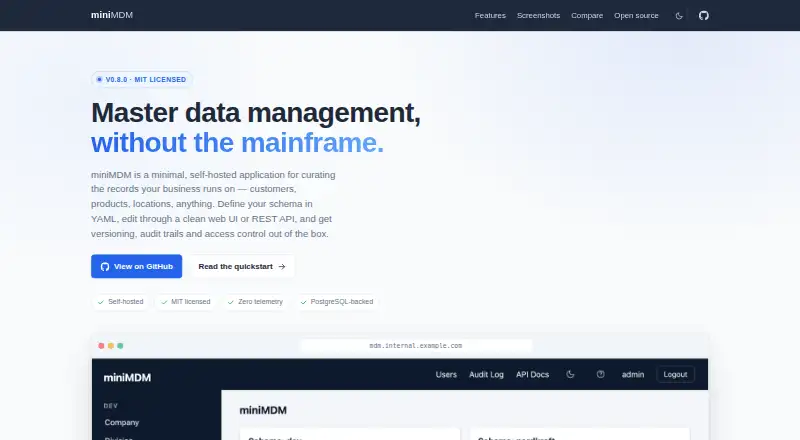
miniMDM is a self-hosted application for managing business reference data such as customers, products, locations and custom objects. It is intended for teams whose records have outgrown spreadsheets but do not require a multi-year enterprise MDM rollout. Teams define data objects in YAML or JSON, including fields, types, references and required flags. Records can move through draft, active and retired states, and each edit creates a version that users can review or restore. Viewer, Editor, Publisher and Admin tiers support per-schema access grants. A REST API has an OpenAPI specification, and webhook callbacks report lifecycle changes; an inbound receiver accepts upstream records as drafts for review. Bulk import and export support CSV, TSV and JSON, with template-assisted imports and optional upsert-by-key. The project is MIT licensed and described as free, without per-seat licensing or separately purchased modules. It runs on premises, uses PostgreSQL, and is built with FastAPI and SQLAlchemy. The site describes zero telemetry.
Who it suits
miniMDM suits teams that need to govern customer, product, location or other reference records beyond spreadsheets. Its positioning is for teams that do not need a multi-year enterprise MDM rollout and can self-host.
What it does well
- MIT licensed and described as free to use
- No per-seat licensing or separately purchased modules
- Record edits create reviewable versions
- Bulk tools support CSV, TSV and JSON
- Per-schema access tiers support governance
What to know first
- Self-hosted deployment requires teams to run it themselves
- Record objects are defined through YAML or JSON configuration
Plans
| Plan | Billed and limits | Price |
|---|---|---|
| miniMDM | Self-hosted · MIT licensed · No per-seat licensing · PostgreSQL-backed | Free |
As minimdm.dev lists them, read 15 Oct 2026. The maker's own page has the final word.
Getting started
- Visit https://minimdm.dev/.
- Choose the free miniMDM plan, listed as free.
- Deploy miniMDM on premises as a self-hosted application.
- Define data objects and fields in YAML or JSON configuration files.
- Set schema permissions and lifecycle rules for your records.
Overview
miniMDM is a self-hosted tool for managing shared business records such as customers, products and locations. It suits teams that have outgrown spreadsheets but do not need a large-scale enterprise MDM rollout. Its strongest case is controlled, versioned data management without per-seat fees; the trade-off is that teams must run it themselves and define their data structures in configuration files.
Key features
Teams define data objects in YAML or JSON, including fields, types, references and required flags. That gives administrators control over the shape of their reference data, but makes schema setup a configuration task rather than a purely visual exercise.
Every record edit creates a version, which users can review or revert. Draft, active and retired states support governed changes, while approval rules and per-schema permissions help separate viewing, editing, publishing and administration. This is useful when records need review before they become operational; teams seeking a broad, prebuilt enterprise workflow may need a different scale of product.
For system integration, miniMDM offers a REST API with an OpenAPI specification, webhook callbacks for lifecycle transitions and an inbound receiver that stages upstream records as drafts. CSV, TSV and JSON bulk imports and exports include templates and optional upsert-by-key. Together, these are practical routes for synchronizing and maintaining records, though the workflow still centers on miniMDM's configured schemas and review states.
The application uses PostgreSQL and is built with FastAPI and SQLAlchemy, with Alembic migrations and correlated request logs. It is described as self-hosted with zero telemetry; changing a password ends that account's open sessions. The MIT license and absence of per-seat licensing or separately purchased modules make the cost structure straightforward, while on-premises deployment puts operational responsibility on the adopting team.
Pricing
The miniMDM plan costs nothing. It is free and MIT licensed, self-hosted, with no per-seat licensing or paid modules. The project is described as free to use; the plan details do not state seat or record quotas. There is no free trial because the offering is free.
There are no paid tiers to unlock additional capabilities. That is attractive for teams able to operate their own deployment, but it also means choosing miniMDM is a commitment to its self-hosted model rather than a route to a vendor-hosted upgrade.
Platforms
miniMDM is available as an API, a web application and self-hosted software, with on-premises deployment. Its infrastructure requirements include PostgreSQL. This combination suits teams that can manage their own deployment and want both browser access and programmatic integration.
Who it's for
miniMDM is aimed at teams whose business reference data has become too important or complex for spreadsheets, but whose needs do not justify a multi-year enterprise MDM rollout. It is a good fit when configurable schemas, record history, review states and bulk exchange solve the core problem. It is a weaker fit for teams that cannot take on self-hosting or want a commercially tiered, vendor-managed service.
Pros and cons
- Pros: Version history and reversion make record changes traceable and recoverable.
- Pros: Draft, active and retired states, approval workflows and per-schema permission tiers support controlled publishing.
- Pros: API, lifecycle webhooks, inbound draft staging and CSV, TSV and JSON bulk handling cover several integration paths.
- Pros: Free, MIT-licensed use without per-seat fees or separately purchased modules keeps licensing costs simple.
- Cons: Self-hosting and PostgreSQL place deployment and operations on the team.
- Cons: Schemas are defined in YAML or JSON, so teams looking for a no-configuration data model may find setup less suitable.
Alternatives
For a wider comparison, see Master Data Management Software.
Choose Pimcore if its broader platform fit matters more than miniMDM's fully free, MIT-licensed model: it has a free Community Edition for non-production use and annual revenue under EUR/USD 5 million, plus a Professional Edition priced at $9,900 a year.
AtroCore MDM is another self-hosted, open-source option, with an Open-Source Edition at no cost; consider it if free modules on your own infrastructure are a fit and you are comfortable with premium modules and professional support costing extra. Its SaaS Edition is also an option.
Civica Complaints Management is a paid alternative for readers considering a complaints-management product rather than miniMDM's reference-data focus.
Veeva Network MDM is positioned for enterprise pharma, biotech, animal health and consumer health, making it the more relevant alternative for organizations in those sectors.
CluedIn may suit teams looking for a paid, credit- and record-based model with a free allowance: its Essential plan includes the first 15,000 records free and $100 AI credit, with unlimited records and users.
Prospecta MDO is worth considering for an SAP-oriented deployment: its Starter Edition is $24,000, paid once, with a minimum one-year contract and one production tenant.
Vinculum Vin OMS is another paid option to compare.
Stibo Systems STEP is an enterprise master data management platform to consider for enterprise-scale needs.
Verdict
Choose miniMDM if your team needs governed, versioned reference data, can operate an on-premises deployment and wants to avoid per-seat and module fees. Its combination of schema control, review states, APIs and bulk handling is a focused answer to the gap between spreadsheets and an enterprise rollout. Look elsewhere if self-hosting is a burden or you need a vendor-managed product with a broader enterprise remit.
Verdict
miniMDM provides versioned, governed reference data with APIs, webhooks and bulk file handling. Its self-hosted approach and configuration-based schema definition are important considerations for teams evaluating it.
Questions
How much does miniMDM cost?
The miniMDM plan is listed as free. The project is described as free to use, with no per-seat licensing or separately purchased modules.
Is miniMDM open source?
Yes. miniMDM is MIT licensed.
Where can miniMDM be deployed?
It is self-hosted and listed for on-premises deployment.
What data can it manage?
It supports customers, products, locations, and custom data objects.
Can miniMDM connect to other systems?
It provides a REST API with an OpenAPI specification, webhook callbacks for lifecycle transitions, and an inbound webhook receiver for upstream records.
What platforms are listed?
The listed platforms are API, self-hosted, and web.
Facts from miniMDM's own pages
- Access control
- Four roles—Viewer, Editor, Publisher and Admin—provide schema-level read, write and publish permissions. · github.com, 15 Oct 2026
- API sorting limit
- Server-side sorting is intentionally unavailable for parent and reference columns because those values require relationship resolution. · github.com, 15 Oct 2026
- Audit log
- The application records what changed, who changed it, when, why, affected record and client IP, with filtering available through the API. · github.com, 15 Oct 2026
- Authentication
- API clients use bearer tokens, while the web UI uses an httpOnly JWT cookie; inbound webhooks use X-Api-Key instead. · github.com, 15 Oct 2026
- Bulk data exchange
- CSV, TSV and JSON import/export is supported, including template downloads and optional upsert by key. · github.com, 15 Oct 2026
- Docker installation
- Docker Compose can run the application without local Python or PostgreSQL installation. · github.com, 15 Oct 2026
- Documentation coverage
- The repository includes installation, quickstart, Docker, deployment, logging, migrations, backup, upgrading, API reference, testing, software inventory and troubleshooting documents. · github.com, 15 Oct 2026
- Imports and exports
- Bulk import and export supports CSV, TSV, and JSON, with template-assisted imports and optional upsert-by-key. · minimdm.dev, 8 Oct 2026
- Inbound integration
- External systems can submit records through an inbound webhook endpoint authenticated with scoped API keys; submissions enter as drafts. · github.com, 15 Oct 2026
- Inbound sync
- Upstream systems can send records through an inbound webhook receiver, where incoming records land as drafts for review. · minimdm.dev, 8 Oct 2026
- Installation requirements
- Native installation requires Python 3.11 or newer, PostgreSQL 14 or newer and the uv package manager. · github.com, 15 Oct 2026
- Integrations
- miniMDM provides a REST API with an OpenAPI specification and webhook callbacks for record lifecycle transitions. · minimdm.dev, 8 Oct 2026
- Intended users
- The site positions miniMDM for teams whose reference data has outgrown a spreadsheet but does not need a multi-year enterprise MDM rollout. · minimdm.dev, 8 Oct 2026
- License
- The project is released under the MIT License. · github.com, 15 Oct 2026
- License and cost
- The project is MIT licensed and described as free to use, with no per-seat licensing or separately purchased modules. · minimdm.dev, 8 Oct 2026
- Lifecycle
- Records can move through draft, active, and retired states, with governance rules for review, retirement, and bulk imports. · minimdm.dev, 8 Oct 2026
- Lifecycle workflow
- Records move through draft, active and retired states, with publishing used to promote drafts to the active master. · minimdm.dev, 15 Oct 2026
- Limit: operational responsibility
- Because the product is self-hosted, operators must provide the reverse proxy, TLS certificates, PostgreSQL service, backups and process management. · github.com, 15 Oct 2026
- Limit: validation behavior
- Validation-rule violations do not permanently block writes; records can be saved with an override and are marked valid or invalid. · github.com, 15 Oct 2026
- Maker identity
- The GitHub organization/user planemarlin publicly lists minimdm and minimdm-site as its two repositories. · github.com, 15 Oct 2026
- Notable news: version 0.8.0
- The changelog dated 2026-09-19 introduced configurable soft validation rules and validation-status tracking. · github.com, 15 Oct 2026
- Notable news: version 0.8.1
- The changelog dated 2026-10-03 added import-template downloads and upgraded PyJWT and urllib3 to address Dependabot security alerts. · github.com, 15 Oct 2026
- Outbound webhooks
- Configurable webhooks notify external URLs when records are created, published or retired, and delivery is asynchronous. · github.com, 15 Oct 2026
- Production deployment
- Production deployments require a reverse proxy with TLS, private PostgreSQL access and secure environment configuration. · github.com, 15 Oct 2026
Where miniMDM stands on Freedom251
- Master Data Management Software#1 of 21