Freedom251 › AI Video Background Removers
MatAnyone
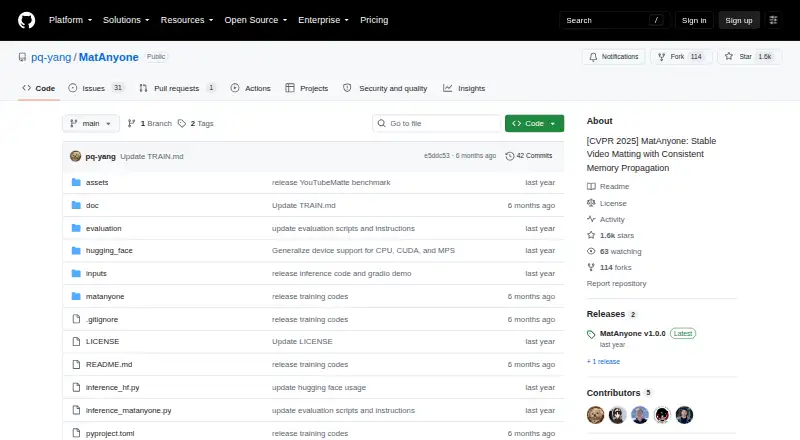
What MatAnyone is
MatAnyone is a human video matting framework that separates a selected target from a video. Inference uses the video and a segmentation mask for its first frame, then produces foreground and alpha videos; users can also save per-frame images. The framework aims to maintain stable core regions while preserving fine boundary detail. Its inference scripts can handle multiple targets by using separate masks.
The project includes a Gradio demo for uploading a video or image and assigning target masks with a few clicks. The demo can run on Hugging Face or locally, and the repository documents loading the model from Hugging Face. Example video formats are MP4, MOV, and AVI. Input resolution has no maximum by default, though users can set a maximum size to downsample larger videos. Local setup uses Conda, Python 3.8, and pip, with an optional dependency set for the demo. MatAnyone is open source under the S-Lab License 1.0, which permits non-commercial use; commercial use requires contacting the contributors. The repository includes training instructions, evaluation scripts, and benchmark data for research, and asks users to cite its CVPR 2025 paper. The project page points to MatAnyone 2 as a newer release. The listed maximum export resolution is 1080p.
Who it suits
MatAnyone suits video creators or researchers who need to isolate a person or other selected target and can supply a first-frame segmentation mask. It is especially relevant to users comfortable with a Conda and Python setup, or those who want to try the hosted or local Gradio demo. Commercial users should contact the contributors about the license.
What it does well
- Produces foreground and alpha videos from a video and first-frame mask.
- Separate masks support processing multiple targets.
- Gradio demo supports mask assignment with a few clicks.
- Accepts MP4, MOV, and AVI example inputs.
- Repository includes training instructions, evaluation scripts, and benchmark data.
What to know first
- The S-Lab License 1.0 permits non-commercial use; commercial use requires contacting contributors.
- Local setup uses Conda, Python 3.8, and pip.
- Listed maximum export resolution is 1080p.
Limits
The listed maximum export resolution is 1080p. Input resolution has no maximum by default, but users can set a maximum size to downsample larger videos. Commercial use requires contacting the contributors under the S-Lab License 1.0.
Getting started
- Visit the MatAnyone GitHub repository.
- Choose the Hugging Face demo or prepare a local setup.
- For local use, clone the repository and create a Conda environment with Python 3.8.
- Install the documented dependencies with pip; add the optional demo dependencies if needed.
- Provide a video and a segmentation mask for its first frame.
Verdict
Pick MatAnyone if you need target-based video matting and can work with its first-frame mask workflow. Its demo offers a more direct way to assign masks, while local use requires a Conda and Python environment. Commercial use requires contacting the contributors.
Questions
Is MatAnyone free?
It is open source and listed as free. The S-Lab License 1.0 permits non-commercial use; commercial use requires contacting the contributors.
What does MatAnyone output?
Inference produces foreground and alpha videos from a video and its first-frame segmentation mask. Per-frame images can also be saved.
Which video formats are supported?
The example inputs include MP4, MOV, and AVI files.
Can I use MatAnyone in a browser?
The project provides a Gradio demo that can run on Hugging Face or locally.
What do I need for local setup?
The repository documents installation with Conda and Python 3.8, followed by pip installation of dependencies. The Gradio demo has an optional dependency set.
Can it process more than one target?
Yes. The inference scripts support multiple targets when each target has a separate mask.
Facts from MatAnyone's own pages
- Compute limit
- Users can set a maximum input size; videos exceeding it are downsampled, and no maximum is set by default. · github.com, 9 Oct 2026
- Inputs
- Inference takes a video and a segmentation mask for its first frame; documented video formats include MP4, MOV, and AVI. · github.com, 9 Oct 2026
- Inputs and outputs
- Inference takes a video and its first-frame segmentation mask and outputs foreground and alpha videos. · github.com, 4 Oct 2026
- Install
- The documented setup clones the repository, creates a Conda environment with Python 3.8, and installs dependencies with pip. · github.com, 9 Oct 2026
- Integration
- The README documents loading the model from Hugging Face for inference and identifies a Hugging Face integration. · github.com, 9 Oct 2026
- Integrations
- The project provides Hugging Face model loading and a Hugging Face demo, and references SAM2 as an example source of segmentation masks. · github.com, 4 Oct 2026
- Interactive demo
- The project offers a Gradio demo on Hugging Face and says it can also be launched locally, with target masks assigned through a few clicks. · github.com, 9 Oct 2026
- License
- The S-Lab License 1.0 permits redistribution and use for non-commercial purposes under stated conditions; commercial use requires contacting the contributors. · github.com, 9 Oct 2026
- Local setup
- The repository documents installation with Conda and Python 3.8, plus an optional dependency set for the Gradio demo. · github.com, 4 Oct 2026
- Multiple targets
- The README documents processing multiple targets by supplying a separate mask for each target. · github.com, 9 Oct 2026
- Outputs
- The inference results include a foreground video and an alpha video, with an option to save per-frame images. · github.com, 9 Oct 2026
- Product
- MatAnyone is a practical human video matting framework that supports assigning a target and produces stable core regions and fine-grained boundary details. · github.com, 4 Oct 2026
- Purpose
- MatAnyone is a human video matting framework designed for stable core-region semantics and fine-grained boundary details, with target assignment. · github.com, 9 Oct 2026
- Related release
- The repository points users to MatAnyone 2 as a newer release. · github.com, 9 Oct 2026
- Research context
- The repository identifies the work as a CVPR 2025 paper by researchers affiliated with NTU S-Lab and SenseTime Research. · github.com, 9 Oct 2026
- Research use
- The repository provides training instructions, evaluation scripts, benchmark data, and asks users to cite the CVPR paper when using the repository for research. · github.com, 4 Oct 2026
- Resolution handling
- Input resolution has no maximum by default, but users can set a maximum size that downsamples larger videos. · github.com, 4 Oct 2026
- Security
- The project pages opened do not state security or compliance certifications. · github.com, 9 Oct 2026
- Security and trust
- The project pages opened for this research do not state security certifications or compliance claims. · github.com, 4 Oct 2026
- Support
- The README invites questions by email at [email protected]. · github.com, 9 Oct 2026
- Video formats
- The example inputs include MP4, MOV, and AVI video files. · github.com, 4 Oct 2026
Where MatAnyone stands on Freedom251
- AI Video Background Removers#17 of 29