Freedom251 › Email Parsing Software

MailParse
What MailParse is
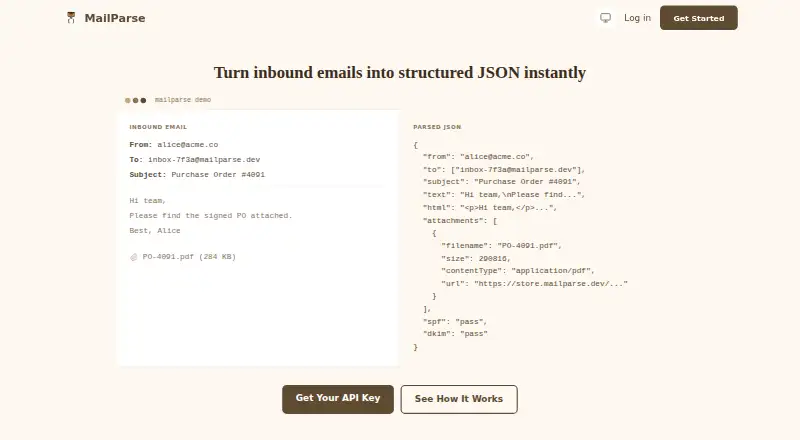
MailParse receives inbound email, parses MIME content into structured JSON and delivers the results through webhooks or a REST polling API. It can extract text and HTML bodies, inline images, attachments, headers and routing information, including from multipart and nested messages. Webhook delivery uses exponential-backoff retries and HMAC signature verification; polling supports filters for sender, date range, subject and attachment type, with cursor-based pagination. MailParse validates SPF, DKIM and DMARC, adds spam scoring, and offers per-address rules to reject, quarantine or pass messages. Users can connect a custom domain by adding an MX record and verifying ownership. Attachments are available through signed download URLs and are retained for 72 hours by default, with plan-dependent retention. If a webhook is unavailable, retries continue for up to 24 hours; emails can also be replayed or retrieved through polling. The free plan includes 100 emails monthly. Pro costs $29 a month and includes 10,000 emails monthly; Scale costs $99 a month and includes unlimited emails.
Who it suits
It suits teams that need to turn inbound messages into structured data and route results to their systems. Developers can use webhook delivery or the REST polling API.
What it does well
- Parses message content, attachments and routing details.
- Supports webhook and REST polling delivery.
- Offers SPF, DKIM and DMARC validation.
- Failed webhook delivery can be retried for 24 hours.
- Pro includes 10,000 emails monthly.
What to know first
- Free plan includes 100 emails per month.
- Attachments are retained for 72 hours by default.
- Specific third-party integrations are not named.
Limits
The Free plan allows 100 emails per month and one inbound address. Pro allows 10,000 emails per month and 50 inbound addresses; Scale lists unlimited emails, domains, and addresses. Attachment retention is configurable by plan; Scale lists custom retention.
Plans
| Plan | Billed and limits | Price |
|---|---|---|
| Free | 100 emails/month · Webhook delivery · REST polling API · 1 inbound address · Community support | Free |
| Pro | 10,000 emails/month · Webhook + polling · Custom domains · 50 inbound addresses · Priority support · 72h attachment retention | $29 a month |
| Scale | Unlimited emails · Webhook + polling · Unlimited domains · Unlimited addresses · Dedicated support · Custom retention · SLA guarantee | $99 a month |
As mailparse.dev lists them, read 4 Oct 2026. The maker's own page has the final word.
Getting started
- Visit the MailParse website.
- Choose the Free, Pro, or Scale plan.
- For a custom domain, add an MX record to MailParse’s servers and verify ownership in the dashboard.
- Configure a webhook endpoint or use the REST polling API to receive parsed messages.
MailParse is an inbound-email parsing service for teams that need MIME messages turned into structured data and delivered to an application. It suits developers building mail-driven workflows who want both webhooks and an API fallback. Its strongest case is reliable message intake with authentication checks and recovery, while attachment-retention limits and plan quotas need careful matching to your volume.
Overview
MailParse receives inbound email, parses MIME into structured JSON, and exposes the result through webhook delivery or a REST polling API. Parsing covers text and HTML bodies, inline images, attachments, headers, and routing data, including nested and multipart messages. That breadth makes it useful for systems that cannot rely on simple, single-part messages.
Webhook requests include exponential-backoff retries and HMAC signature verification. If an endpoint is unavailable, MailParse retries for up to 24 hours; you can also replay messages manually or retrieve them through polling. This recovery path is a meaningful advantage for production pipelines, although the 72-hour default attachment retention means teams handling slower processes should choose a plan with suitable retention controls.
Key features
Parsing and retrieval
The REST API can filter by sender, date range, subject, or attachment type and uses cursor-based pagination. That combination supports targeted reprocessing and avoids relying on webhook receipt as the only record of an email. Custom domains require adding an MX record to MailParse’s servers and verifying ownership in the dashboard.
Message checks
MailParse validates SPF, DKIM, and DMARC, adds spam scoring, and supports per-address rules to reject, quarantine, or pass messages. These controls are useful when inbound addresses receive mixed-quality mail and you need policy decisions before handing data to downstream systems.
Attachments and operations
Attachments are delivered through signed download URLs. They are retained for 72 hours by default, with retention configurable by plan; Pro explicitly includes 72-hour retention, while Scale offers custom retention. The maker describes webhook and REST API delivery but does not name specific third-party integrations, so expect to connect your own application rather than select a catalog connector.
Pricing
| Plan | Price | Includes |
|---|---|---|
| Free | free | 100 emails/month, webhook delivery, REST polling API, one inbound address, community support |
| Pro | $29 a month | 10,000 emails/month, webhook and polling, custom domains, 50 inbound addresses, priority support, 72-hour attachment retention |
| Scale | $99 a month | Unlimited emails, webhook and polling, unlimited domains and addresses, dedicated support, custom retention, SLA guarantee |
Free is a practical evaluation tier or a very small mailbox, but 100 emails per month and one inbound address leave little room for a growing workflow. Pro is the sensible fit for most production teams: the 10,000-email quota and 50 addresses support multiple sources, and custom domains remove the single-address constraint. Scale is aimed at high-volume or operationally critical deployments; unlimited usage, custom retention, dedicated support, and an SLA justify its higher fixed cost when reliability and storage control matter. Paid plans start at $29 per month. Support rises from community to priority to dedicated as you move up the tiers.
Platforms
MailParse is offered through an API and web interface. The API model suits developers integrating ingestion into existing services, while the web dashboard handles domain verification and account administration.
Who it's for
Choose MailParse for applications that turn inbound mail into records, tickets, or automated jobs and need both push delivery and a searchable recovery path. It is particularly well suited to teams processing multipart messages, validating sender authentication, or routing attachments by policy. Small experiments can stay on Free; businesses with several addresses should budget for Pro. Look elsewhere if you need a self-hosted parser, named third-party integrations, or attachment storage beyond the retention terms of your selected plan.
Pros and cons
Pros
- Two delivery modes: webhooks provide immediate processing, while cursor-paginated polling supports filtering and recovery.
- Production safeguards: HMAC verification, retry behavior, 24-hour delivery recovery, and manual replay reduce the impact of endpoint outages.
- Deep MIME coverage: nested and multipart content, inline images, headers, routing data, and attachments are represented in structured output.
- Inbound controls: SPF, DKIM, DMARC, spam scoring, and per-address actions help enforce mail-handling rules.
Cons
- Restrictive Free quota: 100 emails per month and one inbound address make it unsuitable for anything beyond a small workload.
- Retention constraints: attachments default to 72 hours, and custom retention is reserved for Scale.
- Integration uncertainty: no named third-party integrations are provided, so connecting external services may require your own development.
- Cost at scale: Scale is $99 per month, a substantial step up for teams that need unlimited volume or an SLA.
Alternatives
PHP MIME Mail Parser is a free, MIT-licensed open-source library for PHP 8.2+ that requires the mailparse extension; choose it when self-hosting and code-level control matter more than managed webhooks.
Stalwart mail-parser is a free Rust library under an MIT or Apache-2.0 license with no paid plan or usage limit; it fits teams wanting an open-source, self-hosted parser.
CloudMailin offers a free 10,000-email monthly plan with a 512KB-per-message limit and a $25-per-month Starter plan with 2MB messages; consider it when those message-size and price points fit better.
DigiParser targets document and payslip parsing, with paid plans starting at $14 per month for 100 payslips; choose it for that document-focused use case.
Document Parser is web-based, with a free 20-document tier and a $69.90-per-user monthly Premium plan; it is the alternative for document workflows rather than inbound-email infrastructure.
MailFrame provides API and web access with a free tier capped at 100 parse operations per month and a $19-per-month Indie plan; pick it when a lower paid entry point matches your volume.
noima uses euro-denominated document quotas, from 10 one-time documents free to 150 documents per month for €12; it suits document parsing with those retention terms.
Parserr offers a free tier with 15 emails, 10 documents, one inbox, unlimited parsing rules, and Zapier plus Microsoft Flow; choose it when those automation integrations are the priority.
See the broader Email Parsing Software list for more options.
Verdict
MailParse is a strong choice for developers and businesses that need dependable inbound-email ingestion, authentication checks, and a webhook pipeline with polling and replay when delivery fails. Pro is the best balance for a multi-address production service. Look elsewhere if you require self-hosting, built-in third-party connectors, or retention and volume economics that do not fit its $29 and $99 plans.
Verdict
MailParse provides several ways to parse and retrieve inbound email, along with message checks and webhook recovery. Compare the free and paid email limits and attachment retention terms with your workflow.
Questions
Is there a free plan?
Yes. The Free plan costs nothing and includes 100 emails per month, webhook delivery, REST polling API, one inbound address, and community support.
What do the paid plans cost?
Pro costs $29 a month. Scale costs $99 a month.
Which platforms does MailParse support?
The listed platforms are web and API.
How can I receive parsed emails?
MailParse delivers results to a configured webhook or through its REST polling API. Polling supports filters and cursor-based pagination.
Can I use my own domain?
Yes. Add an MX record pointing to MailParse’s servers and verify domain ownership in the dashboard. Custom domains are included in the Pro plan.
What support comes with each plan?
Free lists community support, Pro lists priority support, and Scale lists dedicated support.
Facts from MailParse's own pages
- Attachment retention
- Attachments are available through signed download URLs and are retained for 72 hours by default, with retention configurable by plan. · mailparse.dev, 4 Oct 2026
- Custom domains
- Users can bring their own domain by adding an MX record to MailParse’s servers and verifying domain ownership in the dashboard. · mailparse.dev, 4 Oct 2026
- Delivery recovery
- If a webhook endpoint is down, MailParse retries for up to 24 hours, and users can manually replay emails or retrieve them through polling. · mailparse.dev, 4 Oct 2026
- Integrations
- The maker describes webhook and REST API delivery, but the opened product page does not name specific third-party integrations. · mailparse.dev, 4 Oct 2026
- MIME parsing
- It extracts text and HTML bodies, inline images, attachments, headers, and routing information, including from nested and multipart messages. · mailparse.dev, 4 Oct 2026
- Privacy
- MailParse says it does not sell personal information and may share it with service providers, when legally required, to protect users, in business transfers, or with consent. · mailparse.dev, 4 Oct 2026
- Purpose
- MailParse receives inbound emails, parses MIME into structured JSON, and delivers the results through webhooks or a REST polling API. · mailparse.dev, 4 Oct 2026
- REST API
- The REST polling API supports filtering by sender, date range, subject, or attachment type, with cursor-based pagination. · mailparse.dev, 4 Oct 2026
- Security statement
- The privacy policy says MailParse uses appropriate technical and organizational safeguards, while noting that internet transmission and electronic storage cannot be guaranteed completely secure. · mailparse.dev, 4 Oct 2026
- Spam and authentication
- MailParse validates SPF, DKIM, and DMARC and includes spam scoring and per-address rules to reject, quarantine, or pass messages. · mailparse.dev, 4 Oct 2026
- Support
- The Free plan lists community support, Pro lists priority support, and Scale lists dedicated support. · mailparse.dev, 4 Oct 2026
- Support contact
- The contact page lists [email protected] as a direct support email address. · mailparse.dev, 4 Oct 2026
- Webhook delivery
- Parsed emails are POSTed to a configured webhook, with exponential-backoff retries and HMAC signature verification. · mailparse.dev, 4 Oct 2026
Where MailParse stands on Freedom251
- Email Parsing Software#5 of 22