Freedom251 › IT Financial Management Software

MagicOrange
What MagicOrange is
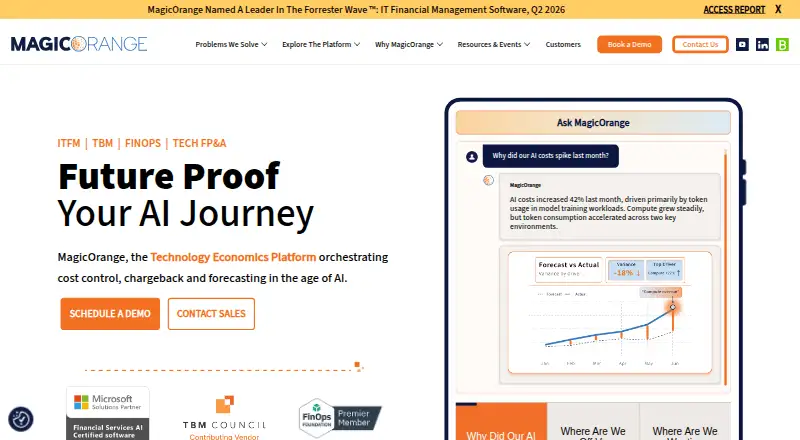
MagicOrange is an IT financial management, FinOps, and shared services expense management platform for technology and finance executives. It combines cost and usage information across cloud, infrastructure, SaaS, and AI workloads into a technology economics model. The platform supports TBM and FinOps frameworks and connects technology activity with financial outcomes. Planning capabilities include budgeting, forecasting, flexible cost modelling, and predictive analysis for trends, scenarios, total cost of ownership, and return on investment. Reporting uses Microsoft Power BI for interactive dashboards, automated reports, and configurable data exploration. Data integrations include SAP, Oracle, AWS, Azure, Jira, Workday, ServiceNow, Microsoft Dynamics 365, Flexera, BMC, IBM, GCP, and Alibaba. Data can be brought in through APIs, ERP connectors, ETL/ELT, and cloud cost imports at daily, weekly, or monthly intervals. MagicOrange runs as a cloud-native platform on Microsoft Azure and is listed in Azure Marketplace. It lists SOC 2 Type II, ISO 27001:2022, CSA STAR Level 1, Cyber Essentials, and GDPR compliance. Security controls include role-based access, continuous vulnerability monitoring on Azure, and regular independent penetration testing. Pricing is on request; prospective customers are directed to contact sales or schedule a demo.
Who it suits
MagicOrange is intended for CIOs, CTOs, CFOs, IT financial management practitioners, and FinOps practitioners. It suits teams bringing technology costs into budgeting, forecasting, and reporting processes.
What it does well
- Combines cost data across cloud, infrastructure, SaaS, and AI
- Supports TBM and FinOps frameworks
- Includes budgeting, forecasting, and scenario planning
- Integrates with Power BI reporting
- Offers multiple data integration methods
What to know first
- Pricing is available on request
- No public plan prices are listed
- No trial terms are listed
Getting started
- Visit the MagicOrange website.
- Schedule a demo or contact sales to discuss pricing.
- Use the web platform or API.
- Access the cloud service through Microsoft Azure or Azure Marketplace.
MagicOrange is a cloud-native IT financial management and FinOps platform for organizations that need one view of technology costs across cloud, infrastructure, SaaS and AI. It suits CIO, CTO, CFO, ITFM and FinOps teams with complex estates and multiple financial systems. The trade-off is a sales-led purchase with custom pricing rather than a self-serve package.
Overview
MagicOrange combines IT financial management, FinOps and shared-services expense management in a technology economics model. It unifies cost and usage information so technology activity can be related to budgets, forecasts, allocations and financial outcomes. Support for TBM and FinOps makes it a specialist platform for technology economics, rather than a general budgeting application.
This approach is most useful when spending is distributed across many environments, suppliers and teams. A smaller organization with one cloud account and limited allocation requirements may find the breadth unnecessary, while a large technology estate can use the common model to bring finance and engineering conversations together.
Key features
Planning and economic modelling
Budgeting, forecasting and flexible cost modelling cover ongoing planning, while predictive modelling adds trend analysis, scenario planning, total-cost-of-ownership and return-on-investment analysis. That combination supports comparing possible spending paths instead of merely reporting historical invoices. The quality of those decisions depends on feeding the model complete, timely source data.
Allocation and accountability
Cost allocation, showback and chargeback let organizations attribute shared technology expenses to teams or services. This is valuable where business units need visibility or formal financial responsibility for consumption, but it also requires agreed allocation rules and dependable source records.
Data integration
MagicOrange supports prebuilt ERP connectors, APIs, data transformation, flexible ETL/ELT and real-time data access. Cloud-cost imports can run daily, weekly or monthly. Listed sources include SAP, Oracle, Microsoft Dynamics 365, AWS, Azure, Jira, Workday, ServiceNow, Flexera, BMC, IBM, GCP and Alibaba, giving enterprises several routes into the model. Buyers should map their own systems and refresh requirements during the sales process, particularly if reporting depends on near-real-time data.
Reporting and security
The reporting experience uses familiar Microsoft Power BI tools, with drag-and-drop insight building, interactive dashboards, automated reports and configurable data exploration. It is a practical fit for teams already using Power BI and wanting configurable outputs rather than a fixed dashboard set.
The service lists SOC 2 Type II attestation, ISO 27001:2022 certification, CSA STAR Level 1 registration, Cyber Essentials certification and GDPR compliance. Role-based access controls, continuous vulnerability monitoring on Microsoft Azure and regular independent penetration testing address common enterprise control requirements, although governance teams should still validate the controls against their own policies.
Pricing
MagicOrange uses paid, custom pricing. Prospective customers are directed to schedule a demo or contact sales, and no public plan prices, seat allowances, quotas, renewal terms or trial period are provided. This suits organizations prepared for a scoped enterprise procurement process, but it prevents straightforward online comparison and gives buyers no self-serve entry tier.
Platforms
MagicOrange is offered through web and API access. It is described as a cloud-first, multi-tenant SaaS platform running on Microsoft Azure and is available through the Azure Marketplace. Azure hosting and marketplace availability may simplify procurement for Microsoft-centric organizations, while API access supports integration into existing data workflows.
Who it's for
The primary audience is CIOs, CTOs, CFOs, IT financial management practitioners and FinOps practitioners. It is a strong candidate for organizations that must reconcile cloud, infrastructure, SaaS and AI economics across multiple business systems, and for teams that need showback or chargeback alongside forecasting and scenario analysis. Buyers seeking a transparent price, a short trial or a lightweight budgeting tool should look elsewhere.
Pros and cons
Pros
- Broad technology economics scope: one model spans cloud, infrastructure, SaaS and AI usage and cost.
- Enterprise data coverage: ERP connectors, APIs, ETL/ELT and numerous named systems support varied estates.
- Planning depth: scenario, TCO and ROI analysis extends beyond basic cost reporting.
- Allocation controls: cost allocation, showback and chargeback support financial accountability.
- Enterprise assurance: recognized security attestations, certifications and Azure controls support governed deployments.
Cons
- No public pricing or trial: every buyer must enter a sales process before assessing commercial fit.
- Potentially excessive for simple estates: organizations with few sources may not benefit from the platform's broad modelling and integration scope.
- Power BI orientation: teams not using Microsoft's reporting ecosystem may face a less familiar reporting workflow.
Alternatives
For a wider shortlist, see IT Financial Management Software.
- Planview AdaptiveWork is worth considering when Android and iOS clients matter alongside web and API access; pricing is also handled by an account executive.
- Choose Serviceware Performance if a free trial and self-hosted deployment option are priorities.
- ClearCost IT Financial Management is another paid, demo-led option when you want to compare a separate IT financial management product.
- Consider Flexera One IT Asset Management when a free plan and self-hosted or web deployment are important.
- ISG Inform provides a web platform with full access arranged through ISG.
- KP-One, Omnia Financial Management and OneView are alternative paid products with web access; Omnia also supports self-hosting.
Verdict
Choose MagicOrange when you need a governed technology economics model connecting diverse cost sources to budgeting, forecasting, allocation and FinOps reporting. Its integrations, planning analysis and enterprise security posture are the main reasons to shortlist it. Look elsewhere if transparent pricing, a free trial, self-service signup or a simpler budgeting scope is more important than cross-estate financial management.
Verdict
MagicOrange focuses on connecting technology usage to financial planning and reporting, with support for multiple data sources and frameworks. Prospective customers need to contact sales for pricing.
Questions
How much does MagicOrange cost?
Pricing is on request. Prospective customers can contact sales or schedule a demo.
Which teams is MagicOrange for?
The company identifies CIOs, CTOs, CFOs, ITFM practitioners and FinOps practitioners as users it serves.
What data sources does it connect to?
Listed integrations include SAP, Oracle, Microsoft Dynamics 365, AWS, Azure, Jira, Workday, ServiceNow, Flexera, BMC, IBM, GCP and Alibaba. Data can also come through APIs, ERP connectors, ETL/ELT and cloud cost imports.
What planning and reporting tools are included?
The platform lists budgeting, forecasting, flexible cost modelling, predictive modelling, scenario planning and TCO and ROI analysis. Reporting integrates with Microsoft Power BI.
Where is MagicOrange hosted?
MagicOrange describes its service as cloud-native and running on Microsoft Azure. It is available through Azure Marketplace.
What security credentials does MagicOrange list?
It lists SOC 2 Type II attestation, ISO 27001:2022 certification, CSA STAR Level 1 registration, Cyber Essentials certification and GDPR compliance.
Facts from MagicOrange's own pages
- Availability model
- A company article describes MagicOrange as a cloud-first, multi-tenant SaaS offering listed on the Azure Marketplace. · magicorange.com, 4 Oct 2026
- Cloud platform
- MagicOrange describes itself as a cloud-native ITFM platform on Microsoft Azure and says it is available through the Azure Marketplace. · magicorange.com, 3 Oct 2026
- Company history
- A MagicOrange customer story says the IT financial management organization was founded in 2015. · magicorange.com, 4 Oct 2026
- Cost modeling
- The platform ingests and unifies cost and usage data across cloud, infrastructure, SaaS and AI workloads into a technology economics model. · magicorange.com, 4 Oct 2026
- Cost planning
- The site lists budgeting and forecasting, flexible cost modelling, reporting, and predictive modelling among the platform’s key features. · magicorange.com, 3 Oct 2026
- Data handling
- The platform offers prebuilt ERP connectors, flexible ETL/ELT, APIs and cloud cost imports at daily, weekly or monthly intervals. · magicorange.com, 4 Oct 2026
- Data integrations
- MagicOrange describes integrations with SAP, Oracle, AWS, Azure, Jira, Workday, ServiceNow, Microsoft Dynamics 365, Flexera, BMC, IBM, GCP, and Alibaba. · magicorange.com, 3 Oct 2026
- Frameworks
- The platform is built to support TBM and FinOps frameworks and connect technology activity to financial outcomes. · magicorange.com, 3 Oct 2026
- Headquarters
- The company lists offices in the United States, South Africa, the United Kingdom, India and Australia, including a London office at 50 Liverpool Street. · magicorange.com, 4 Oct 2026
- Hosting
- MagicOrange says its ITFM and FinOps platform is cloud-native and runs on Microsoft Azure. · magicorange.com, 4 Oct 2026
- Integration methods
- Its data integration capability includes APIs, data transformation, flexible ETL/ELT, and real-time data access. · magicorange.com, 3 Oct 2026
- Integrations
- The integrations page lists SAP, Oracle, Microsoft Dynamics 365, AWS, Azure, Jira, Workday, ServiceNow, Flexera, BMC, IBM, GCP and Alibaba among supported data sources. · magicorange.com, 4 Oct 2026
- Intended users
- The company identifies CIOs, CTOs, CFOs, ITFM practitioners and FinOps practitioners as audiences for the platform. · magicorange.com, 4 Oct 2026
- Planning
- Its predictive modeling feature supports trend analysis, scenario planning and total cost of ownership and return on investment analysis. · magicorange.com, 4 Oct 2026
- Product
- MagicOrange is an IT financial management, FinOps, and shared services expense management platform for technology and finance executives. · magicorange.com, 3 Oct 2026
- Reporting
- MagicOrange integrates with Microsoft Power BI for interactive dashboards, automated reports and configurable data exploration. · magicorange.com, 4 Oct 2026
- Reporting interface
- The maker says the platform uses familiar Power BI tools and a drag-and-drop interface for insights and reporting. · magicorange.com, 3 Oct 2026
- Sales and pricing
- The official site directs prospective customers to schedule a demo or contact sales; the pricing pages checked did not show public prices. · magicorange.com, 4 Oct 2026
- Sales model
- The site directs prospective customers to schedule a demo or contact sales; I found no public plan prices or trial terms on the pages opened. · magicorange.com, 3 Oct 2026
- Security
- MagicOrange lists SOC 2 Type II attestation, ISO 27001:2022 certification, CyberVadis Gold with a score of 911/1000, CSA STAR Level 1 registration, Cyber Essentials certification and GDPR compliance. · magicorange.com, 4 Oct 2026
- Security controls
- The maker’s security article says it uses role-based access controls, continuous vulnerability monitoring on Microsoft Azure, and regular independent penetration testing. · magicorange.com, 3 Oct 2026
- Support
- MagicOrange says it has offices in the United States, South Africa, the United Kingdom, India, and Australia to provide localized support and services. · magicorange.com, 3 Oct 2026
- Technology economics
- It ingests and unifies cost and usage data across cloud, infrastructure, SaaS, and AI workloads into a dynamic economic model. · magicorange.com, 3 Oct 2026
- What it does
- MagicOrange describes its platform as unifying IT financial management, FinOps and shared services expense management to give technology and finance leaders visibility into expenses and cost drivers. · magicorange.com, 4 Oct 2026
Where MagicOrange stands on Freedom251
- IT Financial Management Software#12 of 22