Freedom251 › Deep Learning Software
Ludwig
What Ludwig is
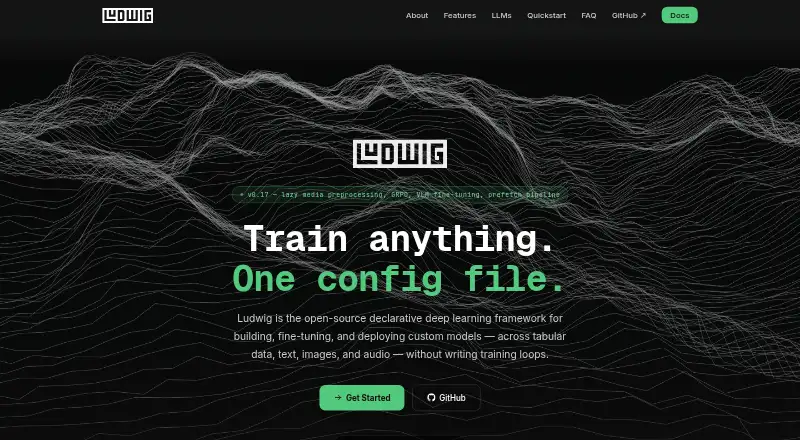
Ludwig is an open-source framework for building, fine-tuning and deploying custom deep learning models through declarative configuration. It supports tabular data, text, images, audio, time series and other listed data types, including geospatial, vector, sequence and anomaly data. Users specify preprocessing, encoders, architecture, training and hyperparameter optimization in a validated YAML file without writing training loops. The framework supports multimodal and multi-task models, plus LLM tuning methods SFT, DPO, KTO, ORPO and GRPO, with parameter-efficient methods such as LoRA and QLoRA. Distributed training through Ray includes DDP, FSDP and DeepSpeed, with Kubernetes and KubeRay also listed. Hyperparameter optimization integrates Ray Tune and Optuna, with SQLite or PostgreSQL persistence. Models can be served as a REST API or exported to SafeTensors, ONNX or torch.export. Ludwig also provides experiment tracking integrations, training reports, visualizations, and customizable model components. The project is Apache 2.0 licensed, and its FAQ describes it as suitable for beginners using YAML as well as experts customizing PyTorch components.
Who it suits
Ludwig suits people building models across varied data types, from beginners using YAML to experts customizing PyTorch components. Its listed distributed training and deployment options also suit teams working across multiple targets.
What it does well
- Validated YAML configuration avoids writing training loops
- Supports multimodal and multi-task models
- Includes multiple LLM tuning and parameter-efficient methods
- Ray-based distributed training supports DDP, FSDP and DeepSpeed
- Exports to SafeTensors, ONNX and torch.export
What to know first
- Unsloth may be faster for LLM-only tuning when maximum throughput is needed
- Python is the listed supported language
Limits
The listed open-source plan costs nothing, and the official site lists no paid plans. The FAQ says Unsloth may be faster when fine-tuning only LLMs and seeking maximum throughput.
Plans
| Plan | Billed and limits | Price |
|---|---|---|
| Open source | Apache 2.0 license · no paid plans listed on the official site | Free |
As ludwig.ai lists them, read 9 Oct 2026. The maker's own page has the final word.
Getting started
- Visit the Ludwig website.
- Choose an API, Linux, macOS, Windows, or self-hosted environment.
- Define preprocessing, encoders, architecture, and training in a validated YAML file, or use `auto_train()`.
- Select a training approach; Ray-based distributed training is available.
- Use a REST API to serve a model or export it to SafeTensors, ONNX, or `torch.export`.
- Connect experiment tracking tools such as W&B, MLflow, TensorBoard, Comet ML, or Aim if needed.
Overview
Ludwig is a Python framework for defining and running deep-learning workflows across a wide range of data and tasks. It is best suited to practitioners who want a configurable path from model setup through deployment, whether they are starting with YAML or extending PyTorch components. Its range is valuable for varied workloads, but not necessarily the best fit for teams focused exclusively on LLM fine-tuning throughput.
Key features
A validated YAML configuration covers preprocessing, encoders, architecture, training, and hyperparameter optimization, so users can describe a workflow without writing training loops. Beginners can also use auto_train(); advanced users can plug in custom encoders, decoders, combiners, loss functions, and metrics, or use HuggingFace models as backbones. That combination serves both quick starts and specialized models without forcing every user into the same level of abstraction.
Ludwig supports tabular, text, image, audio, time-series, geospatial, vector, date/time, sequence, and anomaly tasks. Models can combine modalities and tasks, including text, images, audio, tabular data, and time series. Input options include CSV, TSV, JSON, Parquet, Feather, HDF5, Pandas DataFrames, and Dask DataFrames. This breadth is useful for teams working across different kinds of data; it is more than needed for a narrowly focused modeling workflow.
For LLM fine-tuning, Ludwig supports SFT, DPO, KTO, ORPO, and GRPO, with LoRA, QLoRA, DoRA, and VeRA among its parameter-efficient methods. The FAQ says Unsloth may be faster when maximum throughput is the priority for LLM-only fine-tuning, so Ludwig is not the obvious choice for that specific use case.
Ray supports distributed training with DDP, FSDP, and DeepSpeed, as well as Kubernetes and KubeRay deployment. Built-in hyperparameter optimization integrates with Ray Tune and Optuna, and can persist results in SQLite or PostgreSQL. For tracking experiments, Ludwig integrates with W&B, MLflow, TensorBoard, Comet ML, and Aim, and generates training reports and visualizations. Feature importance, model explainability, and visualizations are also among its AutoML capabilities.
Models can be served as a REST API or exported to SafeTensors, ONNX, and torch.export. Docker images are available for CPU, GPU, and Ray. The listed integrations span PyTorch and HuggingFace Transformers, data and training tools, experiment trackers, and deployment options, giving teams multiple ways to connect the framework to their stack. Ludwig is open source under the Apache 2.0 License and hosted by Linux Foundation AI & Data; community channels include Discord, GitHub Issues, and GitHub Discussions.
Pricing
Open source: free. The Apache 2.0 project has no paid plans. It is a fit for individuals and teams able to work with the open-source framework and manage their own training and deployment setup; there is no paid tier with additional service or usage terms to weigh.
Platforms
Ludwig supports Python and is available for Linux, macOS, and Windows, with API and self-hosted options. GPU acceleration is supported. Its deployment choices include REST API serving, Docker, Kubernetes, and KubeRay, which make it applicable to both local development and distributed environments.
Who it's for
Ludwig suits beginners who want to define experiments in YAML or start with auto_train(), as well as experts who need to customize PyTorch components and hyperparameters. It is particularly relevant to teams handling multiple data types or needing tuning, experiment tracking, and deployment in a shared framework. If the sole requirement is maximum-throughput LLM fine-tuning, its own FAQ points toward considering Unsloth instead.
Pros and cons
- Broad task and data coverage: multimodal support and many accepted formats let teams use one framework across varied modeling work.
- Configurable depth: validated YAML reduces the need for hand-written training loops, while custom components and HuggingFace backbones preserve room to adapt.
- Training-to-deployment range: distributed training, optimization, experiment tracking, serving, and export support a workflow beyond model training alone.
- Not the throughput-first LLM pick: users tuning only LLMs for maximum speed may get better results from a specialized alternative.
Alternatives
ONNX Runtime is a free option with support across mobile, desktop, web, and self-hosted platforms; consider it when that platform reach matters more than Ludwig's declarative model-building workflow.
Apache TVM is another free, Apache-licensed option spanning mobile, desktop, web, API, and self-hosted use; it may suit readers comparing open-source frameworks with broad deployment-platform coverage.
Paperspace Gradient offers a free individual plan with 5GB storage, with billed Plus utilization costs on paid instances, and a Pro individual plan at $8 a month plus utilization costs. Consider it when a hosted coding playground and its stated individual plans are a better match.
TensorFlow is a free, open-source framework available across mobile, desktop, web, API, and self-hosted platforms; choose it when that framework and platform coverage better fit your project.
MATLAB Grader is free with a current MATLAB license under maintenance, while LMS integration requires a qualifying academic license; it is relevant when those license conditions and LMS use align with the need.
MegEngine is an open-source framework with Python packages for Linux, Windows, macOS, and Android; consider it when those platform-specific packages suit your deployment needs.
tinygrad is a free open-source library installable from source or pip, for readers who prefer that library option.
Apache SINGA is a free distributed deep-learning library under Apache License 2.0; consider it when a distributed library is the more direct fit.
See Deep Learning Software for more options.
Verdict
Choose Ludwig if you want an open-source Python framework that spans varied data, configurable model workflows, distributed training, and deployment without requiring hand-written training loops. Its main advantage is that breadth, paired with room for expert customization. Look elsewhere if your work is limited to LLM fine-tuning and maximum throughput outweighs the value of a broader framework.
Verdict
Ludwig combines declarative model setup with broad data support, tuning methods and deployment options. For LLM-only fine-tuning where maximum throughput is the priority, its FAQ notes Unsloth may be faster.
Questions
How much does Ludwig cost?
The Open source plan is free. The official site lists no paid plans.
Is Ludwig open source?
Yes. Ludwig is licensed under Apache 2.0.
Which platforms can I use?
The listed platforms are API, Linux, macOS, self-hosted, and Windows.
What kinds of models and data does Ludwig support?
It supports models using tabular, text, image, audio, time-series, geospatial, vector, date/time, sequence, and anomaly data, including multimodal and multi-task models.
Which tools does Ludwig integrate with?
Listed integrations include HuggingFace Transformers, PyTorch, Ray, Weights & Biases, MLflow, TensorBoard, Optuna, Ray Tune, Docker, Kubernetes, vLLM, DeepSpeed, ONNX, SafeTensors, Dask, PyArrow, Comet ML, and Aim.
Can Ludwig serve or export models?
Yes. Models can be served as a REST API and exported to SafeTensors, ONNX, or `torch.export`. The site also lists MLflow among supported model formats.
Facts from Ludwig's own pages
- Configuration
- Users define preprocessing, encoders, architecture, training, and hyperparameter optimization in a validated YAML file. · ludwig.ai, 9 Oct 2026
- Customization
- Users can plug in custom encoders, decoders, combiners, loss functions, and metrics, and use HuggingFace models as backbones. · ludwig.ai, 9 Oct 2026
- Data and tasks
- The framework supports tabular, text, image, audio, time series, geospatial, vector, date/time, sequence, and anomaly data tasks. · ludwig.ai, 9 Oct 2026
- Distributed training
- A Ray backend enables distributed training using DDP, FSDP, or DeepSpeed, and the site also lists Kubernetes and KubeRay support. · ludwig.ai, 9 Oct 2026
- Experiment tracking
- The site says Ludwig integrates with W&B, MLflow, TensorBoard, Comet ML, and Aim, and generates training reports and visualizations. · ludwig.ai, 9 Oct 2026
- Explainability
- The site lists automatic baseline training, feature importance, model explainability, and visualizations. · ludwig.ai, 9 Oct 2026
- Extensibility
- Users can plug in custom encoders, decoders, combiners, loss functions, and metrics, and use HuggingFace models as backbones. · ludwig.ai, 8 Oct 2026
- Formats
- Supported data formats include CSV, TSV, JSON, Parquet, Feather, HDF5, Pandas DataFrames, and Dask DataFrames. · ludwig.ai, 9 Oct 2026
- Hyperparameter optimization
- Built-in HPO integrates Ray Tune and Optuna, with SQLite or PostgreSQL persistence. · ludwig.ai, 9 Oct 2026
- Integrations
- Listed integrations include HuggingFace Transformers, Ray, PyTorch, W&B, MLflow, TensorBoard, Optuna, Ray Tune, Docker, Kubernetes, vLLM, DeepSpeed, ONNX, SafeTensors, Dask, PyArrow, Comet ML, and Aim. · ludwig.ai, 9 Oct 2026
- License
- The site identifies Ludwig as open source under the Apache 2 License. · ludwig.ai, 8 Oct 2026
- License and hosting
- The project is described as open source under the Apache 2.0 License and hosted by Linux Foundation AI & Data. · ludwig.ai, 9 Oct 2026
- LLM fine-tuning
- The site lists SFT, DPO, KTO, ORPO, and GRPO, plus LoRA, QLoRA, DoRA, and VeRA methods. · ludwig.ai, 8 Oct 2026
- LLM tuning
- Ludwig supports SFT, DPO, KTO, ORPO, and GRPO, with parameter-efficient methods including LoRA and QLoRA. · ludwig.ai, 9 Oct 2026
- Modalities
- The framework supports multimodal and multi-task models combining features such as text, images, audio, tabular data, and time series. · ludwig.ai, 8 Oct 2026
- Notable limitation
- The FAQ says Unsloth may be faster when a user only fine-tunes LLMs and needs maximum throughput. · ludwig.ai, 9 Oct 2026
- Optimization
- Built-in hyperparameter optimization integrates Ray Tune and Optuna and supports SQLite or PostgreSQL persistence. · ludwig.ai, 8 Oct 2026
- Scaling
- Ludwig supports distributed training with Ray, including DDP, FSDP, DeepSpeed, and KubeRay deployment. · ludwig.ai, 8 Oct 2026
- Serving and export
- Ludwig can serve models as a REST API and export to SafeTensors, ONNX, or torch.export. · ludwig.ai, 9 Oct 2026
- Support and community
- The site links to Discord, GitHub Issues, GitHub Discussions, and contribution resources. · ludwig.ai, 9 Oct 2026
- What it does
- Ludwig is an open-source declarative deep learning framework for building, fine-tuning, and deploying custom models without writing training loops. · ludwig.ai, 9 Oct 2026
- Who it is for
- The FAQ says Ludwig is for both beginners using YAML and auto_train() and experts customizing PyTorch encoders and hyperparameters. · ludwig.ai, 8 Oct 2026
Where Ludwig stands on Freedom251
- Deep Learning Software#12 of 35