Freedom251 › Deep Learning Software
Apache TVM
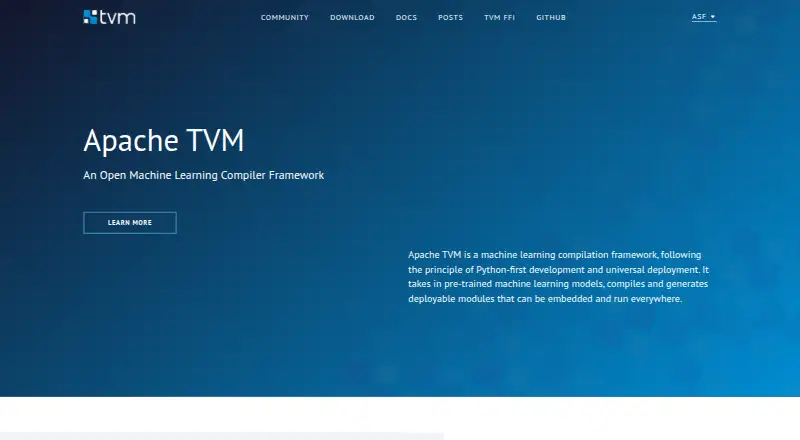
What Apache TVM is
Apache TVM is a free machine learning compilation framework that turns pre-trained models into deployable modules. Its optimization process can be customized in Python without recompiling the TVM stack, and users can compose additional optimization passes, libraries, and code generation. Model importers support PyTorch, ONNX, and TensorFlow Lite. Deployment backends include CPU, GPU, Metal, ROCm, Vulkan, OpenCL, x86, ARM, and WebAssembly. A lightweight runtime can run compiled code in JavaScript, Java, Python, and C++ on Android, iOS, Raspberry Pi, and web browsers. Users can install TVM from PyPI, build it from source, or use Docker images. Cross-compilation and RPC deployment cover ARM, x86, RISC-V, embedded systems, and accelerator devices. The default generated binary relies on a minimum runtime API and limited system calls such as malloc. One important security constraint is that the RPC server assumes trusted users and networks: API users can write arbitrary files and gain full remote code execution. TVM is open-source software under Apache License 2.0.
Who it suits
TVM suits developers who need to compile pre-trained models for varied hardware and runtime targets, and who want to customize optimization in Python. Its RPC interface requires particular care in trusted environments.
What it does well
- Imports PyTorch, ONNX, and TensorFlow Lite models
- Customizes optimization in Python without recompiling TVM
- Supports CPU, GPU, and multiple deployment backends
- Lightweight runtime covers mobile devices and browsers
- Free open-source software under Apache License 2.0
What to know first
- RPC assumes trusted users and networks
- RPC API users can write arbitrary files and execute code remotely
Plans
| Plan | Billed and limits | Price |
|---|---|---|
| Apache TVM | open-source framework · no licensing cost | Free |
As tvm.apache.org lists them, read 15 Oct 2026. The maker's own page has the final word.
Getting started
- Visit the Apache TVM website.
- Install TVM from PyPI, build it from source, or use a Docker image.
- Import a model from PyTorch, ONNX, or TensorFlow Lite.
- Customize the optimization process in Python and compile for a supported target.
- Use cross-compilation or RPC deployment for supported device targets.
Overview
Apache TVM is a machine-learning compilation framework for developers deploying pre-trained models beyond their original training environment. It is a strong fit when hardware targets or runtime constraints call for custom optimization; it is not a turnkey model-serving product.
The breadth of backends and language runtimes gives deployment teams room to adapt, but that flexibility comes with engineering work. Its RPC server also deserves particular caution: API users can write arbitrary files and execute code remotely, so it belongs only in a trusted network with trusted users.
Key features
TVM imports models from PyTorch, ONNX and TensorFlow Lite and compiles them into deployable modules. Developers can customize optimization in Python without rebuilding the TVM stack, and compose new optimization passes, libraries and code generators. That is useful for teams with distinct deployment needs, while adding less value to readers seeking a ready-made application or a fixed, simple inference path.
Targets include CPUs and GPUs as well as Metal, ROCm, Vulkan, OpenCL, x86, ARM and WebAssembly. Cross-compilation and RPC deployment extend to ARM, x86, RISC-V, embedded systems and accelerator devices. This reach can help teams working across unlike hardware, though it also means choosing and configuring a suitable target is part of the job.
The lightweight runtime executes compiled code through JavaScript, Java, Python and C++ on Android, iOS, Raspberry Pi and web browsers. The default generated binary relies on a minimal runtime API and limited system calls, such as malloc, which suits constrained deployments. Installation choices include PyPI, source builds and Docker images.
TVM’s project resources cover contributor guidance, community guidelines, code review, testing, releases and security. Undisclosed vulnerabilities should be sent to the Apache Software Foundation’s private security mailing list at [email protected].
Pricing
Apache TVM is free open-source software under the Apache License 2.0. The Apache TVM plan costs nothing. There are no paid tiers or seat and usage limits described for this plan; its trade-off is not price but the developer effort required to configure and deploy a compilation framework.
Platforms
TVM is offered across Android, iOS, Linux, macOS, Windows, web, API and self-hosted environments. Its runtime and deployment targets cover more ground than those platform labels alone suggest, including Raspberry Pi, embedded systems and accelerator devices.
Who it's for
Choose TVM if you need to compile pre-trained models for varied hardware, customize optimization in Python, or deploy into constrained runtimes. It suits developers and teams willing to handle compilation and target configuration. Look elsewhere if you need an end-user application or want a managed, ready-to-run inference service.
Pros and cons
- Pro: Imports PyTorch, ONNX and TensorFlow Lite models, giving teams several common starting points.
- Pro: Python customization and composable passes allow optimization to be adapted without recompiling the TVM stack.
- Pro: Broad backend, cross-compilation and runtime support helps reach mobile, browser, embedded and accelerator environments.
- Con: The framework requires deployment and optimization work; it is not a turnkey runner.
- Con: The RPC server allows arbitrary file writes and remote code execution for API users, making untrusted access unsafe.
Alternatives
ONNX Runtime is a free alternative to consider when its support for Android, iOS, Linux, macOS, self-hosted, web and Windows fits the deployment environment.
Paperspace Gradient may suit readers looking for a freemium coding playground rather than a compilation framework; its Free (Individual) plan costs nothing and includes 5GB storage, with paid-instance utilization costs billed separately.
TensorFlow is another free, open-source machine-learning option, with platforms spanning Android, API, iOS, Linux, macOS, self-hosted, web and Windows.
MATLAB Grader is free with a MATLAB license current under maintenance; LMS integration requires a qualifying academic license.
MegEngine is a free framework option for Android, iOS, Linux, macOS, self-hosted and Windows.
Ray Train is a free, open-source option for Linux, macOS, self-hosted and Windows.
Trackio is a free library with Hugging Face hosting, for API, Linux, macOS, self-hosted, web and Windows.
DeepSpeed is a free Apache-2.0 software library for Linux, macOS and self-hosted use.
Verdict
Apache TVM is a compelling choice for developers who need Python-driven model optimization and deployment across diverse backends and runtimes, especially where a compact runtime matters. Its breadth and zero price are meaningful advantages, but teams must be ready to configure targets and secure RPC access tightly. Choose another tool if you need a managed service or cannot isolate its high-trust RPC interface.
Verdict
TVM offers broad model, backend, and runtime support with Python-based optimization. Treat its RPC server as a high-trust interface because API users can write files and execute code remotely.
Questions
How much does Apache TVM cost?
Apache TVM is free. Its listed plan is free.
Is Apache TVM open source?
Yes. It is open-source software under Apache License 2.0.
Which model formats can TVM import?
It supports PyTorch, ONNX, and TensorFlow Lite models.
Where can compiled code run?
Its lightweight runtime can run code on Android, iOS, Raspberry Pi, and web browsers. Supported backends include CPU, GPU, Metal, ROCm, Vulkan, OpenCL, x86, ARM, and WebAssembly.
How can I install TVM?
You can install it from PyPI, build it from source, or use Docker images.
Is the TVM RPC server safe for untrusted networks?
The RPC server assumes trusted users and networks. API users can write arbitrary files and obtain full remote code execution.
Facts from Apache TVM's own pages
- Build requirements
- Source builds require CMake 3.24 or newer, LLVM preferably 15 or newer, Git, a C++20 compiler and Python 3.10 or newer. · tvm.apache.org, 15 Oct 2026
- Code-generation backends
- Documented code generators include LLVM, CUDA, ROCm, NVPTX, Metal, OpenCL, Vulkan, WebGPU and C. · tvm.apache.org, 15 Oct 2026
- Community and support
- The project provides contributor guidance, community guidelines, code reviews, testing guidance, release processes and a security guide. · tvm.apache.org, 1 Oct 2026
- Composable optimization
- TVM combines graph optimizations such as operator fusion and layout rewrites with tensor-program optimization. · tvm.apache.org, 15 Oct 2026
- Cross compilation
- TVM can compile for a target device even when that physical device is absent from the build machine if its toolchain is available. · tvm.apache.org, 15 Oct 2026
- Deployment backends
- TVM supports CPU, GPU and emerging backends, including Metal, ROCm, Vulkan, OpenCL, x86, ARM and WebAssembly. · tvm.apache.org, 1 Oct 2026
- Documentation depth
- The documentation is organized into getting-started guides, how-to tutorials, deep dives, API references, architecture material and contributor guidance. · tvm.apache.org, 15 Oct 2026
- Independent performance result
- A peer-reviewed paper reported TVM quantized-network speedups of 2.35x on Intel Xeon, 2.15x on Nvidia T4, 1.35x on Raspberry Pi 3 and 1.40x on Raspberry Pi 4 versus optimized FP32 execution. · arxiv.org, 15 Oct 2026
- Independent teaching material
- UC San Diego course slides describe TVM as highly general with many tools and target processors but warn that numerous optimization choices make optimal instruction generation complex. · cseweb.ucsd.edu, 15 Oct 2026
- Installation
- Users can install TVM from PyPI, build it from source or use Docker images. · tvm.apache.org, 1 Oct 2026
- Installation options
- Official installation paths are PyPI wheels, source builds and Docker images. · tvm.apache.org, 15 Oct 2026
- Licence
- The repository states that TVM is licensed under Apache License 2.0. · github.com, 15 Oct 2026
- Limit: learning curve
- ToolDirectory reviewers said TVM requires compiler and hardware knowledge and has a steep learning curve. · tooldirectory.ai, 15 Oct 2026
- Limit: tuning and debugging
- ToolDirectory reviewers described tuning and debugging as potentially time-consuming and brittle. · tooldirectory.ai, 15 Oct 2026
- Maker headquarters
- The Apache Software Foundation lists 1000 N West Street, Suite 1200, Wilmington, Delaware 19801, U.S.A. as its mailing address. · apache.org, 15 Oct 2026
- Maker legal entity
- The Apache Software Foundation is a U.S. 501(c)(3) nonprofit public charity formed in 1999. · apache.org, 15 Oct 2026
- Mobile and browser runtime
- Its lightweight runtime can run compiled code in JavaScript, Java, Python and C++ on Android, iOS, Raspberry Pi and web browsers. · tvm.apache.org, 1 Oct 2026
- Model importers
- TVM supports importing models from PyTorch, ONNX and TensorFlow Lite. · tvm.apache.org, 1 Oct 2026
- Model imports
- Official frontends support PyTorch, ONNX and TensorFlow Lite models. · tvm.apache.org, 15 Oct 2026
- Praise: hardware breadth
- ToolDirectory reviewers praised compilation across mobile, edge, accelerators and TPUs. · tooldirectory.ai, 15 Oct 2026
- Praise: scheduling control
- ToolDirectory reviewers praised fine-grained control over compute scheduling and memory layout. · tooldirectory.ai, 15 Oct 2026
- Project origin
- TVM began as a research project at the University of Washington's Paul G. Allen School and later joined the Apache incubator. · tvm.apache.org, 1 Oct 2026
- Public documentation policy
- TVM documentation says public functions are documented and usage examples are supplied when needed. · tvm.apache.org, 15 Oct 2026
- PyPI platform wheels
- That PyPI release provided wheels for Windows x86-64, Linux x86-64, Linux ARM64 and macOS 11 ARM64. · pypi.org, 15 Oct 2026
Where Apache TVM stands on Freedom251
- Deep Learning Software#1 of 35