Freedom251 › Deep Learning Software
Chainer
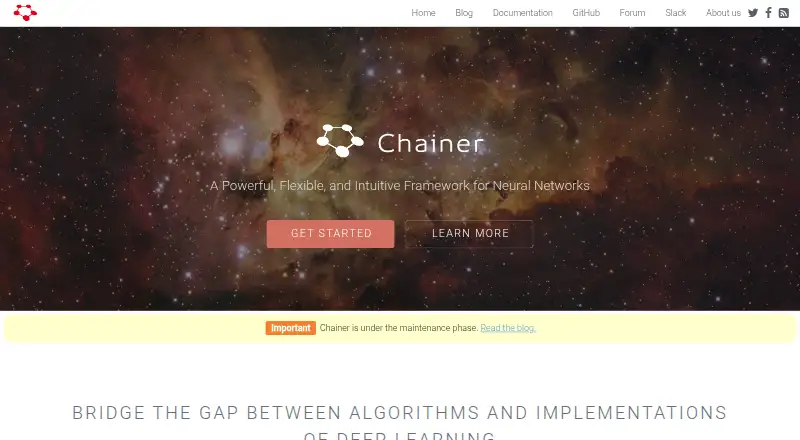
What Chainer is
Chainer is a free, standalone, open-source Python framework for developing deep-learning models. Its define-by-run automatic differentiation lets forward computations use ordinary Python control flow while retaining backpropagation, supporting code that is intended to be easier to debug. The framework handles feed-forward, convolutional, recurrent, recursive and per-batch architectures. It supports CUDA and multi-GPU computation; CUDA requires CuPy, and cuDNN is optional. ChainerRL adds deep reinforcement-learning algorithms, while ChainerCV provides computer-vision neural-network tools. Optional dependencies enable image datasets, HDF5 serialization and distributed learning with ChainerMN. ONNX-Chainer is integrated, and most features are compatible with ChainerX ndarray. Chainer is in maintenance, with further development limited to bug fixes. Version 7 supports Python 3.5.2 through 3.8, while documentation does not guarantee Windows or macOS operation.
Who it suits
It suits Python developers and researchers working on local deep-learning experiments, including GPU and distributed workloads. Users planning new development should note the project’s maintenance status and migration resources for PyTorch.
What it does well
- Free, open-source Python framework
- Define-by-run automatic differentiation
- Supports multiple neural-network architectures
- CUDA and multi-GPU computation
- Extensions for reinforcement learning and vision
What to know first
- Project is limited to maintenance work
- Windows and macOS operation not guaranteed
- CUDA requires separate CuPy installation
- Python 2 is unsupported
Verdict
Chainer offers flexible Python-based model development with dynamic computation and GPU support. Its maintenance-only status and platform guidance make project planning and migration considerations important.
Facts from Chainer's own pages
- Automatic differentiation
- It provides automatic differentiation APIs using the define-by-run approach, also known as dynamic computational graphs. · github.com, 11 Oct 2026
- Community support
- The documentation links to Chainer community Slack chat and forums. · docs.chainer.org, 11 Oct 2026
- Development status
- Chainer is in maintenance phase, with further development limited to bug fixes and maintenance. · docs.chainer.org, 11 Oct 2026
- Extensions
- ChainerRL implements deep reinforcement-learning algorithms, and ChainerCV provides tools for computer-vision neural networks. · chainer.org, 11 Oct 2026
- Founded
- 2015 · chainer.org, 28 Sept 2026
- GPU computing
- Chainer supports CUDA computation and can run on multiple GPUs; CUDA support requires installing CuPy separately. · chainer.org, 11 Oct 2026
- GPU support
- Chainer supports CUDA computation and multi-GPU use; CUDA support requires CuPy, and cuDNN support is optional. · docs.chainer.org, 11 Oct 2026
- Installation
- The documentation recommends installing Chainer with pip and also describes installation from a source tarball or Git repository. · docs.chainer.org, 11 Oct 2026
- Integrations
- The v7 release announcement says ONNX-Chainer is integrated into Chainer and that most Chainer features, including ChainerMN, are compatible with ChainerX ndarray. · chainer.org, 11 Oct 2026
- License
- The GitHub repository identifies Chainer's license as the MIT License. · github.com, 11 Oct 2026
- Maintenance status
- Chainer is in maintenance, with further development limited to bug fixes and maintenance. · docs.chainer.org, 11 Oct 2026
- Migration
- The maker says it chose PyTorch as Chainer's replacement and released migration resources for users moving to PyTorch. · chainer.org, 11 Oct 2026
- Model types
- It supports feed-forward, convolutional, recurrent, recursive, and per-batch network architectures. · chainer.org, 11 Oct 2026
- Network architectures
- It supports feed-forward, convolutional, recurrent, and recursive networks, as well as per-batch architectures. · chainer.org, 11 Oct 2026
- Optional capabilities
- Optional dependencies enable image-dataset support, HDF5 serialization, and distributed deep learning with ChainerMN. · docs.chainer.org, 11 Oct 2026
- Optional features
- Image dataset support, HDF5 serialization, and distributed deep learning with ChainerMN require optional dependencies. · docs.chainer.org, 11 Oct 2026
- Platform limits
- The documentation recommends 64-bit Ubuntu 14.04 or 16.04 and CentOS 7, and says it cannot guarantee operation on Windows or macOS. · docs.chainer.org, 11 Oct 2026
- Platforms
- The recommended environments are 64-bit Ubuntu 14.04/16.04 LTS and CentOS 7; the documentation says it cannot guarantee operation on Windows or macOS. · docs.chainer.org, 11 Oct 2026
- Product
- Chainer is a Python-based, standalone open-source framework for building deep-learning models. · chainer.org, 11 Oct 2026
- Python control flow
- Forward computation can use Python control-flow statements while retaining backpropagation, which the site says makes code intuitive and easy to debug. · chainer.org, 11 Oct 2026
- Python support
- Chainer v7 supports Python 3.5.2 and later versions through 3.8, while Python 2 is unsupported. · docs.chainer.org, 11 Oct 2026
- Target users
- The maker describes Chainer as supporting deep-learning research and development, and says it chose PyTorch as the replacement framework for its own development efforts. · chainer.org, 11 Oct 2026
Where Chainer stands on Freedom251
- Deep Learning Software#10 of 35