Freedom251 › Continuous Integration Software
LUCI
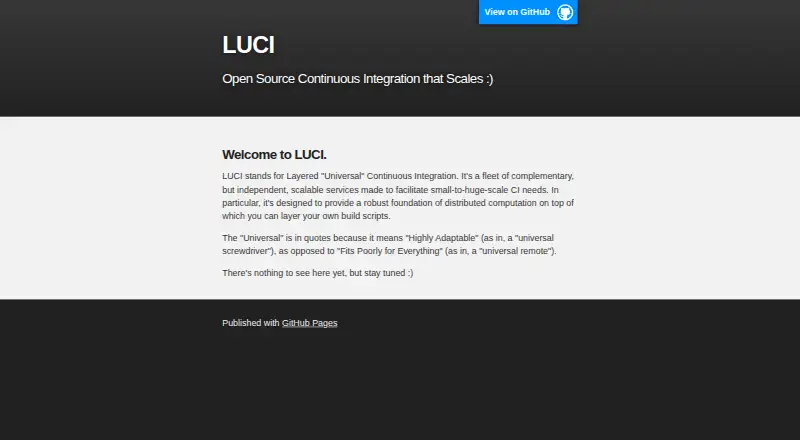
What LUCI is
LUCI is a free, open-source ensemble of independent services for large-scale continuous integration and distributed computation for build scripts. Swarming distributes tasks across thousands of bots, while Isolate server distributes tens of thousands of files per task. Buildbucket tracks builds, queues them to builders, and can turn scheduled builds into Swarming tasks. Milo displays builder, build, and test-result information from Buildbucket and ResultDB, including custom consoles. The toolkit includes federated authentication, access control lists, Git-based configuration propagation, and automatic Google Compute Engine virtual-machine recycling. LUCI Recipes is a Python 3 framework for testable, shareable, cross-platform CI scripts that can run locally and connect with the LUCI UI; subprocesses can appear as colored steps with descriptions and debugging logs. LUCI runs primarily on Google Cloud Platform and is designed for large projects. It is used by Chromium and other teams. Documentation lists Windows, OSX, Ubuntu Linux, Android, iOS, and ChromeOS environments. The luci-py project uses Apache v2.0.
Who it suits
LUCI suits teams building large distributed CI systems with self-hosted runners and artifact or dependency caching. It is especially relevant to projects using its documented build, test, and cloud components.
What it does well
- Free open-source CI service ensemble
- Distributed tasks across thousands of bots
- Python 3 Recipes framework
- Integrated build and test result UI
- Git-based configuration propagation
What to know first
- Designed primarily for large projects
- Runs primarily on Google Cloud Platform
- Documentation names OSX rather than macOS
- Components are independent services to assemble
Verdict
LUCI provides a broad set of services for distributed continuous integration, from scheduling and execution to files, recipes, and result displays. Its scale and component-based design fit large engineering organizations more than simple single-runner setups.
Facts from LUCI's own pages
- Access controls
- LUCI configuration supports role based access controls for permissions such as reading project configurations, logs, and build information. · chromium.googlesource.com, 11 Oct 2026
- Build foundation
- LUCI is designed to provide a robust foundation for distributed computation on which teams can layer their own build scripts. · luci.github.io, 11 Oct 2026
- Build scheduling
- Buildbucket tracks builds, queues them into builders, and can translate a scheduled build into a Swarming task. · chromium.googlesource.com, 11 Oct 2026
- Build UI
- Milo displays information from Buildbucket and ResultDB about builders, builds, and test results, and can show custom consoles. · chromium.googlesource.com, 11 Oct 2026
- Configuration
- LUCI service configuration can specify access controls, Swarming dimensions, recipe names, and properties for builders. · chromium.googlesource.com, 11 Oct 2026
- Design
- LUCI is a fleet of complementary, independent, scalable services designed to provide distributed computation for build scripts. · luci.github.io, 5 Oct 2026
- Distributed execution
- Swarming runs arbitrary tasks across a fleet of workers called Swarming bots. · chromium.googlesource.com, 11 Oct 2026
- File distribution
- Isolate server distributes tens of thousands of files per task. · chromium.googlesource.com, 5 Oct 2026
- Hosting
- LUCI runs primarily on Google Cloud Platform and is designed to scale for large projects. · chromium.googlesource.com, 5 Oct 2026
- Infrastructure
- The toolkit includes automatic Google Compute Engine virtual machine recycling. · chromium.googlesource.com, 5 Oct 2026
- Integrations
- Buildbucket has native integration with Swarming and recipes, allowing builds to be scheduled on Swarming to run a configured recipe. · chromium.googlesource.com, 11 Oct 2026
- License
- The luci-py project is licensed under Apache v2.0. · chromium.googlesource.com, 5 Oct 2026
- Operating systems
- The documentation lists Windows, OSX, and Linux (Ubuntu), with Android, iOS, and ChromeOS use. · chromium.googlesource.com, 5 Oct 2026
- Purpose
- LUCI stands for Layered “Universal” Continuous Integration and is a fleet of complementary, independent, scalable services for CI needs ranging from small to huge. · luci.github.io, 11 Oct 2026
- Recipe framework
- LUCI Recipes are a Python 3 framework for CI scripts designed to be testable, cross-platform, shareable, locally runnable, and integrated with the LUCI UI. · chromium.googlesource.com, 5 Oct 2026
- Scale
- The LUCI overview describes Swarming as distributing tasks across thousands of bots and Isolate server as distributing tens of thousands of files per task. · chromium.hanana2.link, 11 Oct 2026
- Supported environments
- The LUCI overview lists Windows, OSX, and Linux (Ubuntu) environments used with Android, iOS, and ChromeOS. · chromium.hanana2.link, 11 Oct 2026
- Task distribution
- Swarming distributes tasks across thousands of Swarming bots. · chromium.googlesource.com, 5 Oct 2026
- Test results
- Milo displays test result information from ResultDB alongside builder and build information. · chromium.googlesource.com, 11 Oct 2026
- UI integration
- Recipes can display subprocesses as steps, with step colors, descriptive text, and debugging logs in the LUCI UI. · chromium.googlesource.com, 5 Oct 2026
- Use
- LUCI is used by the Chromium project. · chromium.googlesource.com, 5 Oct 2026
- Users
- LUCI is used by the Chromium project and other teams, according to the LUCI repository overview. · chromium.hanana2.link, 11 Oct 2026
Where LUCI stands on Freedom251
- Continuous Integration Software#32 of 58