Freedom251 › Reverse Image Search Software
LocalLens
What LocalLens is
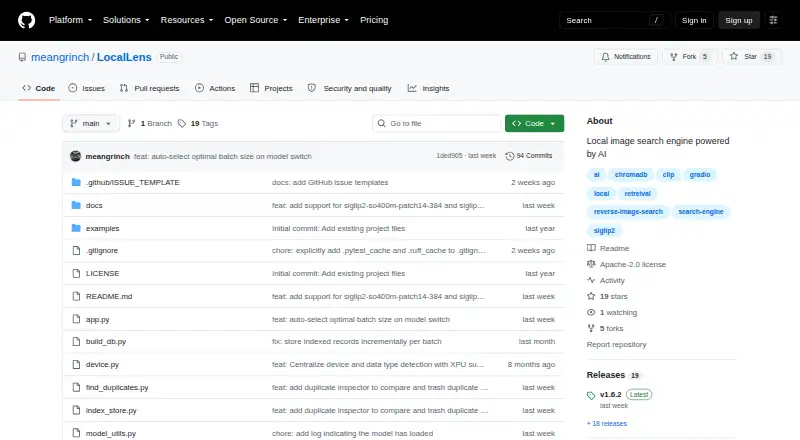
LocalLens is a free, offline visual search engine for image and video collections stored locally. It recursively indexes directories into ChromaDB, then searches indexed files using text descriptions and ranks results by similarity. Users can also upload an image to find visually similar files or combine image and text inputs to refine a search. A duplicate finder surfaces duplicate and near-duplicate image pairs using a similarity threshold. Listed formats include JPG, PNG, WebP, MP4, and MKV. LocalLens provides a Gradio web interface and a command-line interface, and can sync indexed folders when files are added or deleted. Supported vision embedding backbones include SigLIP 2, MetaCLIP, DFN-CLIP, and CLIP. The project is open-source under Apache-2.0, with no paid plans or usage limits stated. Portable builds are provided for Windows, Linux, and macOS; Linux and macOS require Python 3.10 or later and Git. The documented baseline is a 4-core CPU, 8 GB RAM, no VRAM, and 20 MB storage; the project recommends 6 or more CPU cores, 12 GB or more RAM, and 4 GB or more VRAM. The gallery can access any indexed directory by default; LOCALLENS_ALLOWED_PATHS can restrict accessible directories.
Who it suits
LocalLens suits people with local image or video collections who want text-based, visual, or duplicate searches. It may appeal to users who prefer an offline, open-source tool and can meet its platform requirements.
What it does well
- Searches images and videos with text descriptions
- Supports image-based search and combined image-text queries
- Finds duplicate and near-duplicate image pairs
- Offline and open-source under Apache-2.0
- Offers both a web interface and command-line interface
What to know first
- Linux and macOS require Python 3.10 or later and Git
- Gallery can access any indexed directory by default
- Recommended hardware includes 4 GB or more of VRAM
Plans
| Plan | Billed and limits | Price |
|---|---|---|
| LocalLens | Open-source software; no paid plans or usage limits stated | Free |
| Free | Open-source software · local image/video collections · Windows portable build or Python installation on Linux/macOS | Free |
As github.com lists them, read 5 Oct 2026. The maker's own page has the final word.
Getting started
- Open the LocalLens GitHub website.
- Choose a portable build for Windows, Linux, or macOS, or use the applicable setup route.
- For Linux or macOS, have Python 3.10 or later and Git available.
- Index the directories containing your media.
- Use the Gradio web interface or command-line interface to search.
Overview
LocalLens is an offline visual search engine for image and video collections stored in local folders. It suits people who need to find or compare files in their own media library, not those looking to track images across the wider web. Its combination of search methods and open-source licensing is compelling at no cost, though setup requirements and directory access call for care.
Key features
Search by description or reference image
Search indexed media with a text description, or upload an image to find visually similar files. You can also combine an image with text to refine the search, a useful option when a visual reference alone is too broad. Results are ranked by similarity, so this is a way to surface likely matches rather than guarantee an exact one.
Indexing and duplicate detection
LocalLens recursively indexes directories into ChromaDB and can sync indexed folders to account for additions and deletions. That suits collections that change over time, rather than requiring a static one-time scan. Its duplicate finder surfaces duplicate and near-duplicate image pairs according to a similarity threshold. This can help identify lookalikes, but threshold-based results still need review before treating files as duplicates.
Models, formats and interfaces
Supported vision embedding backbones include SigLIP 2, MetaCLIP, DFN-CLIP and CLIP. Supported media includes JPG, PNG and WebP images and MP4 and MKV video. A Gradio web interface and a command-line interface give users a choice between browsing results visually and working from the terminal.
Privacy and access
The project describes LocalLens as offline, a useful fit for people who want to search their own collections without relying on a web-wide image service. The gallery can access any indexed directory by default. Set LOCALLENS_ALLOWED_PATHS to restrict accessible directories, especially when other people can reach the web interface.
Pricing
LocalLens is free open-source software under the Apache-2.0 license. Its free plan costs nothing, and no paid plans or usage limits are stated. There is no free trial to weigh against a paid subscription; the trade-off is that users must handle installation and access controls themselves.
Platforms
LocalLens supports Linux, macOS, self-hosted use, web and Windows. Portable builds are provided for Windows, Linux and macOS; Linux and macOS installations require Python 3.10+ and Git. The documented baseline is a 4-core CPU, 8 GB RAM, 0 GB VRAM and 20 MB storage. The recommended configuration of 6+ CPU cores, 12+ GB RAM and 4+ GB VRAM gives more headroom, so users with modest hardware can start at the baseline but should consider the recommendation for a more capable setup.
Who it's for
LocalLens is a strong fit for people with sizable or frequently changing local image and video libraries who want to search by description, reference image or visual similarity. Its command-line option and self-hosted, offline approach also suit users comfortable managing their own software and directories. Choose something else if you need to search the wider web, want a managed service, or cannot meet the installation requirements on Linux or macOS.
Pros and cons
- Several ways to find local media: Text, image and combined search can narrow a collection without manually browsing folders.
- Useful for changing libraries: Folder sync accounts for additions and deletions, while threshold-based duplicate detection can surface near-duplicates for review.
- No software charge: The Apache-2.0 open-source license and free plan avoid a paid subscription.
- Access needs deliberate setup: The gallery can access any indexed directory by default, so restricting paths matters when sharing the interface.
- Platform requirements may be a hurdle: Linux and macOS installs require Python 3.10+ and Git, and the recommended hardware exceeds the documented baseline.
Alternatives
Reverse Image Search Software is a broader category to consider if you want to compare other approaches.
Choose ImageRights Discovery instead if its first 100 images on the free ImageRights Pilot plan meet your needs; it supports API, macOS, web and Windows.
Imagga Visual Search may suit a reader seeking API-based visual search and related image tools: its Indie plan costs $79 a month, billed monthly, and includes 70,000 API requests alongside visual search, background removal, barcode recognition and OCR/text recognition APIs.
For reverse image searches across Android, iOS and web, RIMG is another free option; its free plan has no usage limit stated.
SearchReverseImage is worth considering for free photo searches on Android, iOS or web. Its plan allows unlimited searches without signup or watermarks, with JPG/JPEG, PNG, WEBP or GIF uploads up to 4 MB.
Berify is an alternative for basic reverse image search on the web, with free searches and a free tier; it also offers a 1000 Images plan for $5.95 a month, billed monthly.
Choose Pixsy if you need image monitoring and case submission rather than local-library search: its free plan covers 500 monitored images, regular-priority match scanning, no takedown notices and free, unlimited case submission.
Reverse Image Search Anywhere is another alternative.
SerpApi is an alternative.
Verdict
Choose LocalLens if you want a free, open-source way to search and compare media in your own folders using text and image queries. Its offline design and folder sync make it particularly appealing for a personal library that changes over time. Look elsewhere if your goal is web-wide image discovery, or if you are not prepared to meet its setup requirements and restrict the gallery's directory access.
Verdict
LocalLens provides several search methods for local media and can operate offline. Check its default directory access and platform requirements when setting it up.
Questions
Is LocalLens free?
Yes. The listed LocalLens plan is free.
Which platforms does LocalLens support?
Portable builds are provided for Windows, Linux, and macOS. The listed platforms also include web and self-hosted.
Is LocalLens open-source?
Yes. It is licensed under Apache-2.0.
What kinds of media can it search?
It supports images and videos, with formats listed including JPG, PNG, WebP, MP4, and MKV.
Does LocalLens have a command-line interface?
Yes. It provides both a Gradio web UI and a command-line interface.
Facts from LocalLens's own pages
- Access restriction
- The gallery can be restricted to approved directories through the LOCALLENS_ALLOWED_PATHS environment variable. · github.com, 15 Oct 2026
- Chroma API
- Chroma's documentation describes a small Python API for creating collections and adding, updating and deleting records, consistent with LocalLens's ChromaDB indexing layer. · github.com, 15 Oct 2026
- Community size
- The GitHub repository page showed 23 stars, 5 forks and 152 commits when opened. · github.com, 15 Oct 2026
- Database
- LocalLens stores image embeddings in ChromaDB. · github.com, 15 Oct 2026
- Directory indexing
- It recursively indexes directories and supports incremental synchronization for additions and deletions. · github.com, 15 Oct 2026
- Documentation depth
- Official documentation consists of README instructions plus separate installation and hardware-requirements files. · github.com, 15 Oct 2026
- Duplicate detection
- The product identifies duplicate and near-duplicate image and video pairs using a similarity threshold. · github.com, 15 Oct 2026
- EmbeddingGemma integration
- Google's EmbeddingGemma 2 model card describes a 740-million-parameter multimodal embedding model supporting text, images, video and audio. · huggingface.co, 15 Oct 2026
- Embedding models
- Available vision backbones include EmbeddingGemma 2 and several SigLIP 2 variants. · github.com, 15 Oct 2026
- Gradio role
- Gradio describes itself as a Python framework for building machine-learning web interfaces, which is the web UI technology named by LocalLens. · gradio.app, 15 Oct 2026
- Hardware baseline
- The documented baseline is a four-core CPU, 8 GB RAM, no required VRAM and 20 MB storage. · github.com, 15 Oct 2026
- Hardware requirements
- The documented baseline is a 4-core CPU, 8 GB RAM, 0 GB VRAM, and 20 MB storage; 6+ CPU cores, 12+ GB RAM, and 4+ GB VRAM are recommended. · github.com, 5 Oct 2026
- Higher-end model cost
- The SigLIP 2 512 model is documented as adding about 2.3 GB VRAM, 4 GB RAM and 4.58 GB storage. · github.com, 15 Oct 2026
- Indexing and sync
- It recursively indexes directories into ChromaDB and can sync indexed folders for additions or deletions. · github.com, 5 Oct 2026
- Install platforms
- Portable builds are provided for Windows, Linux, and macOS; Linux and macOS require Python 3.10+ and Git. · github.com, 5 Oct 2026
- Interfaces
- LocalLens provides a Gradio web interface and a command-line interface. · github.com, 15 Oct 2026
- Licence
- The repository declares the Apache-2.0 licence. · raw.githubusercontent.com, 15 Oct 2026
- License
- LocalLens is open-source and licensed under Apache-2.0. · github.com, 5 Oct 2026
- Linux and macOS installation
- Linux and macOS manual installs require Python 3.10 or newer and Git. · github.com, 15 Oct 2026
- Maintainer model activity
- The maintainer's Hugging Face profile showed six public models and four followers when opened. · huggingface.co, 15 Oct 2026
- Maker profile
- The maintainer's GitHub profile identifies the account as grinnch and lists LocalLens as a public Python repository. · github.com, 15 Oct 2026
- Media formats
- The README lists image and video support, including JPG, PNG, WebP, MP4, and MKV. · github.com, 5 Oct 2026
- Model availability limitation
- The SigLIP 2 384 model page states that the checkpoint was not deployed by any inference provider when opened. · huggingface.co, 15 Oct 2026
- Model hardware cost
- The hardware guide lists EmbeddingGemma 2 as adding about 1 GB VRAM, 2 GB RAM and 1.53 GB storage. · github.com, 15 Oct 2026
Where LocalLens stands on Freedom251
- Reverse Image Search Software#1 of 21