Freedom251 › LLM Evaluation Tools
LM Evaluation Harness
What LM Evaluation Harness is
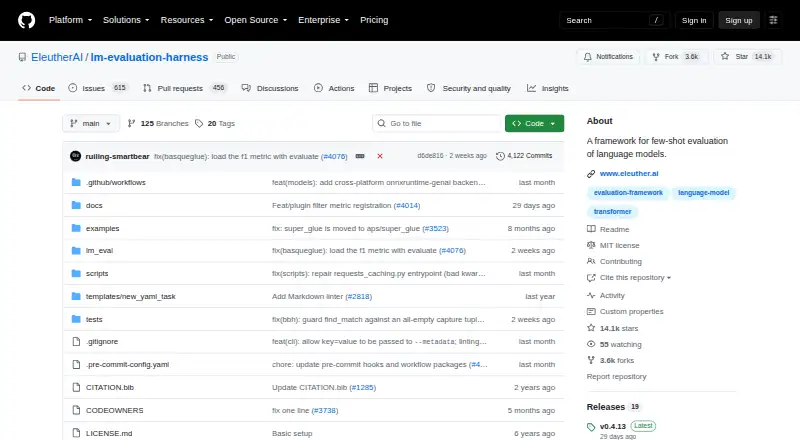
LM Evaluation Harness is a free, open-source framework for evaluating generative language models across evaluation tasks. It brings together more than 60 standard academic benchmarks, with hundreds of subtasks and variants. Supported model options include Hugging Face Transformers, GPT-NeoX, Megatron-DeepSpeed, and vLLM. It can also connect to hosted APIs such as OpenAI and Anthropic, plus local servers compatible with OpenAI APIs. Users can define prompts and evaluation metrics, configure tasks with YAML, and extend the framework with model backends, filters, metrics, and aggregations from external packages or local modules. The project says publicly available prompts support reproducibility and comparison between papers. The core framework is provided in the base package, while model backends and task dependencies may require separate optional installs. It is MIT-licensed for self-hosted use. Documented runtime options include Windows ML and ONNX Runtime providers for CPU, CUDA, DirectML, NPU, ROCm, and other accelerators. For APIs without logits or log probabilities, use is limited to generate-until tasks.
Who it suits
It suits researchers and organizations evaluating generative language models across benchmarks or custom tasks. Its self-hosted design and configurable tasks may fit users who can manage separate backend and task-dependency installs.
What it does well
- More than 60 academic benchmarks
- Supports hosted APIs and local compatible servers
- Users can define custom prompts and metrics
- MIT-licensed software with no listed price
What to know first
- Model backends may need separate optional installs
- Some APIs are limited to generate-until tasks
- MIT license provides the software without warranty
Limits
The base package provides the core framework, while model backends and task dependencies may require separate optional installs. APIs without logits or log probabilities are limited to generate-until tasks.
Plans
| Plan | Billed and limits | Price |
|---|---|---|
| LM Evaluation Harness | MIT-licensed software · model backends and task dependencies may require separate optional installs | Free |
As github.com lists them, read 4 Oct 2026. The maker's own page has the final word.
Getting started
- Open the LM Evaluation Harness GitHub repository.
- Install the base package for the core framework.
- Install optional model backends and task dependencies as needed.
- Choose a supported model option, hosted API, or compatible local server.
- Configure tasks with YAML and define any custom prompts or metrics.
Verdict
LM Evaluation Harness offers a shared framework for benchmark and custom model evaluations, with a range of model options and extensibility. Users should account for optional installs and the stated limitation for APIs that do not provide logits or log probabilities.
Questions
Is LM Evaluation Harness free?
Yes. The listed plan costs nothing, and the software is MIT-licensed.
Where can it run?
The listed platforms are API, Linux, and self-hosted. Documented runtime options include Windows ML and ONNX Runtime providers for CPU, CUDA, DirectML, NPU, ROCm, and other accelerators.
Which models and APIs does it support?
Listed model options include Hugging Face Transformers, GPT-NeoX, Megatron-DeepSpeed, and vLLM. It also supports hosted OpenAI and Anthropic APIs and local servers compatible with OpenAI APIs.
Can users create custom evaluations?
Yes. Users can define custom prompts and metrics, configure tasks with YAML, and add model backends, filters, metrics, and aggregations through external packages or a local module.
Is it open source, and who makes it?
It is open source under the MIT License. The project is hosted in the EleutherAI GitHub repository.
What support is available?
The project directs users to open a GitHub issue or join the EleutherAI Discord.
Facts from LM Evaluation Harness's own pages
- API integrations
- The harness supports hosted APIs including OpenAI and Anthropic, plus local servers compatible with OpenAI APIs. · github.com, 4 Oct 2026
- Benchmarks
- The project lists over 60 standard academic LLM benchmarks with hundreds of subtasks and variants. · github.com, 4 Oct 2026
- Custom evaluation
- Users can define custom prompts and evaluation metrics, and can configure tasks with YAML. · github.com, 4 Oct 2026
- Installation
- The base package provides the core framework while model backends are installed separately as optional extras. · github.com, 4 Oct 2026
- Model support
- Supported model options include Hugging Face Transformers, GPT-NeoX, Megatron-DeepSpeed, and vLLM. · github.com, 4 Oct 2026
- Notable limitation
- For model APIs that do not provide logits or log probabilities, the documentation limits use to generate-until tasks. · github.com, 4 Oct 2026
- Plugins
- Model backends, filters, metrics, and aggregations can be registered from external packages through entry points or loaded from a local module. · github.com, 4 Oct 2026
- Purpose
- LM Evaluation Harness is a unified framework for evaluating generative language models across evaluation tasks. · github.com, 4 Oct 2026
- Reproducibility
- The project says its use of publicly available prompts supports reproducibility and comparability between papers. · github.com, 4 Oct 2026
- Security and license
- The repository provides the software under the MIT License, which states that it is provided “AS IS” without warranty. · github.com, 4 Oct 2026
- Support
- The project directs users to open a GitHub issue or join the EleutherAI Discord for support. · github.com, 4 Oct 2026
- Supported platforms
- Documented runtime options include Windows ML and ONNX Runtime providers for CPU, CUDA, DirectML, NPU, ROCm, and other accelerators. · github.com, 4 Oct 2026
- Users
- The project says the harness serves as the backend for Hugging Face’s Open LLM Leaderboard and is used by research papers and organizations. · github.com, 4 Oct 2026
Where LM Evaluation Harness stands on Freedom251
- LLM Evaluation Tools#14 of 29
- AI LLM Evaluation Tools#19 of 30