Freedom251 › Data Fabric Software
Kamu
What Kamu is
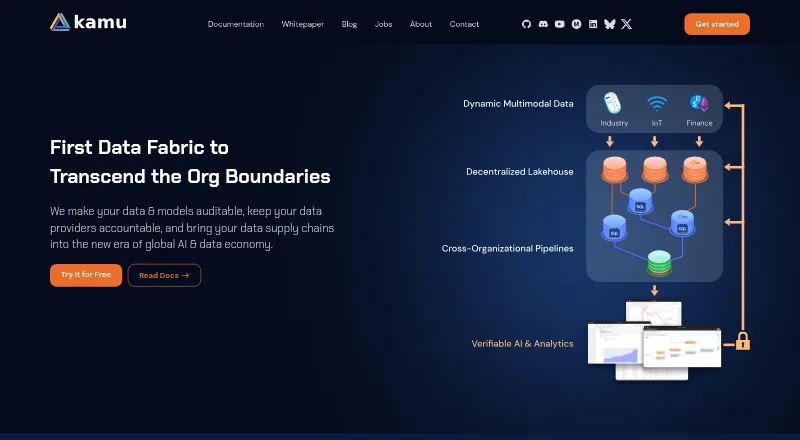
Kamu is a data fabric for verifiable data processing and exchange between organizations. Its free CLI manages dynamic structured data and, according to its maker, can be used without an account, credit card, or cloud subscription. It records data history and transformation code so users can trace where data came from and how it changed. SQL-based pipelines can use engines such as Flink, Spark, and DataFusion; ingestion options include Debezium, web polling, MQTT brokers, and blockchain logs. Users can explore datasets through an embedded SQL shell, Jupyter notebooks, an embedded web UI, or BI tools such as Apache Superset. Open Data Fabric formats and protocols support sharing through conventional or decentralized storage. Kamu Node is a server counterpart deployable as Kubernetes applications in distributed environments. The CLI works on Linux, macOS, and Windows with WSL2. The documentation says Kamu is not well suited to high-frequency, high-volume work, though it may suit insights derived from such data. The maker identifies Kamu Data Inc. as the company and welcomes contributors to its open development.
Who it suits
Kamu may suit organizations exchanging data across independent parties, especially for low-to-moderate-frequency, mission-critical information where traceability matters. It is not described as a fit for high-frequency, high-volume workloads.
What it does well
- Free CLI requires no account or cloud subscription.
- Records data history and transformation code.
- SQL pipelines can use multiple processing engines.
- Supports notebook, web UI, and BI exploration.
- Kamu Node can run as Kubernetes applications.
What to know first
- Not well suited to high-frequency, high-volume cases.
- Windows CLI use requires WSL2.
- Kamu Platform is labeled coming soon.
Limits
The free Kamu CLI plan runs on a laptop and can scale to a large on-premises cluster. Kamu's documentation says the system is not well suited to high-frequency, high-volume cases, although it may suit insights derived from those workloads.
Plans
| Plan | Billed and limits | Price |
|---|---|---|
| Kamu CLI | Runs on a laptop; can scale to a large on-prem cluster | Free |
As kamu.dev lists them, read 30 Sept 2026. The maker's own page has the final word.
Getting started
- Visit the Kamu website.
- Install Kamu CLI on Linux, macOS, or Windows with WSL2.
- Use the CLI without an account, credit card, or cloud subscription.
- Build SQL-based pipelines and connect supported processing engines or ingestion sources.
- For a distributed server deployment, install Kamu Node as a Kubernetes application.
Kamu is a data fabric for teams that need to exchange and process structured data across organizational boundaries. Its free CLI makes it worth considering when traceability is central to the work, but its documented workload limits rule it out for some streaming use cases.
Overview
Kamu pairs a command-line tool for managing and verifiably processing dynamic data with Kamu Node, a server counterpart designed for larger-scale deployments. The Open Data Fabric (ODF) formats and protocols underpin data exchange and verifiable processing across both. The distinction is practical: the CLI can run on a laptop and scale to a large on-prem cluster, while Node is designed to run as a distributed Kubernetes application and provide APIs to applications and smart contracts.
ODF datasets can be shared through conventional storage such as S3, GCS, and Azure, or decentralized storage such as IPFS. That gives parties options for exchanging data without requiring publishers to move it to a central point. Kamu's emphasis on accountable collaboration is a strength for cross-organization workflows, but it is a more specific proposition than a general-purpose data platform.
Key features
Traceability and processing
Kamu records data history and transformation code so teams can follow data to its origins, see how it changed, and verify reproducible results. Temporal SQL supports data manipulation and near-real-time autonomous pipelines. For organizations that need to audit transformations, this makes provenance part of the processing workflow rather than an afterthought.
Pipeline and analytics ecosystem
SQL-based ETL pipelines can use processing engines including Flink, Spark, and DataFusion; integrations with those engines and Arroyo are offered as plugins. Ingestion options include Debezium, web polling, MQTT brokers, and blockchain logs. An embedded SQL shell, Jupyter notebooks, an embedded web UI, Apache Superset, and other BI tools provide ways to explore or query datasets. This breadth lets teams connect ingestion, processing, and analysis, though the choice of engines and interfaces will matter most to teams prepared to assemble a data workflow around Kamu.
Accountability and privacy
Changes made by people with admin access leave a trace, and data provenance is intended to keep publishers and processors accountable. Kamu describes its sharing model as privacy-preserving, with publishers retaining ownership and control instead of moving data to a central point. These properties suit sensitive exchanges between independent parties; they do not remove the need to assess deployment security. The installation guide warns that sudo-less Docker access can expose the filesystem with root privileges and recommends rootless Podman as an alternative.
Pricing
Kamu CLI — free. The free plan runs on a laptop and can scale to a large on-prem cluster. The maker says the CLI includes the features of a modern data lakehouse and can be installed and used without a credit card, account, or cloud subscription. This makes it a low-barrier option for individual evaluation and on-premises use. The plan's stated scope does not establish the terms or costs of operating a separate server deployment.
Kamu Node is the server counterpart, designed for large scale and deployable on Kubernetes. The listed plan is the free CLI; no price for Node is given here, so it should not be assumed to be included in that plan.
Platforms
Kamu supports API, Linux, macOS, self-hosted, web, and Windows platforms. The CLI installation guide specifies Linux, macOS, and Windows with WSL2. Node is self-hosted as a distributed Kubernetes application. The web platform is marked as coming soon, so readers seeking a currently ready web product should not treat it as an established option.
Who it's for
Kamu is a fit for teams exchanging data between independent parties and for low-to-moderate-frequency, mission-critical workloads where trustworthiness and protection from malicious actors matter. Its documented use cases span energy, enterprise and government data, science and research, IoT and smart cities, fintech and insurtech, healthcare, Web3, and DePIN. Despite the IoT applications, the CLI documentation says Kamu is not well suited to high-frequency, high-volume workloads; it may instead suit insights derived from those workloads.
Pros and cons
- Pros: Recorded history and transformation code support traceability and reproducibility, useful when data crosses organizational boundaries.
- Pros: The free CLI runs without an account or cloud subscription, and can scale from a laptop to a large on-prem cluster.
- Pros: Multiple ingestion sources, processing engines, storage options, and analytics integrations support varied collaborative pipelines.
- Cons: Kamu is explicitly a poor fit for high-frequency, high-volume workloads, narrowing its role in demanding streaming scenarios.
- Cons: Node's Kubernetes deployment and the CLI's command-line interface call for teams comfortable operating data infrastructure rather than readers seeking a ready-made web service.
- Cons: The web platform is coming soon, limiting its appeal to teams that need a finished web product now.
Alternatives
Consider InterSystems IRIS if you want to compare a paid platform that also offers a free Community Edition and free trial. Denodo Platform is another option to weigh: its Developer plan describes a single-server allowance with 4 cores, 50 data products, and 2.5 TB/year. Teradata VantageCloud may suit readers looking at a freemium platform with a free trial and a VantageCloud Lake Standard plan.
Informatica Intelligent Data Management Cloud is worth comparing if a cloud data-integration offering is a better match; its free plan includes up to 20M rows and 10 compute hours per month. GE Vernova Proficy Plant Applications is an alternative to consider for manufacturing applications. K2View Fabric offers a 30-day free trial built around a basic Customer 360 scenario. Cloudera Data Lake Service is another data lake service to evaluate, while DataOS offers pay-per-use and yearly subscription plans.
For more options, browse Data Fabric Software.
Verdict
Choose Kamu if your team needs a free, traceable way to process and exchange mission-critical data across organizational boundaries, and can work within its low-to-moderate-frequency focus. Its combination of provenance, flexible pipelines, and laptop-to-cluster deployment is the case for it. Look elsewhere for high-frequency, high-volume processing or a ready web platform.
Verdict
Kamu focuses on traceable data processing, with a free CLI and a deployable server counterpart. Its documented limitation on high-frequency, high-volume workloads is important to consider when evaluating fit.
Questions
Is Kamu free?
The Kamu CLI plan costs nothing. The maker says it can be installed and used without an account, credit card, or cloud subscription.
Which operating systems can run Kamu CLI?
The CLI installation page lists Linux, macOS, and Windows with WSL2.
Is Kamu open source?
The maker says its technology and tooling are developed in the open and welcomes contributors.
What is Kamu Node?
Kamu Node is the server counterpart to Kamu CLI, with the same features designed for large scale. It can be deployed as Kubernetes applications in a distributed environment.
Which processing engines does Kamu support?
Kamu says it integrates Spark, Flink, Arroyo, and DataFusion as plugins. Its pipeline documentation also names Flink, Spark, and DataFusion.
What kinds of workloads suit Kamu?
The CLI documentation describes it as a fit for low-to-moderate-frequency, mission-critical data exchanged between independent parties. It says Kamu is not well suited to high-frequency, high-volume cases.
Facts from Kamu's own pages
- Analytics tools
- Documented exploration integrations include an embedded SQL shell, Jupyter notebooks, an embedded web UI, and Apache Superset and other BI tools. · docs.kamu.dev, 30 Sept 2026
- Company
- The site identifies the company as Kamu Data Inc. · kamu.dev, 29 Sept 2026
- Data exchange
- ODF datasets can be shared through conventional storage such as S3, GCS, and Azure, or decentralized storage such as IPFS. · docs.kamu.dev, 30 Sept 2026
- Data lineage
- Kamu preserves data history and lets users trace data origins and see who transformed it and how. · kamu.dev, 29 Sept 2026
- Data processing
- Kamu uses temporal SQL for data manipulations and supports near real-time, autonomous pipelines. · kamu.dev, 29 Sept 2026
- Deployment
- Kamu Node is a scalable server implementation of ODF, deployable as Kubernetes applications in a distributed environment. · docs.kamu.dev, 30 Sept 2026
- Existing tools
- Kamu says it can ingest data from databases and that standard protocols and SQL let notebooks, BI tools, and analytics platforms query its datasets. · kamu.dev, 29 Sept 2026
- Free CLI
- The maker says Kamu CLI includes all features of a modern data lakehouse and can be installed and used for free without a credit card, account, or cloud subscription. · kamu.dev, 29 Sept 2026
- History and provenance
- Kamu records data history and transformation code so users can trace sources and verify reproducible results. · docs.kamu.dev, 30 Sept 2026
- Ingestion
- Kamu supports extractors such as Debezium and built-in sources including web polling, MQTT brokers, and blockchain logs. · docs.kamu.dev, 30 Sept 2026
- Integrations
- Kamu says it integrates Spark, Flink, Arroyo, and Datafusion as plugins, allowing different engines in one pipeline. · kamu.dev, 29 Sept 2026
- Node
- Kamu Node is described as a server counterpart to the CLI, with the same features designed for large scale. · kamu.dev, 29 Sept 2026
- Notable limit
- The CLI docs say Kamu is not well suited for IoT or other high-frequency, high-volume cases, though it may suit insights derived from such data. · docs.kamu.dev, 30 Sept 2026
- Open source
- The maker says Kamu technology and tooling are developed in the open and welcomes contributors. · kamu.dev, 30 Sept 2026
- Pipelines
- Users can build SQL-based ETL pipelines using processing engines including Flink, Spark, and DataFusion. · docs.kamu.dev, 30 Sept 2026
- Platforms
- The CLI supports Linux and Intel and M-series macOS; Windows use is documented through WSL2 or Docker Desktop, while the native Windows binary is described as highly experimental. · docs.kamu.dev, 30 Sept 2026
- Privacy
- Kamu describes its data sharing as privacy-preserving and says publishers can retain ownership and control without moving data to a central point. · kamu.dev, 29 Sept 2026
- Product
- Kamu is a data fabric for auditable, accountable data supply chains and collaborative processing across organizational boundaries. · kamu.dev, 29 Sept 2026
- Protocol
- Open Data Fabric (ODF) is the set of formats and protocols for data exchange and verifiable processing implemented by Kamu CLI and Node. · kamu.dev, 29 Sept 2026
- Security
- The CLI installation guide warns that sudo-less Docker access can expose the filesystem with root privileges and recommends rootless Podman as an alternative. · docs.kamu.dev, 30 Sept 2026
- Security and accountability
- The maker says data changes by people with admin access leave a trace, and data provenance keeps publishers and processors accountable. · kamu.dev, 29 Sept 2026
- Self-hosting
- Kamu Node is documented as a Kubernetes application set that can be installed in a distributed environment and provides APIs to applications and smart contracts. · docs.kamu.dev, 29 Sept 2026
- Support
- The maker directs users to GitHub issues or Discord for feedback and questions. · kamu.dev, 30 Sept 2026
- Supported systems
- The CLI installation page says it works on Linux, macOS, and Windows with WSL2. · kamu.dev, 29 Sept 2026
Where Kamu stands on Freedom251
- Data Fabric Software#3 of 25