Freedom251 › Learning Record Store Software
Jupiter
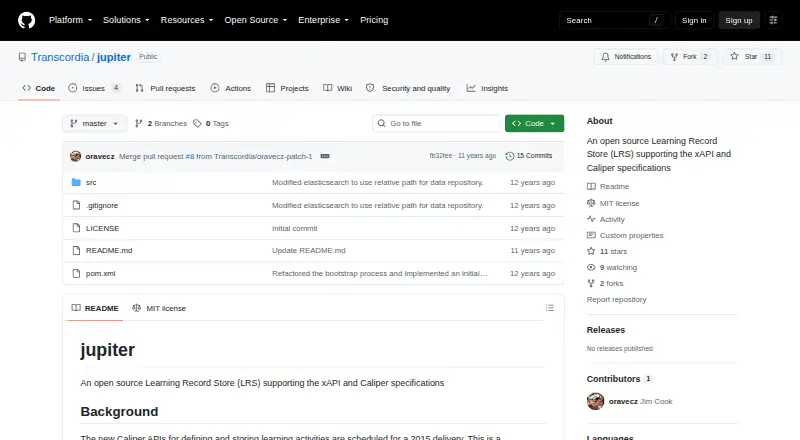
What Jupiter is
Jupiter is an open source Learning Record Store that supports xAPI and Caliper specifications. The repository is described as a cloud-based system for ingesting Experience API and Caliper API payloads, and its maker characterizes it as scalable and fault tolerant. Jupiter includes Metis, an open source interface for building queries and viewing metrics. Metis presents results as tables and visualizations, exports them in multiple formats, and monitors cluster health with alerts for network or hardware failures. Jupiter can be self-hosted. Transcordia also offers Jove, a hosted LRS built on Amazon Web Services and powered by Jupiter; the maker says Jove can handle tens of thousands of learning events per second. Jove includes up to 1 million events per year at no charge. Above that free allowance, the listed rate is $1 per month for each 10,000 events per month. Jupiter is identified under the MIT license, and Transcordia invites coding contributions and pull requests. Its stated audience includes educational institutions, research organizations and others interested in learning record stores.
Who it suits
Jupiter may suit educational institutions, research organizations and others that need a learning record store for xAPI or Caliper data. It is relevant to teams seeking self-hosting or a hosted option through Jove.
What it does well
- Supports both xAPI and Caliper specifications.
- Metis provides query results as tables and visualizations.
- Metis monitors cluster health and can send alerts.
- Jupiter is available for self-hosting.
- Jove includes up to 1 million events per year free.
What to know first
- Jove charges above its free event allowance.
- Jove pricing is based on monthly event volume.
Limits
Jove's free plan covers up to 1 million events per year. Above that allowance, the listed rate is $1 a month for each 10,000 events per month.
Plans
| Plan | Billed and limits | Price |
|---|---|---|
| Jove hosted LRS — up to 1M events/year | Up to 1M events per year | Free |
| Jove hosted LRS — above 1M events/year | $1 for each 10,000 events per month · $1 per 10,000 events per month after the free allowance | $1 a month |
As github.com lists them, read 4 Oct 2026. The maker's own page has the final word.
Getting started
- Visit the Jupiter GitHub repository.
- Choose self-hosted or web use for Jupiter.
- Use Jove if you want Transcordia's hosted LRS.
- Use Jove's free allowance for up to 1 million events per year.
- Contribute code or submit a pull request to the community.
Jupiter is an open-source learning record store for teams collecting learning activity through xAPI or Caliper. It fits educational institutions and research organizations that can run their own infrastructure and want built-in analysis and operational visibility. The main trade-off is between software-cost freedom and the responsibility of operating a self-hosted service.
Overview
Jupiter accepts Caliper API and Experience API payloads in a cloud-capable repository designed for learning records. Transcordia describes the system as highly scalable and fault tolerant, useful characteristics for organizations expecting sustained event traffic, although self-hosting still requires responsibility for deployment and maintenance. The project is released under the MIT license, and the maker welcomes coding contributions and pull requests, making it a practical option for organizations that value an open development model.
Key features
Metis querying and reporting
The included Metis interface lets users build queries and inspect metrics instead of treating Jupiter as storage only. Query results can be shown as visualizations or tables and exported in multiple formats. That supports analysis and sharing with people who need readable outputs, while the open-source interface can be adapted by teams with the relevant technical skills.
Cluster monitoring
Metis also monitors cluster health and can notify users about network or hardware failures. This gives operators a way to spot infrastructure problems, which is especially valuable when learning data supports active programs or research. It does not replace the need for staff who can respond to alerts and manage the underlying deployment.
Hosted route
Jove is Transcordia’s cloud deployment, built on Amazon Web Services and powered by Jupiter. Transcordia says it can handle tens of thousands of learning events per second, making it the more suitable route for teams that need hosted capacity rather than maintaining Jupiter themselves. Its event-based pricing should be considered alongside that convenience.
Pricing
Jupiter itself is free and open source, with no software fee. The cost is shifted toward infrastructure and administration when you self-host, so this model suits organizations that already have deployment capability.
| Plan | Price | What it includes |
|---|---|---|
| Jove hosted LRS — up to 1M events/year | free | Up to 1M events per year |
| Jove hosted LRS — above 1M events/year | $1 a month | Billed $1 for each 10,000 events per month; $1 per 10,000 events per month after the free allowance |
The free Jove tier is suitable for smaller pilots or workloads staying within one million annual events. Once usage exceeds that allowance, charges are tied to monthly event volume, so high-throughput deployments should budget for variable bills rather than a fixed subscription.
Platforms
Jupiter is available as self-hosted software with a web interface. Jove provides a cloud deployment for teams that prefer a managed environment.
Who it's for
Jupiter is aimed at educational institutions, research organizations, and other groups building learning record store infrastructure. Choose it when xAPI or Caliper compatibility, open licensing, and control over deployment matter more than turnkey operations. Teams without infrastructure capacity should favor Jove or another hosted service.
Pros and cons
Pros
- MIT-licensed and free: avoids software charges and permits community-driven modification.
- Two learning-data standards: accepts both xAPI and Caliper payloads, useful when systems use different specifications.
- Analysis built in: Metis combines query building, visual and tabular results, and exports.
- Operational alerts: cluster-health monitoring can notify operators about network or hardware failures.
Cons
- Self-hosting work: Jupiter leaves infrastructure operation with your organization.
- Hosted usage is metered: Jove is free only up to 1M events per year, then charges per 10,000 monthly events.
Alternatives
Browse Learning Record Store Software for a wider comparison. Veracity Learning is a freemium, multi-platform choice with a free Lite plan supporting five LRSs and paid Starter pricing at $100 a month. SQL LRS is another free, Apache 2.0 open-source, self-hosted option, with support services quoted separately. Cluelabs LRS suits readers seeking a freemium web and mobile-oriented service. Mosra offers a free launch-period plan with unlimited lessons and listed exports. xh is a free open-source command-line HTTP client rather than a full learning record store. ADL Open Source LRS is a free proof-of-concept intended for a small number of users. Ralph provides an MIT-licensed Python package and Docker image. Sereni LRS has a free plan capped at 100,000 xAPI statements or events and 1 GB of storage, with unlimited LRSs and reporting.
Verdict
Choose Jupiter if your institution or research team wants an MIT-licensed LRS that can ingest xAPI and Caliper data while providing querying, exports, and health monitoring. Look elsewhere if you need a fully managed service without operating infrastructure or metered event costs; in that case, compare Jove’s allowance and usage charges with other hosted LRS options.
Verdict
Jupiter combines learning-data ingestion with querying and monitoring through Metis, and it can be self-hosted. Those preferring a managed option can consider Jove, keeping its event-based charge in mind.
Questions
Is Jupiter free?
Jupiter is listed as free and open source, and its repository identifies an MIT license.
What does Jupiter support?
It supports the xAPI and Caliper specifications and can ingest Experience API and Caliper API payloads.
What is Metis?
Metis is an open-source query and metrics interface included with Jupiter. It displays results as tables and visualizations, supports exports, and monitors cluster health.
Can Jupiter be hosted for me?
Transcordia describes Jove as its hosted LRS, built on Amazon Web Services and powered by Jupiter.
How much does Jove cost?
The free plan covers up to 1 million events per year. Above the allowance, the listed price is $1 a month for each 10,000 events per month.
Who is Jupiter intended for?
Transcordia says it aims to serve educational institutions, research organizations, and others interested in learning record stores.
Facts from Jupiter's own pages
- Audience
- Transcordia says it aims to serve educational institutions, research organizations, and others interested in learning record stores. · github.com, 4 Oct 2026
- Data ingestion
- Jupiter is described as a cloud-based repository capable of ingesting Caliper API and Experience API payloads. · github.com, 4 Oct 2026
- Hosted capacity
- The maker says Jove can handle tens of thousands of learning events per second. · github.com, 4 Oct 2026
- Hosting
- Transcordia describes Jove as its hosted LRS offering, built on Amazon Web Services and powered by Jupiter. · github.com, 4 Oct 2026
- License
- The GitHub repository identifies an MIT license. · github.com, 4 Oct 2026
- Metis query tool
- Jupiter includes Metis, an open source user interface for building queries and viewing metrics. · github.com, 4 Oct 2026
- Monitoring
- Metis monitors cluster health and can notify users about network or hardware failures. · github.com, 4 Oct 2026
- Participation
- The maker invites community participation through coding contributions and pull requests. · github.com, 4 Oct 2026
- Product
- Jupiter is an open source Learning Record Store supporting the xAPI and Caliper specifications. · github.com, 4 Oct 2026
- Reporting
- Metis displays query results as visualizations and tables and can export them in multiple formats. · github.com, 4 Oct 2026
- Scalability
- The maker describes Jupiter as highly scalable and fault tolerant. · github.com, 4 Oct 2026
Where Jupiter stands on Freedom251
- Learning Record Store Software#6 of 23