Freedom251 › Learning Record Store Software
ADL Open Source LRS
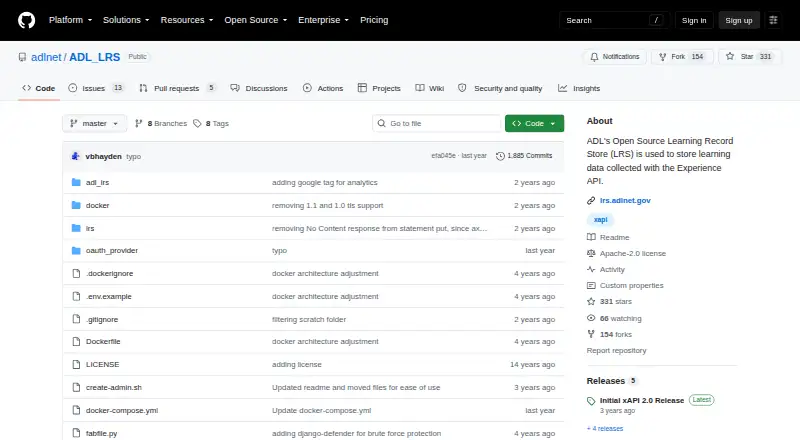
What ADL Open Source LRS is
ADL Open Source LRS stores learning data collected with the Experience API (xAPI). The repository says it was updated to match IEEE 9274.1.1, also known as xAPI 2.0, and describes this version as stable but intended for a small number of users as a proof of concept. It is free, open source, and distributed under the Apache License, Version 2.0. The project recommends Docker and Docker Compose for installation; its deployment includes a Django web service with uWSGI, an nginx HTTP/HTTPS proxy, PostgreSQL, RabbitMQ, and Redis. OAuth and statement webhooks are optional and disabled by default. Webhooks can filter incoming statements and send matches to a client endpoint, with optional HMAC signing. Celery handles activity metadata retrieval, statement voiding, and LRS hooks asynchronously. The database can be changed in settings.ini, and the Docker guide describes an included Certbot container for obtaining a certificate for a publicly available domain. It supports API, self-hosted, and web use, with record export through the API.
Who it suits
It suits teams exploring xAPI learning-data storage in a small proof-of-concept deployment. The project invites code contributions and issue submissions.
What it does well
- Free and open source under Apache License 2.0
- Updated to match IEEE 9274.1.1 (xAPI 2.0)
- Docker deployment includes database, proxy, and supporting services
- Optional filtered webhooks can use HMAC signing
What to know first
- Intended to support only a small number of users
- OAuth and webhooks are disabled by default
Limits
The free plan is a proof of concept intended to support a small number of users. OAuth and statement webhooks are off by default.
Plans
| Plan | Billed and limits | Price |
|---|---|---|
| ADL Open Source LRS | proof of concept · intended to support a small amount of users | Free |
As github.com lists them, read 4 Oct 2026. The maker's own page has the final word.
Getting started
- Open the ADL Open Source LRS repository at https://github.com/adlnet/ADL_LRS.
- Use a self-hosted deployment for the web service and API.
- Follow the project's recommended Docker and Docker Compose installation approach.
- Configure database settings in settings.ini if you need to change the database.
- Enable OAuth through OAUTH_ENABLED and register clients if OAuth is needed.
ADL Open Source LRS is a self-hosted repository for learning records collected through xAPI. It is best suited to teams building a small proof of concept who can operate their own infrastructure. Its open-source, configurable deployment is appealing, but the stated small-user scope makes it a poor choice for larger services.
Overview
The project says this version has been updated to IEEE 9274.1.1, also known as xAPI 2.0. It calls the release stable while describing it as intended for a small number of users in proof-of-concept work. That is a meaningful boundary: stability supports evaluation and limited use, but does not make this the right foundation for a service that needs to scale.
The software is distributed under the Apache License, Version 2.0, giving teams an open-source basis to configure and adapt it. The repository welcomes pull requests and suggests submitting an issue for users who do not want to edit code. This suits organizations willing to engage with a software project, rather than those seeking a managed service relationship.
Key features
Self-hosted deployment
Docker and Docker Compose are the recommended simplest installation route. The deployment brings together a Django web service running with uWSGI, an nginx HTTP/HTTPS proxy, PostgreSQL, RabbitMQ and Redis. Having the components packaged together reduces the burden of assembling a stack from scratch, but the resulting multi-service deployment still needs to be operated and maintained.
Database settings can be changed in settings.ini, which gives teams some control over installation configuration. The Docker guide also describes an included Certbot container for obtaining a certificate for a publicly available domain, with nginx restarted to use it. That is useful for a public deployment, though it remains the operator’s responsibility to run the host and deployment.
Integration controls and processing
OAuth is not enabled by default. Teams that need it must turn it on with the OAUTH_ENABLED setting and register clients with the LRS, so it is a configurable option rather than an out-of-the-box security setting.
Optional statement webhooks can filter incoming xAPI statements and forward matches to a client endpoint. They are disabled by default, and a webhook can include a secret so the LRS sends an HMAC hex digest in the X-LRS-Signature header. These controls can support integrations that need selective delivery and signature verification, but they require deliberate setup.
Celery handles activity-metadata retrieval, statement voiding and LRS-hook checks asynchronously. That separates these tasks from the immediate request flow, a useful design for this kind of processing. The repository does not position the project for high-volume operation, however; its small-user proof-of-concept scope remains the more important capacity constraint.
Pricing
ADL Open Source LRS costs nothing under its free plan, which is described as a proof of concept intended to support a small amount of users. There is no trial period to weigh against a paid subscription; the software is open source under Apache License 2.0. This is a strong fit for evaluation or a deliberately small deployment, but the free price should not be mistaken for a promise of production scale.
Platforms
The project supports API and web access and is self-hosted. That combination fits teams integrating xAPI data into their own systems and operating the service in their own environment, rather than buyers looking for a hosted LRS.
Who it's for
Choose ADL Open Source LRS for a small xAPI proof of concept when standards alignment, self-hosting and the ability to configure the deployment matter more than managed operations or room for a large user base. It is less suitable for organizations that need a hosted service, expect substantial growth, or do not want to maintain a multi-service stack.
Pros and cons
- Apache 2.0 open source: teams can use and adapt the software without a subscription price.
- Updated for xAPI 2.0: the stated alignment makes it relevant to teams working to that standard.
- Bundled Docker deployment: the recommended route packages the web service, proxy, database and supporting services, but still requires stack operations.
- Configurable integrations: optional OAuth and signed, filtered webhooks provide useful controls, though they are not enabled by default.
- Small-user proof-of-concept scope: this is the central drawback for teams planning a larger deployment.
Alternatives
Learning Record Store Software is the broader category to explore when comparing LRS options.
Consider Veracity Learning if you want a freemium alternative with a free Lite plan for five LRSs, based on your infrastructure. SQL LRS is another free, Apache 2.0, self-hosted option; its implementation and support services are quoted separately.
Cluelabs LRS is a freemium alternative with API, Android, iOS and web platforms, maintained by an eLearning company described as a provider of custom training solutions. Mosra offers a free launch-period plan with unlimited lessons and listed features and exports, with paid plans planned but not yet live.
xh is a free open-source command-line HTTP client, rather than an LRS. Jupiter offers a hosted Jove LRS free up to 1 million events per year. Ralph is a free, MIT-licensed LRS distributed as a Python package and Docker image. Sereni LRS may suit teams seeking a free plan with up to 100,000 xAPI statements or events, 1 GB of storage, unlimited LRSs, and unlimited reporting and analytics.
Verdict
ADL Open Source LRS is a sensible choice for technically capable teams that need a free, self-hosted xAPI 2.0 proof of concept and want control over configuration. The main reason to choose it is the combination of an open-source license and a packaged Docker deployment; the main reason to look elsewhere is its explicitly small-user scope, which makes it difficult to recommend for a growing or large-scale service.
Verdict
ADL Open Source LRS offers xAPI storage with a Docker deployment and optional integration controls. Its stated small-user proof-of-concept scope is an important limit for prospective adopters.
Questions
How much does ADL Open Source LRS cost?
The ADL Open Source LRS plan is free.
Is it open source?
Yes. The repository distributes it under the Apache License, Version 2.0.
What does it run on?
It is listed for API, self-hosted, and web platforms. The project recommends Docker and Docker Compose for installation.
Which xAPI standard does it support?
The repository says this version was updated to match IEEE 9274.1.1, also known as xAPI 2.0.
Does it include OAuth and webhooks by default?
OAuth is not enabled by default, and optional statement webhooks are disabled by default.
Facts from ADL Open Source LRS's own pages
- Asynchronous processing
- The project uses Celery to retrieve activity metadata, process statement voiding and check LRS hooks asynchronously. · github.com, 4 Oct 2026
- Database configuration
- The installation guide says the database can be changed through the database settings in settings.ini. · github.com, 4 Oct 2026
- Deployment
- The project recommends Docker and Docker Compose as the simplest installation method. · github.com, 4 Oct 2026
- Included services
- The Docker deployment includes a Django web service with uWSGI, an nginx HTTP/HTTPS proxy, PostgreSQL, RabbitMQ and Redis. · github.com, 4 Oct 2026
- License
- The repository distributes the software under the Apache License, Version 2.0. · github.com, 4 Oct 2026
- OAuth
- OAuth is not enabled by default; the wiki describes enabling it through the OAUTH_ENABLED setting and registering clients with the LRS. · github.com, 4 Oct 2026
- Purpose
- The LRS stores learning data collected with the Experience API (xAPI). · github.com, 4 Oct 2026
- Scale
- The project describes this version as stable but intended to support only a small number of users as a proof of concept. · github.com, 4 Oct 2026
- SSL
- The Docker installation guide describes an included Certbot container for obtaining a certificate for a publicly available domain and restarting nginx to use it. · github.com, 4 Oct 2026
- Standard
- The repository says the LRS was updated to match IEEE 9274.1.1, also known as xAPI 2.0. · github.com, 4 Oct 2026
- Statement webhooks
- Optional webhooks can filter incoming xAPI statements and send matching statements to a client endpoint; they are disabled by default. · github.com, 4 Oct 2026
- Support and contributions
- The repository invites contributions through pull requests and directs users who do not want to edit code to submit an issue. · github.com, 4 Oct 2026
- Webhook signing
- A webhook can optionally include a secret that the LRS uses to send an HMAC hex digest in the X-LRS-Signature header. · github.com, 4 Oct 2026
Where ADL Open Source LRS stands on Freedom251
- Learning Record Store Software#3 of 23