Freedom251 › Review Generation Software

Junip
What Junip is
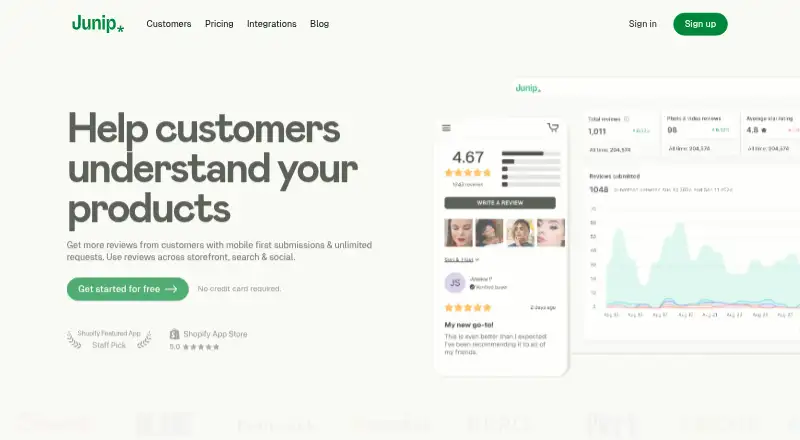
Junip helps ecommerce businesses gather customer product reviews and show them on storefronts, in search and across social channels. Automated review requests and unlimited orders are included on every plan. Its step-by-step mobile forms accept photo and video reviews, while customizable widgets, media galleries and carousels display reviews on websites. Review management includes analytics, public replies, customer editing, tagging, search and filtering. Listed integrations include Shopify, Klaviyo, Omnisend, Postscript, Drip, Attentive and Shopify Flow. Reviews can be syndicated to Google, Meta Shops, TikTok Shop, Shop App and Bazaarvoice. Junip also documents APIs for app integrations, review analysis and replies, webhooks, and custom displays. Plans are Free, Core at $29 a month, Growth at $79 a month, and Premium at $299 a month; a 7-day trial is listed. The Free plan has limited support and one storefront. Premium includes three storefronts, with additional stores at $99/mo each. Security measures include encryption, access controls, backups and customer data segregation.
Who it suits
Junip is built for ecommerce brands that want to collect and display product reviews across their storefront and other listed channels. It may suit Shopify businesses as well as teams using its listed marketing integrations or review APIs.
What it does well
- Unlimited review requests and orders on every plan.
- Mobile forms support photo and video reviews.
- Syndicates reviews to Google, Meta Shops and TikTok Shop.
- Includes analytics, replies, tagging, search and filtering.
- Offers a free plan and a 7-day trial.
What to know first
- Free plan support is limited.
- Free, Core and Growth include one storefront.
- Additional Premium storefronts cost $99/mo each.
- Premium costs $299 a month.
Limits
The Free plan includes one storefront and limited support. Paid plans start with Core at $29 a month; Free, Core, and Growth include one storefront, while Premium at $299 a month includes three. Additional Premium stores are priced at $99/mo each.
Plans
| Plan | Billed and limits | Price |
|---|---|---|
| Free | USD/mo · unlimited orders · unlimited review requests · on-site displays · automated request emails · analytics · review replies | Free |
| Core | USD/mo · everything in Free · incentivized reviews · product groups and bundles · Google review snippets · advanced on-site configuration · PDP media galleries | $29 a month |
| Premium | USD/mo · everything in Growth · Junip AI · review tagging · API and custom apps · multi-store management · organization-wide syndication | $299 a month |
| Growth | USD/mo · everything in Core · Google Shopping, Meta, TikTok Shop and Shop App syndication · Klaviyo/Postscript integrations · dynamic translations · custom questions · search/filter displays · media incentives | $79 a month |
As junip.co lists them, read 15 Oct 2026. The maker's own page has the final word.
Getting started
- Open https://junip.co/.
- Choose the Free plan or start the listed 7-day trial.
- Connect a storefront using an available integration, such as Shopify.
- Set up automated review requests and mobile review forms.
- Add a review widget, media gallery, or carousel to your website.
Junip is an ecommerce product-review platform for brands that want to collect customer feedback and use it across their storefronts and shopping channels. It is best suited to Shopify-focused businesses building a review program; its unlimited collection is a useful starting point, but syndication and advanced management sit behind higher-priced plans.
For a single-store brand, Junip covers the path from review request to on-site display. Businesses with several storefronts should weigh Premium’s included three against its monthly price and charge for each additional store.
Overview
Junip brings review collection, display, management, and distribution together for ecommerce brands. Automated requests and orders are unlimited on every plan, so the free tier does not impose a volume ceiling on collection. Shopify users can draw on existing product and customer data, while integrations with Klaviyo, Omnisend, Postscript, Drip, Attentive, and Shopify Flow connect Junip with listed marketing and commerce tools.
The trade-off is a clear feature ladder: Free covers basic collection and replies, while richer presentation, channel syndication, and API access require paid plans. That makes Junip a stronger fit for brands ready to invest in review operations than for businesses seeking a broad, low-cost multi-store setup.
Key features
Collection and display
Step-by-step forms designed for mobile support photo and video reviews, giving customers a way to contribute more than a rating and comment. Customizable widgets, galleries, and carousels let brands feature reviews on their sites. Free includes on-site displays; Core adds advanced configuration and media galleries on product detail pages, which is the relevant upgrade for brands that need more control over presentation.
Management and distribution
Free includes analytics and public replies. Junip also offers customer editing, tagging, search, and filtering, but the plan comparison places review tagging on Premium and search-and-filter displays on Growth. Growth is the tier for syndication to Google Shopping, Meta, TikTok Shop, and Shop App, alongside marketing integrations, dynamic translations, additional custom questions, and media incentives. Junip also lists Bazaarvoice as a syndication destination.
Premium adds Junip AI, API and custom apps, multi-store management, and syndication across stores in an organization. The documented APIs support app integrations, review analysis and replies, webhooks, and custom displays. Encryption at rest and in transit, access controls, backups, and customer-data segregation are part of Junip’s security measures.
Pricing
Junip has a free plan and a 7-day trial. Paid plans are billed monthly in USD; all include unlimited review requests and orders. The main distinction is what each tier adds, not how many reviews a brand can collect.
- Free — free: Includes on-site displays, automated request emails, analytics, and review replies. Its 1-storefront limit and limited support suit a single-store business establishing its review program, but not one needing advanced configuration or channel syndication.
- Core — $29 a month: Adds incentivized reviews, product groups and bundles, Google review snippets, advanced on-site configuration, and media galleries on product detail pages. It fits a single-store brand prioritizing review presentation and incentives; it does not include the Growth syndication bundle.
- Growth — $79 a month: Adds Google Shopping, Meta, TikTok Shop, and Shop App syndication, marketing integrations, dynamic translations, additional custom questions, searchable and filterable review displays, and media incentives. This is the practical choice for brands seeking wider distribution and richer display controls while remaining on one storefront.
- Premium — $299 a month: Adds Junip AI, review tagging, API and custom apps, multi-store management, and syndication across stores in an organization. It includes 3 storefronts; each additional store costs $99/mo. This tier is aimed at businesses needing API access or centralized multi-store operations, though the added-store charge matters as the footprint grows.
Email and chat support are listed, with limited support on Free. The paid tiers retain a 1-storefront allowance until Premium, so a business needing multiple stores should account for the Premium price rather than assume Growth scales beyond one.
Platforms
Junip is available on web and through an API. Its ecommerce orientation and Shopify integration make it most directly suited to brands operating storefronts, while API access is a Premium feature.
Who it's for
Junip is a good fit for ecommerce brands that want unlimited review collection, photo and video submissions, and on-site presentation in one service. Shopify businesses can benefit from its use of existing product and customer data. Free and Core suit single-store operators focused on collection and presentation; Growth is better for brands distributing reviews across shopping channels. Choose another approach if multiple storefronts are central but Premium’s three-store allowance and $99/mo additional-store charge do not fit the budget.
Pros and cons
Pros
- Unlimited requests and orders on every plan: Brands can collect reviews without a plan-level order or request cap.
- Useful collection and display formats: Mobile forms accept photo and video reviews, while widgets, galleries, and carousels support on-site presentation.
- Growth connects reviews to shopping channels: Its syndication destinations include Google Shopping, Meta, TikTok Shop, and Shop App.
- Premium supports technical and multi-store needs: API access, custom apps, and organization-wide syndication are included alongside multi-store management.
Cons
- Free support is limited: That may be a drawback for businesses relying on support while building their review process.
- Key capabilities require higher tiers: Syndication begins with Growth, while API access and multi-store management are Premium features.
- Multi-store scaling can add cost: Premium includes three storefronts, with each additional store priced at $99/mo.
Alternatives
- Judge.me is worth considering for a free plan that expressly includes unlimited review requests, a review widget, star-rating badge, CSV imports, and photo and video review requests; its Awesome plan is $15 a month.
- Yotpo Reviews may suit a business that prefers a lower paid entry point: Starter is $15 a month, while its Free plan is capped at 50 orders per month, 500 outgoing emails, and 200 kick-start credits.
- Loox is another freemium option with a free Beginner plan capped at 500 total orders and a $49 a month Convert plan.
- HiFiveStar offers a free-forever plan for one location with review monitoring, replies, review links and QR codes, and widgets.
- ReviewJet may fit teams looking for a paid service with a defined request quota and seat allowance: Starter is $49 a month for 1,000 requests a month, one seat, and one workspace.
- REVIEWS.io offers a free plan with 25 review invites per month; its Essentials plan includes 300 invites.
- Birdeye is an alternative with Android, iOS, web, and API platforms and pricing based on deployment across locations.
- Podium Webchat offers a free plan and custom quotes tailored to the business.
- Review Generation Software and Product Review Software are broader categories to browse when comparing options.
Verdict
Choose Junip if you run an ecommerce brand, especially on Shopify, and want unlimited review collection with a path from on-site displays to shopping-channel syndication. Growth is the strongest fit for a single store that needs distribution; Premium makes sense when API access or multi-store management is essential. Look elsewhere if you need those capabilities at a lower tier or expect to scale beyond three storefronts without an added monthly store charge.
Verdict
Junip combines review collection, display, management and syndication, with unlimited requests and orders across its plans. The free plan has limited support, and multi-store businesses should note Premium's three-store allowance and added-store charge.
Questions
Is Junip free?
Yes. Junip has a Free plan at no cost. It includes unlimited review requests and orders, on-site displays, automated review request emails, analytics, and review replies.
How much do Junip's paid plans cost?
Core costs $29 a month, Growth costs $79 a month, and Premium costs $299 a month.
Does Junip offer a trial?
Yes. A 7-day trial is listed.
Which platforms does Junip support?
The listed platforms are API and web.
Which integrations and review destinations are listed?
Integrations include Shopify, Klaviyo, Omnisend, Postscript, Drip, Attentive, and Shopify Flow. Syndication destinations include Google, Meta Shops, TikTok Shop, Shop App, and Bazaarvoice.
How many storefronts are included?
Free, Core, and Growth include one storefront. Premium includes three, and additional stores are priced at $99/mo each.
Facts from Junip's own pages
- Admin interfaces
- Junip offers a dedicated Admin, Shopify embedding and MCP/CLI/API access for review-management tasks. · junip.co, 15 Oct 2026
- AI feature
- The Premium tier includes Junip AI features including an AI sales agent and review summaries. · apps.shopify.com, 15 Oct 2026
- API
- Developer documentation covers OAuth, an Admin API v2 for analyzing and replying to reviews, webhooks for events, and API v1 for custom displays. · junip.co, 15 Oct 2026
- API plan gate
- Junip's help center says display API access is restricted to Premium merchants. · help.junip.co, 15 Oct 2026
- Audience
- Junip is built for ecommerce brands and its Shopify integration uses existing product and customer data. · junip.co, 30 Sept 2026
- Company facts
- LinkedIn lists Junip as a privately held Internet Publishing company headquartered in Kitchener, Ontario, founded in 2020, with 2–10 employees. · ca.linkedin.com, 15 Oct 2026
- Custom apps
- Junip announced support for third-party custom apps and integrations in its 2026 changelog. · changelog.junip.co, 15 Oct 2026
- Data permissions
- The Shopify listing says the app can access customer contact and device data and edit products, orders, discounts, analytics, themes and reviews. · apps.shopify.com, 15 Oct 2026
- Display features
- The app provides photo and video reviews, star ratings, voting, badges, carousels, galleries, grids, review pages, summaries, Q&A, grouping, filtering and rich snippets. · apps.shopify.com, 15 Oct 2026
- Documentation scope
- The help center is organized into collections for getting started, gathering reviews, displays, review management, catalog, syndication, integrations, settings, Junip 2.0 and Sales Agent. · help.junip.co, 15 Oct 2026
- Google Shopping requirement
- Google Shopping syndication requires at least 50 verified product reviews, matching catalogs and strong product identifiers. · help.junip.co, 15 Oct 2026
- Headless installation
- Headless sites can install Junip with a hosted JavaScript file, store-key markup and custom HTML widgets. · help.junip.co, 15 Oct 2026
- Headquarters
- 101 Spadina Avenue, Unit 207, Toronto, Ontario, Canada · junip.co, 28 Sept 2026
- Integrations
- Listed integrations include Shopify Flow, Attentive, Drip, Klaviyo, Omnisend, Postscript, Gorgias, Rivo, Rebuy, Replo, Rush and Wonderment. · junip.co, 15 Oct 2026
- Licence
- Junip's terms grant subscription users internal-use access and state Junip retains intellectual property in its service, APIs and documentation; third-party components may have separate open-source licences. · junip.co, 15 Oct 2026
- Limit: feature depth
- A Shopify reviewer said Junip should continue innovating and add more features despite its strong base. · apps.shopify.com, 15 Oct 2026
- Limit: language and performance
- AppNavigator summarizes complaints about missing language options, difficulty understanding the app and performance problems. · appnavigator.io, 15 Oct 2026
- Limit: third-party dependency
- Junip's terms disclaim responsibility for the security and availability of third-party platforms and provide services without an uninterrupted-service warranty. · junip.co, 15 Oct 2026
- Mobile forms
- Its step-by-step review forms are designed for mobile and support photo and video reviews. · junip.co, 30 Sept 2026
- Mobile review forms
- Junip markets mobile-first submission forms and reports 85% of reviews are submitted on phones. · junip.co, 15 Oct 2026
- On-site displays
- Junip offers customizable review widgets, media galleries, and review carousels for websites. · junip.co, 30 Sept 2026
- Photo/video collection
- Junip claims its forms collect 178% more photo and video reviews than legacy platforms. · junip.co, 15 Oct 2026
- Plan limits
- The pricing comparison lists 1 storefront for Free, Core, and Growth, and 3 included storefronts for Premium with additional stores priced at $99/mo each. · junip.co, 30 Sept 2026
- Praise: setup and migration
- Shopify reviewers repeatedly praise easy setup, migration from other review tools and straightforward onboarding. · apps.shopify.com, 15 Oct 2026
Where Junip stands on Freedom251
- Review Generation Software#2 of 31
- Product Review Software#5 of 23