Freedom251 › AI Book Writing Software

Jenova Creative Fiction Writer
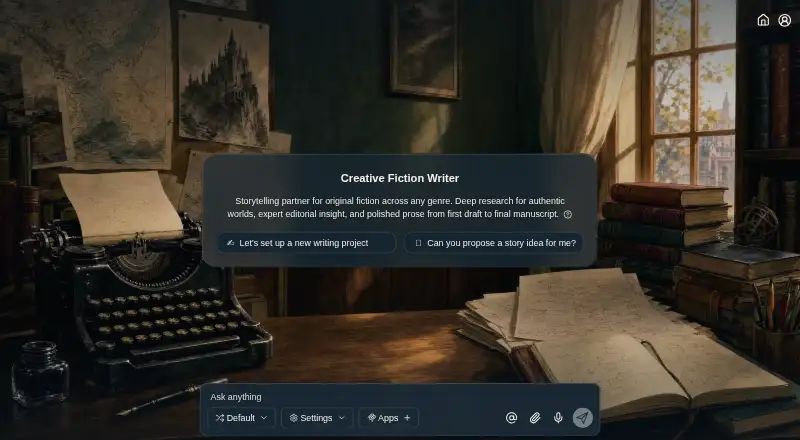
What Jenova Creative Fiction Writer is
Jenova Creative Fiction Writer is a storytelling assistant for fiction writers, with tools for brainstorming, drafting, research, and revision. Its Planning, Writing, and Critique modes address different parts of a project, while persistent memory is intended to carry character details, plot, world rules, and voice decisions across sessions. The service describes real-time research with cited sources and access to multiple models, naming GPT-5.4, Claude Opus 4.6, Gemini 3.1 Pro Preview, xAI, and DeepSeek. It supports book outlining, a chapter workspace, continuity tools, rewrite controls, and exports to PDF, Word, text, CSV, and images. The web service is also available through iOS and Android apps, which support voice input. Integrations through the Model Context Protocol include Gmail, Google Calendar, Google Drive, Notion, and Dropbox. The free plan has limited usage; Plus costs $20/mo. Jenova says its own models are not trained on prompts, outputs, chat history, uploaded files, agent instructions, or knowledge bases.
Who it suits
Jenova recommends it for writers developing research-dependent novels across multiple sessions who want to switch among AI models. It may also suit writers who want outlining, continuity, and revision tools in one workspace.
What it does well
- Planning, Writing, and Critique modes
- Persistent memory for characters, plot, and world rules
- Research includes cited sources
- Mobile apps support voice input
- Exports to PDF, Word, text, CSV, and images
What to know first
- Free plan has limited usage
- No visual beat board or scene-level corkboard
- No compile-to-EPUB export
- Data is processed in the United States and other jurisdictions
Limits
The Free plan includes core features with limited usage. Plus costs $20 a month and includes 30× Free usage; higher paid plans list progressive usage scaling, with Enterprise at 1,500× Free usage.
Plans
| Plan | Billed and limits | Price |
|---|---|---|
| Free | core features · limited daily usage · no credit card | Free |
| Pro | monthly · 100× usage · dedicated support · unlimited chat history · persistent memory | $100 a month |
| Enterprise | monthly · enterprise tier · higher usage than Ultra | $1,000 a month |
| Plus | monthly · 20× usage · custom model selection · unlimited chat history · persistent memory | $20 a month |
| Max | monthly · 200× usage · priority support · unlimited chat history · persistent memory | $200 a month |
| Premium | monthly · higher usage than Plus | $50 a month |
| Ultra | monthly · higher usage than Max | $500 a month |
As jenova.ai lists them, read 19 Oct 2026. The maker's own page has the final word.
Getting started
- Open https://www.jenova.ai/a/creative-fiction-writer.
- Choose the Free plan or a paid plan.
- Use the web app or the Android or iOS app.
- Choose Planning, Writing, or Critique mode for your task.
- Use book outlining, the chapter workspace, continuity tools, or rewrite controls.
- Export finished work to PDF, Word, text, CSV, or images.
Jenova Creative Fiction Writer is an AI-supported workspace for fiction planning, drafting, research, and revision. It is best suited to novelists managing research and story continuity over multiple sessions who want to choose among AI models. Its connected text workflow is compelling, but writers who depend on visual scene boards or EPUB export should look elsewhere.
Overview
Planning, Writing, and Critique modes address different stages of a project, backed by book outlining, a chapter workspace, continuity tools, and rewrite controls. The practical strength is persistent memory: it is designed to carry characters, plot, world rules, and voice decisions across sessions, helping writers maintain consistency as a project grows. That is more useful for long-running stories than for writers who mainly need occasional passage generation.
Research-dependent fiction gets real-time research with cited sources. Jenova also provides access to GPT-5.4, Claude Opus 4.6, Gemini 3.1 Pro Preview, xAI, and DeepSeek. The range is useful for writers who want to switch models within one platform; it is less of a draw if model choice is not part of the workflow. The trade-off is a text-first setup: there is no visual beat board or scene-level corkboard, and no compile-to-EPUB export.
Key features
Planning, drafting, and continuity
Book outlining and Planning mode support story development before drafting, while the chapter workspace provides a place to work through a manuscript and rewrite controls support revision. Persistent memory is intended to keep core story decisions available between sessions. Writers who plan by physically rearranging scenes on a board will miss that visual layer.
Research, models, and integrations
Cited real-time research can help with novels built around subjects that require outside context. Multi-model access offers a choice of named providers and models rather than locking the workflow to one model family. Jenova also supports integrations through the Model Context Protocol, including Gmail, Google Calendar, Google Drive, Notion, and Dropbox. These integrations broaden how the platform can connect with other services, though the core creative workflow remains centered on writing.
Mobile and privacy
The writing agent is available through iOS and Android apps, with voice input, as well as on the web. The privacy policy says prompts, outputs, chat history, uploaded files, agent instructions, and knowledge bases are not used to train Jenova’s own models. It also says primary user interactions are not reviewed by humans, while allowing limited access for legal compliance, security, or technical debugging. Data is transferred to, stored on, and processed using infrastructure in the United States and other jurisdictions where service providers operate.
Pricing
Jenova uses a freemium model: the Free plan costs nothing and includes all core features with limited usage. It is a sensible way to assess the workflow, but its usage cap may constrain sustained writing. Plus costs $20 a month and provides 30× usage versus Free, custom model selection, and no watermarks, making it the clearest step up for regular users who want to choose their model.
Premium costs $50 a month, Pro $100 a month, and Max $200 a month; each offers progressive usage scaling. These tiers suit writers whose main need is more usage, although the plan descriptions do not distinguish additional features. Ultra costs $500 a month, also with progressive usage scaling. Enterprise costs $1,000 a month and provides 1,500× free usage, for users with substantially higher needs. The published pricing does not give renewal terms or seat counts.
Platforms
Jenova supports web, Android, and iOS. Mobile access includes voice input, which can suit writers who want to use the agent away from a desktop.
Who it's for
Jenova is aimed at writers working on research-dependent novels across multiple sessions who value continuity and want to switch among AI models. Its outline, chapter workspace, and revision controls also make it relevant to writers seeking one text-centered environment for several stages of fiction development. It is a weaker fit for authors who need a visual beat board, scene corkboard, or EPUB compilation as part of their process.
Pros and cons
- Persistent story memory: Carries characters, plot, world rules, and voice decisions across sessions, addressing continuity needs in longer projects.
- Research with citations: Supports fiction work involving subjects that need research, with cited sources.
- Model choice and mobile access: Named model options plus iOS and Android apps with voice input offer flexibility in how writers work.
- No visual scene boards: Writers who develop stories by arranging beats or scenes visually will need another tool or method.
- No EPUB compilation: Authors who need an ebook-ready compilation workflow will have to handle that elsewhere.
- Limited free usage: The Free plan includes core features but caps usage, so sustained work may require a paid tier.
Alternatives
AI Book Writing Software is a directory of options for readers comparing tools across the category.
Choose Pendraic if you want a free plan with up to three active books, a full editor and worldbuilder, plus one AI cover and one world map per day; it also supports macOS, Windows, and web.
AIWriteBook Audiobook Studio is another freemium alternative.
BookBud.ai is another freemium alternative.
Choose Bookwiz if EPUB export matters: its free plan supports up to three books and includes KDP-ready EPUB, print PDF, DOCX, and a cover, alongside limited AI prompts and autocompletes.
Calliope is another freemium alternative.
FireQuill is another freemium alternative.
Keter Labs is another freemium alternative.
Manuscripts.ai is another freemium alternative.
Verdict
Choose Jenova if you are writing a research-dependent novel across sessions and want persistent story context alongside a choice of AI models. Its planning, research, drafting, and revision tools bring those needs into one text-focused workflow. Look elsewhere if visual scene arrangement or compile-to-EPUB export is central to how you develop and finish a book.
Verdict
Jenova brings planning, research, drafting, and continuity features together for fiction projects. Its missing visual boards and EPUB compilation may matter to writers who rely on those workflows.
Questions
Is there a free plan?
Yes. The Free plan costs nothing and includes all core features with limited usage.
How much does Plus cost?
Plus costs $20 a month. It includes 30× usage versus Free, custom model selection, and no watermarks.
Which platforms are available?
The product is available on the web, Android, and iOS. The mobile apps support voice input.
Which models does Jenova name?
It names GPT-5.4, Claude Opus 4.6, Gemini 3.1 Pro Preview, xAI, and DeepSeek.
What export formats are supported?
Listed formats are PDF, Word, text, CSV, and images.
How does Jenova describe its use of user content for model training?
Its privacy policy says prompts, outputs, chat history, uploaded files, agent instructions, and knowledge bases are not used to train Jenova’s own models.
Facts from Jenova Creative Fiction Writer's own pages
- API
- The public Agent API uses the base URL https://api.jenova.ai/v1 and Bearer-token authentication. · jenova.ai, 19 Oct 2026
- API billing
- API usage consumes credits according to models, tools, and storage, with no fixed license or minimum commitment stated. · jenova.ai, 19 Oct 2026
- API capabilities
- The API supports persistent sessions, streaming Server-Sent Events, synchronous responses, file attachments, model overrides, and additional request context. · jenova.ai, 19 Oct 2026
- API extensibility
- Custom agents can use instructions, selected models, uploaded knowledge bases, tools, and MCP servers. · jenova.ai, 19 Oct 2026
- API limitation
- The documentation says API creation and editing of agents is not yet supported and scheduled or background workflows are not yet available. · jenova.ai, 19 Oct 2026
- API models
- The API provides one endpoint for models from OpenAI, Anthropic, Google, xAI, DeepSeek, and other providers. · jenova.ai, 19 Oct 2026
- Company facts
- LinkedIn lists Jenova as privately held, founded in 2024, headquartered in New York, and having one employee. · linkedin.com, 19 Oct 2026
- Company legal name
- Crunchbase identifies the legal name as Azeroth Inc. and lists Boris Wang as founder. · crunchbase.com, 19 Oct 2026
- Continuity
- Jenova says persistent memory carries characters, plot, world rules, and voice decisions across sessions. · jenova.ai, 29 Sept 2026
- Data location
- The privacy policy says data is transferred to, stored on, and processed using infrastructure in the United States and other jurisdictions where service providers operate. · jenova.ai, 29 Sept 2026
- Documentation depth
- The API reference covers authentication, messages, sessions, runs, credits, agents, models, streaming, MCP, billing, rate limits, errors, pagination, localization, privacy, and support. · jenova.ai, 19 Oct 2026
- Feature: character development
- It builds characters with motivations, voices, and internal contradictions. · jenova.ai, 19 Oct 2026
- Feature: continuity
- Persistent memory is intended to retain cast, timeline, planted details, and rules across an entire manuscript. · jenova.ai, 19 Oct 2026
- Feature: editorial critique
- It gives feedback on story structure, pacing, characterization, and prose weaknesses. · jenova.ai, 19 Oct 2026
- Feature: model choice
- The product page lists access to GPT-5.4, Claude Opus 4.6, and Gemini 3.1 Pro Preview. · jenova.ai, 19 Oct 2026
- Feature: prose drafting
- It drafts prose while maintaining a requested style, tone, and point of view. · jenova.ai, 19 Oct 2026
- Feature: research
- It researches settings, historical periods, and technical subjects for authenticity. · jenova.ai, 19 Oct 2026
- Feature: story premises
- It generates story premises, plot structures, and scene-by-scene outlines. · jenova.ai, 19 Oct 2026
- Feature: workflow
- The documented workflow is planning, writing, and critique, followed by collaborative revision across multiple passes. · jenova.ai, 19 Oct 2026
- Funding
- Crunchbase shows one angel funding round but does not expose the amount publicly on the page. · crunchbase.com, 19 Oct 2026
- Headquarters
- New York, United States · jenova.ai, 28 Sept 2026
- Human access
- The privacy policy says primary user interactions are not reviewed by humans, with limited access allowed for legal compliance, security, or technical debugging. · jenova.ai, 29 Sept 2026
- Integrations
- Jenova documents MCP connections for Gmail, Google Calendar, Google Drive, Search, Notion, Dropbox, and remote MCP servers. · jenova.ai, 19 Oct 2026
- Limitations
- Jenova’s comparison says Creative Fiction Writer has no visual beat board or scene-level corkboard and does not offer compile-to-EPUB export. · jenova.ai, 29 Sept 2026
Where Jenova Creative Fiction Writer stands on Freedom251
- AI Book Writing Software#3 of 27