Freedom251 › Podcast Website Builders

Jellypod
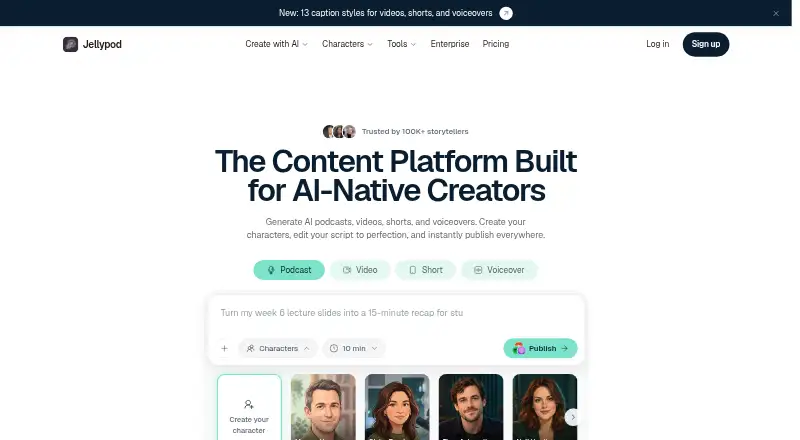
What Jellypod is
Jellypod turns ideas, documents, and scripts into podcasts, videos, short clips, and voiceovers with AI. Its podcast agent can research a topic or source, write a script for multiple hosts, generate audio, and let you revise individual lines with regenerated audio. For video, it makes narrated illustrations in 16 visual styles, plus vertical shorts of 30 seconds or one minute with animation and synchronized captions. A library of more than 3,300 voices in 121 languages supports narration; you can also design characters or clone your own voice.
Each podcast show comes with a hosted website and RSS feed for distribution to Spotify, Apple Podcasts, and YouTube. Developers can use a REST API and OpenAPI spec, while an MCP server connects Jellypod with AI assistants; API access is included on Creator and higher plans. Generating narration and visuals uses credits: 30 per audio minute, 7 per image, and 20 per video clip. Rendering, publishing, and downloading do not use credits. Jellypod says creators own their output and their content is not used to train AI models. The service is available on the web, iOS, and through an API.
Who it suits
Jellypod may suit independent creators, marketers, teachers, training teams, and small businesses that want to produce podcasts or narrated video from written material. Developers and enterprise teams may also find its API, MCP server, and enterprise identity options relevant.
What it does well
- Creates podcasts, illustrated videos, shorts, and voiceovers from ideas or scripts.
- Podcast agent researches sources and generates multi-host scripts and audio.
- More than 3,300 voices are available across 121 languages.
- Podcast shows include a website and RSS feed.
- Rendering, publishing, and downloading are free of credits.
What to know first
- Starter is $25/mo billed annually.
- Generating narration and visuals consumes credits.
- API access starts with Creator, at $50/mo billed annually.
Limits
Starter, the lowest paid plan listed, includes 5,000 credits per month, two automations, 10 AI characters, and two voice clones. It limits podcasts to 60 minutes, shorts and video to 15 minutes, and voiceovers to 20 minutes.
Plans
| Plan | Billed and limits | Price |
|---|---|---|
| Free | Free hosting · Dedicated podcast website | Free |
| Starter | yearly as $300 · 5,000 credits/mo · 2 automations · 10 AI characters · 2 voice clones · podcasts up to 60m · shorts and video up to 15m · voiceovers up to 20m | $25 a month |
| Creator | yearly as $600 · 11,000 credits/mo · 10 automations · unlimited AI characters · 8 voice clones · 2 seats · API access · podcasts up to 60m · shorts and video up to 20m · voiceovers up to 30m | $50 a month |
| Business | yearly as $1,500 · 30,000 credits/mo · unlimited automations · custom website domain · 20 voice clones · 5 seats · shorts and video up to 25m · podcasts and voiceovers up to 60m · priority support | $125 a month |
| Enterprise | Custom pricing · Unlimited credits · unlimited episode length · enterprise SSO · custom contracts · dedicated support and SLA · enterprise-grade security | On request |
As jellypod.com lists them, read 20 Sept 2026. The maker's own page has the final word.
Getting started
- Open the Jellypod website or use its iOS platform.
- Choose a plan; a 7-day trial is available.
- Provide an idea, document, script, or source for podcast creation.
- Select voices or design characters, then generate narration and visuals.
- Publish a podcast show with its hosted website and RSS feed.
Jellypod is an AI production service for turning source material into podcasts, narrated videos, shorts, and voiceovers. It will suit creators and teams looking to publish across formats, but generation credits and paid-plan limits make it a more considered purchase than a casual experiment.
Overview
Its podcast agent can research a topic or source, write a multi-host script, generate audio, and let you revise individual lines by regenerating their audio. Jellypod also makes illustrated videos, short vertical clips, and voiceovers, then gives podcast shows a hosted website and RSS feed for distribution to Spotify, Apple Podcasts, and YouTube. The appeal is a connected production and publishing workflow; the trade-off is that generation consumes credits and output lengths depend on the plan.
Key features
Production across formats
Narrated videos can use 16 visual styles, while vertical shorts run 30 seconds or one minute and pair animated visuals with synchronized captions. Line-level script edits are useful when a passage needs correction without regenerating an entire episode. Plan caps range from 60-minute podcasts on Starter and Creator to unlimited episode length on Enterprise; maximum video and voiceover lengths also vary.
Voices, distribution, and developer tools
The voice library spans more than 3,300 voices in 121 languages. Users can design characters and clone their own voices, with clone allowances increasing on higher plans. Hosted websites and RSS feeds support distribution to major podcast platforms without requiring a separate hosting service. Developers can use a REST API and OpenAPI spec, and AI assistants can connect through an MCP server; API access is included from Creator upward.
Credits, privacy, and support
Narration costs 30 credits per audio minute, generated images cost 7 credits each, and generated video clips cost 20 credits each. Rendering, publishing, and downloading are free, so the monthly credit allowance is the main production constraint. Jellypod says customers own their created content and that it does not train AI models on it. Enterprise data is encrypted in transit and at rest, with database and storage isolation and role-based access controls; the service also supports GDPR and CCPA obligations. Enterprise adds SSO through SAML 2.0 or OIDC and SCIM provisioning. Support is available through in-app chat or email; Business adds priority support and a dedicated Slack channel.
Pricing
Jellypod’s paid plans are billed yearly, despite monthly price presentation, and it offers a 7-day trial. The Free plan costs nothing and provides free hosting and a dedicated podcast website, but it is not a free production plan.
- Starter — $25 a month, billed yearly as $300. Includes 5,000 credits per month, 2 automations, 10 AI characters, 2 voice clones, podcasts up to 60 minutes, shorts and video up to 15 minutes, and voiceovers up to 20 minutes. It suits solo creators with modest, bounded output, but has no API access.
- Creator — $50 a month, billed yearly as $600. Includes 11,000 credits per month, 10 automations, unlimited AI characters, 8 voice clones, 2 seats, API access, podcasts up to 60 minutes, shorts and video up to 20 minutes, and voiceovers up to 30 minutes. The extra credits and API make it the stronger fit for a small production team or developer, though it remains limited to two seats.
- Business — $125 a month, billed yearly as $1,500. Includes 30,000 credits per month, unlimited automations, a custom website domain, 20 voice clones, 5 seats, shorts and video up to 25 minutes, podcasts and voiceovers up to 60 minutes, and priority support. It is aimed at teams needing more throughput and a branded site, but still has fixed credits and seat limits.
- Enterprise — custom pricing. Includes unlimited credits, unlimited episode length, enterprise SSO, custom contracts, dedicated support and SLA, and enterprise-grade security. It is the fit for organizations needing identity controls and negotiated terms rather than a set-price plan.
Because narration and visuals draw from the same monthly credit allowance, frequent video or image generation can use credits quickly. Choose a tier based on the formats and lengths you expect to produce, not just its seat count.
Platforms
Jellypod is available on web and iOS, and it offers an API. That combination serves browser-based production, mobile access, and integrations, while API access itself is included from Creator upward.
Who it's for
Jellypod identifies independent creators, teachers, training teams, marketers, small businesses, healthcare communicators, nonprofits, enterprise teams, and developers among its intended users. Its broad format support is most compelling when one subject or source needs to become a podcast plus video or short-form content. A buyer focused only on listening, or seeking a no-cost way to produce, should look elsewhere.
Pros and cons
- Pros: One workflow covers podcast scripting and audio, narrated video, shorts, voiceovers, and hosted podcast distribution.
- Pros: A large multilingual voice library, character design, and voice cloning offer options for distinct narration styles.
- Pros: Line-level audio regeneration can make targeted script corrections less disruptive.
- Cons: There is no free production plan; the free tier is limited to hosting and a podcast website.
- Cons: Monthly credits cover narration and visuals, so high-volume or visually rich production can be constrained even when rendering and publishing are free.
- Cons: API access starts at Creator, and custom domains start at Business, putting both beyond the entry paid tier.
Alternatives
For a simpler podcast-focused option, 302 AI Podcast Generator has free basic tool usage and runs on Linux, macOS, Windows, and the web.
Podhoc offers a free plan with 50 welcome credits, one source per podcast, two supported languages, and episodes public by default; it is worth considering if those limits fit your needs.
AnyPod is a free listening app with a full catalog, offline listening, and speed control, rather than a production suite.
AudioPod AI offers a free Basic plan with 1,000 credits per month, about three minutes of text-to-speech, about one minute of music, and uploads up to 500 MB.
Tider provides unlimited on-device podcasts and summaries, unlimited cloud audiobooks, and document and URL uploads on its free plan.
Paper2Pod is an alternative for turning material into podcasts, with a Pro plan at $2.99 a month that includes all Free features, all lengths, research overviews, and priority support.
Podcastfy is a free, open-source Python package for developers who prefer a self-hosted option.
Sprep has a free plan limited to one 15-minute episode, one language, and audio with a watermark.
Browse AI Podcast Generators for more production tools, Podcast Website Builders for site-focused options, Explainer Video Software for video alternatives, or Podcast Cover Maker Software for cover design tools.
Verdict
Jellypod is a strong fit for creators and organizations that want AI-assisted production across podcasts, video, shorts, and voiceovers, with podcast hosting and distribution in the same service. Its main advantage is that breadth; its main drawback is the combination of credit-based generation, plan caps, and no free production tier. Choose it when cross-format production matters more than keeping costs or workflows minimal.
Verdict
Choose Jellypod if you want one service for AI-assisted podcast, video, shorts, and voiceover creation, with hosted podcast distribution included.
Questions
Is Jellypod free?
The pricing note mentions a Free plan, but the Free plan field says no.
How much does Jellypod cost?
Starter is $25 per month billed yearly as $300. Creator is $50 per month billed yearly as $600, and Business is $125 per month billed yearly as $1,500. Enterprise uses custom pricing.
Is there a free trial?
Yes. The listed trial lasts 7 days.
What platforms does Jellypod support?
The listed platforms are API, iOS, and web.
Can I use an API with Jellypod?
Jellypod offers a REST API and OpenAPI spec, as well as an MCP server for AI assistants. API access is listed for Creator and higher plans.
Who owns the content I create?
Jellypod says users own the content they create and that it does not train AI models on their content.
Facts from Jellypod's own pages
- API and MCP
- Jellypod offers a REST API and OpenAPI spec for developers, plus an MCP server for AI assistants; API access is listed for Creator and higher plans. · jellypod.com, 8 Oct 2026
- Compliance
- Jellypod says it supports GDPR and CCPA obligations, including data processing agreements, erasure, and data portability. · jellypod.com, 8 Oct 2026
- Content ownership
- Jellypod says users own the content they create and that it does not train AI models on their content. · jellypod.com, 8 Oct 2026
- Credits
- Credits are charged for generating narration and visuals at 30 credits per audio minute, 7 per generated image, and 20 per generated video clip; rendering, publishing, and downloading are free. · jellypod.com, 8 Oct 2026
- Enterprise identity
- Enterprise supports SSO via SAML 2.0 or OIDC and SCIM provisioning. · jellypod.com, 8 Oct 2026
- Intended users
- Jellypod identifies teachers, training teams, marketers, small businesses, healthcare communicators, independent creators, nonprofits, enterprise teams, and developers among its users. · jellypod.com, 8 Oct 2026
- Podcast creation
- Its podcast agent can research a topic or source, write a multi-host script, generate audio, and let users edit lines and regenerate changed audio. · jellypod.com, 8 Oct 2026
- Product
- Jellypod turns ideas, documents, and scripts into podcasts, videos, shorts, and voiceovers using AI. · jellypod.com, 8 Oct 2026
- Publishing integrations
- Podcast shows include a hosted website and RSS feed for distribution to Spotify, Apple Podcasts, and YouTube. · jellypod.com, 8 Oct 2026
- Security
- Enterprise data is encrypted at rest and in transit, organizations are isolated at the database and storage layers, and role-based access controls apply. · jellypod.com, 8 Oct 2026
- Support
- Users can contact support through in-app chat or [email protected], while Business includes priority support and a dedicated Slack channel. · jellypod.com, 8 Oct 2026
- Video and shorts
- Jellypod creates narrated illustrated videos in 16 visual styles and vertical 30-second or one-minute shorts with animated visuals and synchronized captions. · jellypod.com, 8 Oct 2026
- Voice library
- Users can choose from more than 3,300 voices across 121 languages, design characters, and clone their own voice. · jellypod.com, 8 Oct 2026
Where Jellypod stands on Freedom251
- Podcast Website Builders#15 of 28
- AI Podcast Generators#17 of 23
- Explainer Video Software#30 of 40
- Podcast Cover Maker Software#34 of 35