Freedom251 › AI Podcast Generators
Podcastfy
What Podcastfy is
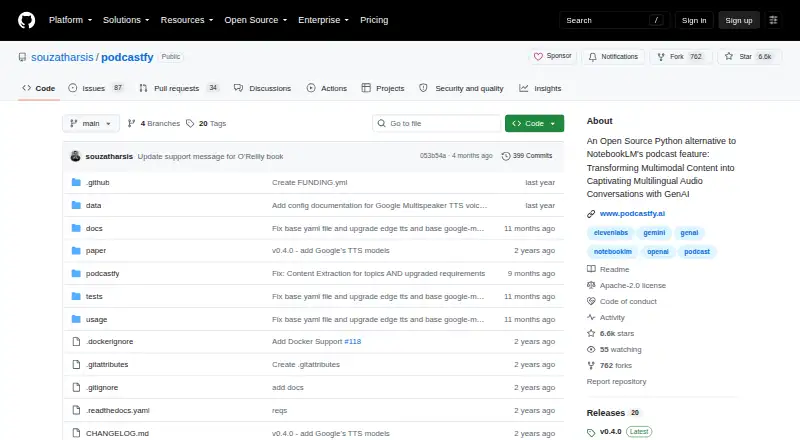
Podcastfy is a free, open-source Python package that turns source material into multilingual audio conversations using generative AI. It accepts websites, PDFs, images, YouTube videos, text, transcript files, and user-provided topics; topic generation can use grounded real-time web search. Users can tailor the format, style, voices, language, and structure, and generate short podcasts of 2–5 minutes or longform episodes of 30 minutes or more. Transcript generation supports more than 100 language models, including OpenAI, Anthropic, and Google models. Listed text-to-speech options include OpenAI, Google, ElevenLabs, and Microsoft Edge. Local LLMs can be used for transcript generation, which the project says offers more privacy and control. Podcastfy provides Python package and command-line use, plus a beta FastAPI service for URLs. Audio exports as MP3. API key requirements depend on the selected transcript and audio models, though a documented local LLM with Edge TTS setup needs no keys. Setup requires Python 3.11 or higher and ffmpeg. Podcastfy is licensed under Apache 2.0.
Who it suits
Podcastfy may suit content creators, educators, researchers, and accessibility advocates who want to turn source material into audio conversations. It is intended for people comfortable setting up a Python package or command-line tool.
What it does well
- Accepts websites, PDFs, images, videos, text, and topics.
- Supports more than 100 transcript-generation models.
- Local LLM and Edge TTS setup needs no API keys.
- Exports generated audio as MP3.
- Licensed under Apache 2.0.
What to know first
- Requires Python 3.11 or higher.
- Requires ffmpeg for audio processing.
- API key needs vary by selected models.
- FastAPI deployment is documented as beta for URLs.
Limits
The listed free package plan costs nothing, and no usage allowance is stated. The quickstart requires Python 3.11 or higher and ffmpeg; Google's multispeaker TTS is limited to English and needs extra setup.
Plans
| Plan | Billed and limits | Price |
|---|---|---|
| Podcastfy open-source Python package | No paid plan or usage allowance is stated on the opened maker pages. | Free |
As github.com lists them, read 8 Oct 2026. The maker's own page has the final word.
Getting started
- Install Podcastfy as a Python package or use its command-line interface.
- Use Python 3.11 or higher and install ffmpeg for audio processing.
- Choose source material such as a website, PDF, image, YouTube video, text, transcript file, or topic.
- Select transcript and audio models; provide API keys as required, or use the documented local LLM with Edge TTS setup without keys.
- Configure format, style, voices, language, and structure, then generate and export the audio as MP3.
- For URL use, consult the documented beta FastAPI deployment.
Verdict
Podcastfy combines a broad range of source inputs with customizable multilingual audio generation and multiple model options. Getting started requires Python 3.11 or higher and ffmpeg, and some model combinations require API keys.
Questions
How much does Podcastfy cost?
The listed open-source Python package plan is free. It is described as a free plan, with no paid plan or usage allowance stated.
What can Podcastfy turn into a podcast?
It accepts websites, PDFs, images, YouTube videos, raw text, transcript files, and user-provided topics. Topic-based generation can use grounded real-time web search.
Which platforms and interfaces does it offer?
Podcastfy is available as a Python package and CLI. A beta FastAPI deployment is documented for URLs; its listed platforms are API and self-hosted.
Does Podcastfy require API keys?
Key requirements depend on the transcript and audio models selected. A documented setup using a local LLM with Edge TTS requires no API keys.
Is Podcastfy open source, and what license does it use?
Yes. The project is licensed under Apache 2.0.
What do I need to get started?
The quickstart requires Python 3.11 or higher and ffmpeg for audio processing.
Facts from Podcastfy's own pages
- API key requirements
- API keys depend on the selected transcript and audio models; the configuration guide also lists a Local LLM with Edge TTS setup requiring no API keys. · github.com, 7 Oct 2026
- API keys
- The configuration guide says API key requirements depend on the selected transcript and audio models; its default setup uses Gemini and OpenAI keys. · github.com, 8 Oct 2026
- Customization
- Users can customize conversation format, style, voices, transcript, audio, language, and structure. · github.com, 8 Oct 2026
- Generation from topics
- The project says it can generate podcasts from a topic using grounded real-time web search. · github.com, 8 Oct 2026
- Inputs
- It accepts websites, PDFs, images, YouTube videos, text, and user-provided topics. · github.com, 7 Oct 2026
- Input sources
- It accepts websites, PDFs, images, YouTube videos, text, and user-provided topics as input. · github.com, 8 Oct 2026
- Interfaces
- The project provides Python package and CLI usage, and documents a FastAPI deployment as beta for URLs. · github.com, 7 Oct 2026
- Language models
- The project says transcript generation supports more than 100 models, including OpenAI, Anthropic, and Google models. · github.com, 8 Oct 2026
- License
- The project is licensed under Apache 2.0. · github.com, 7 Oct 2026
- License and audience
- The software is licensed under Apache 2.0, and the README describes use cases for content creators, educators, researchers, and accessibility advocates. · github.com, 8 Oct 2026
- Local models
- Podcastfy supports local LLMs for transcript generation and describes them as providing increased privacy and control. · github.com, 8 Oct 2026
- No-key option
- The configuration guide gives an example combining a local LLM with Edge text to speech that requires no API keys. · github.com, 8 Oct 2026
- Podcast length
- It can generate short podcasts of 2–5 minutes or longform podcasts of 30 minutes or more. · github.com, 8 Oct 2026
- Prerequisites
- The quickstart requires Python 3.11 or higher and ffmpeg for audio processing. · github.com, 8 Oct 2026
- Requirements
- The quickstart lists Python 3.11 or higher and ffmpeg for audio processing as prerequisites. · github.com, 7 Oct 2026
- Text to speech
- Supported text-to-speech options listed include OpenAI, Google, ElevenLabs, and Microsoft Edge. · github.com, 8 Oct 2026
- TTS limitation
- The configuration guide says Google’s multispeaker TTS model is limited to English and needs extra setup. · github.com, 8 Oct 2026
- Ways to use it
- The README documents installation as a Python package, a command-line interface, and a beta FastAPI service for URLs. · github.com, 8 Oct 2026
- What it does
- Podcastfy is an open-source Python package that turns multimodal content into multilingual audio conversations using generative AI. · github.com, 8 Oct 2026
- Who it is for
- The project lists content creators, educators, researchers, and accessibility advocates as example users. · github.com, 7 Oct 2026
Where Podcastfy stands on Freedom251
- AI Podcast Generators#9 of 23