Freedom251 › AI Podcast Generators
PersonaPod
What PersonaPod is
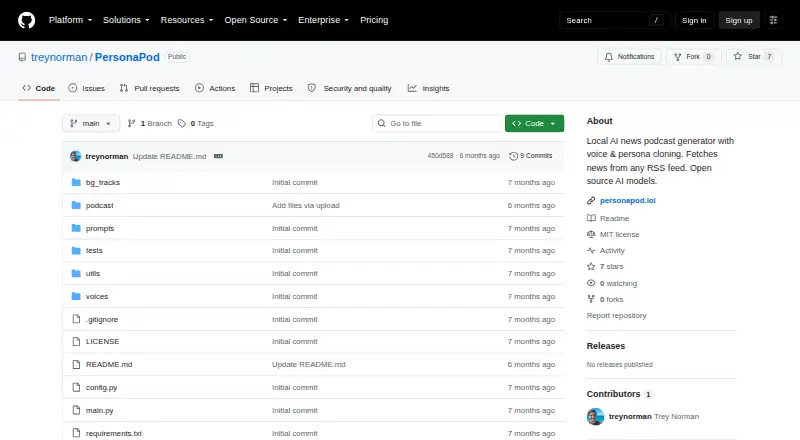
PersonaPod generates news podcast episodes from RSS feeds by extracting and summarizing linked articles, then voicing each segment with a cloned voice and selected persona. The open-source project runs locally on open-source AI models and includes a browser player for listening. Users can set a persona prompt, voice sample, episode title and image, and optionally add background music; audio is exported as MP3. Its Docker-managed services document llama.cpp for language-model inference and MaskGCT for text-to-speech, with voice cloning from a sample of about 5–10 seconds. Generated episodes are uploaded to cloud storage and a public podcast RSS feed is updated. Setup uses Python, Docker, ffmpeg, local AI services, and a configured Cloudflare R2 bucket. The default text-to-speech model requires at least 15 GB of VRAM, while the documented Qwen3-32b 4-bit setup uses nearly 24 GB. The maker describes PersonaPod as a hobby project, not ready for commercial or real-world use without further development.
Who it suits
It suits technically experienced users who can run local AI services and want automated, customizable RSS-based podcast production. The project is presented for hobby use rather than commercial deployment.
What it does well
- Creates episodes from RSS feeds and linked articles
- Supports persona prompts and cloned voices
- Produces MP3 audio and a podcast RSS feed
- Includes a browser-based podcast player
- Runs local AI services through Docker
What to know first
- Default text-to-speech needs at least 15 GB VRAM
- Setup requires Python, Docker, ffmpeg, and Cloudflare R2
- Maker says it is not intended for commercial use
- Generated speech may be misused for impersonation
Limits
The default text-to-speech model requires at least 15 GB of VRAM; the documented Qwen3-32b 4-bit setup uses nearly 24 GB. The maker describes the project as a hobby project and says it is not intended for commercial or real-world applications without further testing and development.
Getting started
- Visit the PersonaPod GitHub repository.
- Prepare Python, Docker and ffmpeg.
- Set up local AI services and the required hardware for the chosen models.
- Configure a Cloudflare R2 bucket for podcast and web-player assets.
- Configure RSS inputs, a persona prompt and voice sample, then generate an episode.
Verdict
PersonaPod provides an open-source, locally run pipeline from RSS articles to voiced podcast episodes. Its substantial hardware and setup requirements, plus the maker’s hobby-project warning, limit where it is appropriate.
Questions
Is PersonaPod free and open source?
The project describes itself as open source, and its public repository includes an MIT license. It has a free plan; the maker pages provide no paid plans or prices.
What does PersonaPod do with RSS feeds?
It extracts and summarizes linked articles, voices the segments with a cloned voice and chosen persona, and updates a podcast RSS feed with generated episodes.
What platforms are listed?
The listed platforms are API, Linux, self-hosted and web. The project also includes a browser-based player.
What does setup require?
The documented setup uses Python, Docker, ffmpeg, local AI services and a configured Cloudflare R2 bucket.
What integrations and AI services are described?
The README describes Cloudflare R2 for hosting, Docker for AI services, MaskGCT for text-to-speech and llama.cpp for local language-model inference. LLM calls can be pointed to another OpenAI-compatible API with minor code changes.
What hardware does it require?
The default text-to-speech model requires at least 15 GB of VRAM. The documented Qwen3-32b 4-bit setup uses nearly 24 GB.
Facts from PersonaPod's own pages
- AI services
- It uses Docker-managed local LLM and text-to-speech containers, and documents llama.cpp and MaskGCT among its services. · github.com, 4 Oct 2026
- API compatibility
- The README says LLM calls can be pointed to another OpenAI-compatible API with minor code changes. · github.com, 8 Oct 2026
- Customization
- Users can define a persona prompt, voice sample, episode title and image, and optionally add background music. · github.com, 8 Oct 2026
- Episode publishing
- Generated episodes are uploaded to cloud storage, with a podcast RSS feed updated to include the latest episodes. · github.com, 4 Oct 2026
- Hardware requirement
- The README specifies a 15 GB minimum VRAM requirement when using the default text-to-speech model. · github.com, 8 Oct 2026
- Integrations
- The README describes Cloudflare R2 for hosting, Docker for AI services, MaskGCT for text-to-speech, and llama.cpp for local language model inference. · github.com, 8 Oct 2026
- Intended use
- The README describes PersonaPod as a hobby project and says it is not intended for commercial or real-world applications without further testing and development. · github.com, 8 Oct 2026
- Local AI
- The project runs locally with open source AI models and manages Docker containers for its AI services. · github.com, 8 Oct 2026
- Model flexibility
- The README says LLM calls can be pointed to another OpenAI-compatible API with minor code changes. · github.com, 4 Oct 2026
- Open source
- The project describes itself as open source and runs locally on open source AI models. · github.com, 4 Oct 2026
- Podcast player
- The project includes a web player for listening to podcast episodes in a browser. · github.com, 8 Oct 2026
- Pricing
- The opened maker pages provide no paid plans or prices; the repository is public and includes an MIT license. · github.com, 4 Oct 2026
- RSS output
- PersonaPod uploads generated episodes to cloud storage and updates a publicly accessible podcast RSS feed. · github.com, 8 Oct 2026
- Security and responsible use
- The README warns that generated speech could be misused for impersonation or disinformation and advises checking accuracy and disclosing AI use. · github.com, 4 Oct 2026
- Security and use
- The README cautions that generated speech may be misused for impersonation or disinformation and says users should check content accuracy and comply with applicable laws. · github.com, 8 Oct 2026
- Setup requirements
- Setup instructions call for Python dependencies, ffmpeg, a public Cloudflare R2 bucket, and configured AI service endpoints and credentials. · github.com, 8 Oct 2026
- Storage integration
- The setup instructions use a public Cloudflare R2 bucket to host the podcast and web player assets. · github.com, 4 Oct 2026
- Voice and persona
- It supports voice cloning and personality customization; the README says MaskGCT can clone from a voice clip about 5–10 seconds long. · github.com, 4 Oct 2026
- Voice cloning
- Its README says MaskGCT can clone a voice from a sample around 5–10 seconds long. · github.com, 8 Oct 2026
- Web player
- The project includes a web app for playing podcasts in a browser. · github.com, 4 Oct 2026
- What it does
- PersonaPod generates news podcast episodes from RSS articles, using a defined persona and cloned voice. · github.com, 8 Oct 2026
Where PersonaPod stands on Freedom251
- AI Podcast Generators#8 of 23