Freedom251 › Data Visualization Software
ivis
What ivis is
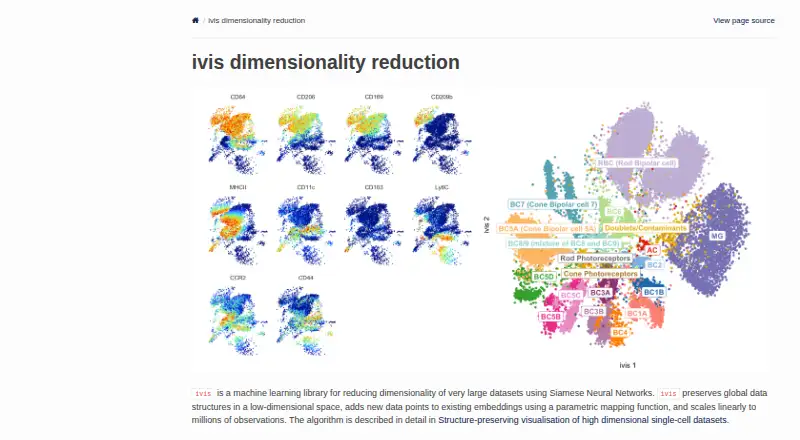
ivis is a free machine-learning library for reducing very large datasets with Siamese Neural Networks. It maps information into a low-dimensional space while preserving global structure, and a parametric mapping can add new points to an existing embedding. Documentation describes linear scaling to millions of observations and unsupervised, semi-supervised, and fully supervised learning. Inputs include N-dimensional and NumPy arrays, sparse matrices, image files, HDF5 files, and custom data connectors. Training supports in-memory and out-of-memory processing, resumable runs, customizable neighbor retrieval, and arbitrary neural-network backbones. HDF5 workflows and custom loaders, including database loaders, are described for large datasets. Callbacks and TensorBoard integration support monitoring. Python and R documentation is provided; Python installation uses pip with CPU and CUDA-based GPU options. Listed dependencies include Python 3.5+, TensorFlow, NumPy greater than 1.14.2, tqdm, and annoy. A Scanpy example applies ivis to single-cell visualization. The project uses the Apache-2.0 license.
Who it suits
ivis suits developers and researchers reducing high-dimensional data, including large scientific datasets. It fits users who need supervised or unsupervised modes and Python or R workflows.
What it does well
- Scales linearly to millions of observations
- Supports three learning modes
- Handles in-memory and out-of-memory data
- Adds new points to embeddings
- CPU and CUDA GPU installation options
What to know first
- Python dependencies include Python 3.5+ and TensorFlow
- GPU option requires CUDA
- Requires technical setup through packages and connectors
Verdict
ivis offers flexible dimensionality reduction for large and varied datasets, with multiple training modes and storage options. Its package dependencies and GPU requirements are important setup considerations.
Facts from ivis's own pages
- Compute options
- The Python installation page documents CPU installation and a GPU option for users with CUDA installed. · beringresearch.github.io, 11 Oct 2026
- Dashboard type
- interactive · beringresearch.github.io, 23 Sept 2026
- Data inputs
- The library supports arbitrary datasets, including N-dimensional arrays, image files on disk, and custom data connectors. · beringresearch.github.io, 12 Oct 2026
- Dependencies
- The Python package documentation lists Python 3.5+, TensorFlow, NumPy, tqdm, and Annoy as dependencies. · beringresearch.github.io, 12 Oct 2026
- Embeddings
- It preserves global data structures in a low-dimensional space and can add new data points to existing embeddings using a parametric mapping function. · beringresearch.github.io, 11 Oct 2026
- Free plan
- Yes · beringresearch.github.io, 23 Sept 2026
- Input data
- The documentation lists N-dimensional arrays, image files on disk, and custom data connectors; the repository README also lists NumPy arrays, sparse matrices, and HDF5 files. · beringresearch.github.io, 11 Oct 2026
- Integration example
- A single-cell analysis example uses Scanpy for data import, preprocessing, and normalization before applying ivis. · beringresearch.github.io, 11 Oct 2026
- Integrations
- The documentation lists callbacks and TensorBoard integration. · beringresearch.github.io, 12 Oct 2026
- Large-data workflow
- For out-of-memory training, the docs demonstrate training from HDF5 files and describe custom dataset loaders for other storage, including databases. · beringresearch.github.io, 11 Oct 2026
- Learning modes
- ivis supports unsupervised, semi-supervised, and fully supervised dimensionality reduction. · beringresearch.github.io, 12 Oct 2026
- License
- The GitHub repository identifies its license as Apache-2.0. · github.com, 11 Oct 2026
- Maker
- The repository credits Bering Limited; the maker's site lists its address as 54 Portland Place, London, United Kingdom. · beringresearch.com, 11 Oct 2026
- New data
- A parametric mapping function can add new data points to existing embeddings. · beringresearch.github.io, 12 Oct 2026
- Platform
- web · beringresearch.github.io, 23 Sept 2026
- Processing
- ivis supports in-memory and out-of-memory data processing. · beringresearch.github.io, 12 Oct 2026
- Purpose
- ivis is a machine learning library for reducing the dimensionality of very large datasets using Siamese Neural Networks. · beringresearch.github.io, 12 Oct 2026
- Python and R
- The documentation provides Python and R package sections, and Python installation instructions use pip. · beringresearch.github.io, 11 Oct 2026
- Python installation
- The documentation provides CPU and GPU installation options through pip; the GPU option is for users with CUDA installed. · beringresearch.github.io, 12 Oct 2026
- Scale
- The library states that it scales linearly to millions of observations. · beringresearch.github.io, 12 Oct 2026
- Structure preservation
- The library preserves global data structures in a low-dimensional space. · beringresearch.github.io, 12 Oct 2026
- Support
- The documentation asks users to report bugs through the GitHub issue tracker and says a reproducible example is helpful. · beringresearch.github.io, 12 Oct 2026
- Training
- Training can be resumed, and the library supports arbitrary neural network backbones. · beringresearch.github.io, 12 Oct 2026
- Use case
- The documentation includes an example applying ivis to visualise single-cell experiments. · beringresearch.github.io, 12 Oct 2026
Where ivis stands on Freedom251
- Data Visualization Software#62 of 98