Freedom251 › Microsegmentation Software

Istio
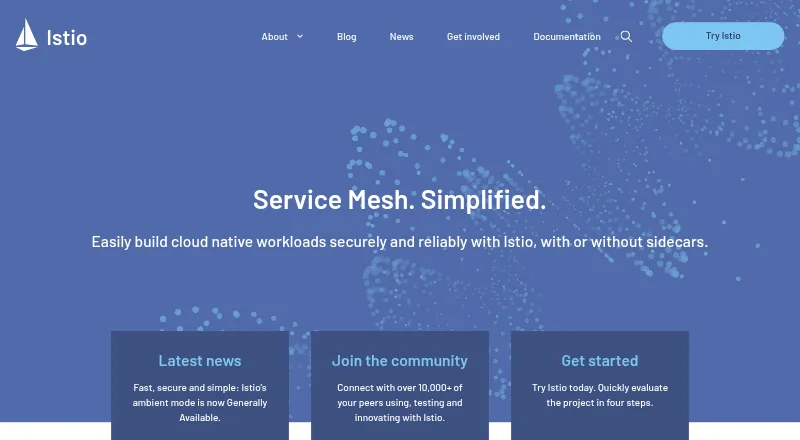
What Istio is
Istio is a free, open-source service mesh for securing, connecting, and monitoring distributed applications with few or no changes to service code. It manages HTTP, gRPC, WebSocket, and TCP traffic through automatic load balancing, routing rules, retries, failovers, and fault injection. Teams can deploy it in sidecar mode or ambient mode, which uses a per-node Layer 4 proxy and can add a per-namespace Envoy proxy for Layer 7 features. Istio’s control plane runs on Kubernetes, and the mesh can also reach other clusters, virtual machines, and endpoints outside Kubernetes. Security tools include workload identity, mutual TLS, authentication, authorization policies, and audit tools. It can produce metrics, logs, and traces for cluster traffic, including ingress and egress. Installation is available with istioctl or Helm. Its documented integrations include cert-manager, Grafana, Jaeger, Kiali, Prometheus, SPIRE, Apache SkyWalking, Zipkin, and third-party load balancers. Istio 1.31 supports Kubernetes 1.32 through 1.36.
Who it suits
Istio suits teams running distributed applications on Kubernetes that need traffic control, workload security, and observability. Its mesh can also extend to virtual machines and endpoints outside Kubernetes.
What it does well
- Free and open source.
- Supports HTTP, gRPC, WebSocket, and TCP traffic.
- Offers sidecar and ambient deployment modes.
- Provides workload identity and mutual TLS.
- Generates traffic metrics, logs, and traces.
What to know first
- The control plane runs on Kubernetes.
- Development builds have no support.
- Minor releases have a defined support window.
Limits
Istio 1.31 supports Kubernetes versions 1.32 through 1.36. Minor releases are supported until six weeks after the N+2 minor release; development builds have no support.
Plans
| Plan | Billed and limits | Price |
|---|---|---|
| Istio | Open source service mesh · Releases accessible at no cost | Free |
As istio.io lists them, read 29 Sept 2026. The maker's own page has the final word.
Getting started
- Visit istio.io.
- Choose istioctl or Helm for installation.
- Install the control plane on Kubernetes.
- Choose sidecar or ambient mode for the mesh.
Overview
Istio is an open-source service mesh for platform teams coordinating traffic and security across distributed workloads. It is a strong fit for Kubernetes operators who need centralized network controls; its main trade-off is the operational commitment of a Kubernetes-based control plane and a short release-support cycle.
Key features
Istio handles HTTP, gRPC, WebSocket, and TCP traffic with automatic load balancing, routing rules, retries, failovers, and fault injection. That breadth gives teams fine-grained ways to steer requests and respond to failures without changing much service code. It is more compelling for teams that need several of these controls together than for those seeking only a narrow traffic-management layer.
Teams can deploy Istio in sidecar or ambient mode. Ambient places a Layer 4 proxy on each node and can add an Envoy proxy per namespace for Layer 7 features, giving operators a choice in data-plane architecture. The control plane runs on Kubernetes, while the mesh can reach other clusters, virtual machines, and endpoints outside Kubernetes; this makes it useful for mixed environments, but Kubernetes remains central to its operation.
Security capabilities include workload identity, mutual TLS, authentication, authorization policies, and audit tools. Istio can also generate metrics, logs, and traces for cluster traffic, including ingress and egress. Integrations cover Prometheus, Grafana, Jaeger, Kiali, SPIRE, Zipkin, cert-manager, Apache SkyWalking, and third-party load balancers. Envoy proxies support extensions such as WebAssembly modules and third-party policy systems, which add flexibility for teams with specialized requirements.
Installation is available through istioctl or Helm; the release archive includes installation profiles, charts, and samples. Istio 1.31 supports Kubernetes 1.32 through 1.36. Supported releases receive community patch releases for critical issues and technical assistance, while development builds have no support. A minor release remains supported only until six weeks after the N+2 release, so upgrade planning is essential; partners may offer longer-term support.
Pricing
Istio is free: its open-source service mesh and releases cost nothing. There is no paid tier in the listed plan structure, making it suitable for teams able to operate the mesh themselves. The trade-off is that community support follows the release window; teams needing longer-term support may need a partner.
Platforms
Istio is self-hosted and supports Linux and macOS. Its supported platforms include Kubernetes and OpenShift, with the control plane running on Kubernetes.
Who it's for
Istio suits platform and infrastructure teams that need a shared layer for traffic management, workload security, and observability across Kubernetes-based services. Its multi-cluster reach and support for virtual machines and external endpoints can help when workloads span more than one environment. It is a weaker fit for teams unwilling to operate a Kubernetes control plane or keep pace with the release-support schedule.
Pros and cons
- Pros: Broad traffic controls cover four protocol types and include retries, failovers, and fault injection, reducing the need to handle these concerns separately in services.
- Pros: Sidecar and ambient deployment modes offer alternative data-plane approaches, while the mesh can extend beyond Kubernetes clusters.
- Pros: Workload identity, mutual TLS, policy controls, and traffic telemetry combine security and visibility in one mesh.
- Cons: The control plane runs on Kubernetes, which makes Istio a substantial operational choice for teams without Kubernetes infrastructure.
- Cons: Support ends six weeks after the N+2 minor release, requiring teams to plan upgrades rather than remain indefinitely on an older minor version.
Alternatives
For a different open-source networking option, Calico Open Source is free and supports Linux, Windows, and self-hosted deployments; its plan includes in-memory data retention and unlimited clusters.
Antrea is another free option, but it requires a Kubernetes cluster and an Open vSwitch kernel module on every Kubernetes node. Cilium is free and self-hosted for Linux, with a Linux kernel requirement of 5.10 or equivalent and AMD64 or AArch64 support.
VMware Workstation Pro is a free option for running on 64-bit Intel or AMD Windows or Linux hosts, rather than a service mesh choice on the terms described for Istio.
ColorTokens Xshield is a paid alternative with a free trial. HashiCorp Nomad offers a free plan alongside freemium offerings, including self-managed customizable plans with premium support. Trellix Data Loss Prevention is a paid enterprise DLP option for protecting data across endpoints, email, web, networks, and storage. OVN-Kubernetes is another free, self-hosted alternative.
Browse Service Mesh Platforms or Microsegmentation Software for related categories.
Verdict
Choose Istio if your Kubernetes team needs a broad, open-source mesh for traffic control, workload security, and observability across clusters and other endpoints. Its range and deployment choices are persuasive, but the Kubernetes control plane and fast-moving support window make it a poor fit for teams that cannot commit to ongoing operations and upgrades.
Verdict
Istio combines traffic management, security, and observability for distributed workloads, with sidecar and ambient deployment choices. Teams should account for its Kubernetes-based control plane and release support window.
Questions
Does Istio cost anything?
Istio is free and its releases are accessible at no cost.
Is Istio open source?
Yes. Istio is an open source service mesh and a graduated Cloud Native Computing Foundation project.
Which platforms does it support?
The listed platforms are Linux, macOS and self-hosted. Supported platforms also include Kubernetes and OpenShift.
How can I install Istio?
Istio can be installed with istioctl or Helm.
Can Istio run beyond Kubernetes?
Its control plane runs on Kubernetes, and the mesh can extend to other clusters, virtual machines and endpoints outside Kubernetes.
How long are releases supported?
A minor release is supported until six weeks after the N+2 minor release. Development builds have no support.
Facts from Istio's own pages
- Community support
- For supported releases, the Istio community provides patch releases for critical issues and technical assistance; partners may offer longer-term support. · istio.io, 29 Sept 2026
- Deployment modes
- Istio supports sidecar mode and ambient mode, which uses a per-node Layer 4 proxy and optionally a per-namespace Envoy proxy for Layer 7 features. · istio.io, 29 Sept 2026
- Extensibility
- Istio uses Envoy proxies and supports extensions including WebAssembly modules and third-party policy systems. · istio.io, 29 Sept 2026
- Founded
- 2016 · istio.io, 23 Sept 2026
- Installation
- Istio can be installed with istioctl or Helm, and its release archive includes the istioctl binary, installation profiles, Helm charts, and samples. · istio.io, 29 Sept 2026
- Integrations
- Istio’s integration documentation covers cert-manager, Grafana, Jaeger, Kiali, Prometheus, SPIRE, Apache SkyWalking, Zipkin, and third-party load balancers. · istio.io, 29 Sept 2026
- Observability
- Istio can generate metrics, logs, and traces for traffic in a cluster, including ingress and egress traffic. · istio.io, 29 Sept 2026
- Project status
- Istio is a graduated Cloud Native Computing Foundation project. · istio.io, 29 Sept 2026
- Release support window
- A minor release is supported until six weeks after the N+2 minor release, and development builds have no support. · istio.io, 29 Sept 2026
- Security
- Istio security features include workload identity, mutual TLS, authentication, authorization policies, and audit tools. · istio.io, 29 Sept 2026
- Supported Kubernetes versions
- The Istio 1.31 release supports Kubernetes versions 1.32 through 1.36. · istio.io, 29 Sept 2026
- Traffic management
- Istio supports automatic load balancing for HTTP, gRPC, WebSocket, and TCP traffic, plus routing rules, retries, failovers, and fault injection. · istio.io, 29 Sept 2026
- What it does
- Istio is an open source service mesh that adds ways to secure, connect, and monitor distributed applications with few or no service code changes. · istio.io, 29 Sept 2026
- Workload environments
- Istio’s control plane runs on Kubernetes and the mesh can extend to other clusters, virtual machines, and endpoints outside Kubernetes. · istio.io, 29 Sept 2026
Where Istio stands on Freedom251
- Microsegmentation Software#4 of 31
- Service Mesh Platforms#6 of 22
- Distributed Systems#17 of 30