Freedom251 › Embedded Systems Toolchains

Infineon ModusToolbox
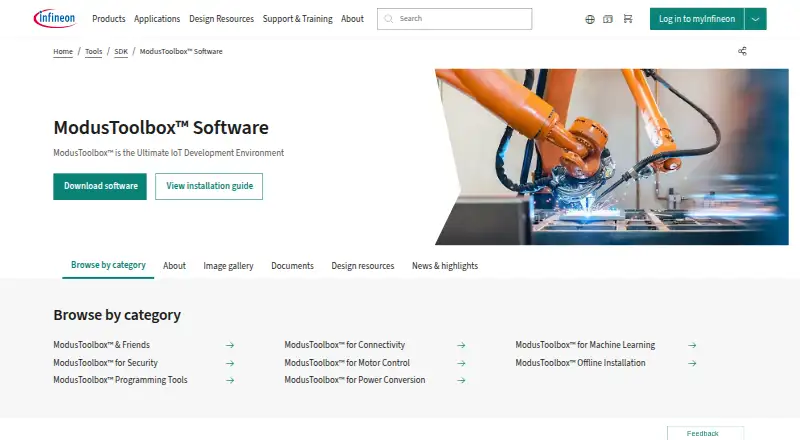
What Infineon ModusToolbox is
Infineon ModusToolbox is a free, extensible development ecosystem for embedded applications built with Infineon microcontrollers. Its desktop applications support creating applications, managing software components, configuring peripherals and middleware, compiling, programming, and debugging. Listed device families include PSOC, TRAVEO T2G, XMC, AIROC Wi-Fi and Bluetooth, and USB-C Power Delivery microcontrollers. The installation package supports Windows, Linux, and macOS. Its GNU make build system supports work in desktop IDEs, a command-line terminal, and continuous integration workflows. Named IDEs include Eclipse IDE, Microsoft Visual Studio Code, IAR Embedded Workbench, and Arm MDK with µVision IDE. The ecosystem includes board support packages, peripheral drivers, middleware, and code examples; board targets can be customized or retargeted. Runtime software repositories hosted on GitHub are accessed by the development tools. Infineon lists GNU Arm Embedded Compiler, Arm compiler, IAR Embedded Workbench, and LLVM ARM among compiler toolchains. ModusToolbox Software v3.8 is available, and updates can be made through the Setup program; an offline installation option is also listed. Security-focused components include Trusted Firmware-M, cryptographic libraries, secure boot, firmware updates, and secure communication protocols.
Who it suits
ModusToolbox suits developers building embedded applications with supported Infineon microcontrollers across Windows, Linux, or macOS. It supports IDE, command-line, and continuous integration workflows.
What it does well
- Free software for Windows, Linux, and macOS.
- Supports desktop IDE, command-line, and CI workflows.
- Includes drivers, middleware, and code examples.
- Board targets can be customized or retargeted.
What to know first
- Focused on Infineon microcontrollers.
- Open-source packages are supplied as is without warranty.
- Runtime repositories are hosted on GitHub.
Limits
The ecosystem targets Infineon microcontrollers, including the listed PSOC, TRAVEO T2G, XMC, AIROC Wi-Fi and Bluetooth, and USB-C Power Delivery families. Free and open-source packages use the applicable license included in each download archive and are supplied as is without warranty.
Plans
| Plan | Billed and limits | Price |
|---|---|---|
| ModusToolbox™ Software | Infineon microcontroller development ecosystem · Windows, Linux, macOS | Free |
As infineon.com lists them, read 7 Oct 2026. The maker's own page has the final word.
Getting started
- Visit the ModusToolbox website.
- Download the installation package for Windows, Linux, or macOS, or use the offline installation option.
- Install and open the development tools.
- Choose a supported Infineon microcontroller and development environment.
- Use the Setup program to update to ModusToolbox Software v3.8.
- Find answers or ask questions through Infineon's Developer Community.
Infineon ModusToolbox is an embedded development ecosystem for applications targeting Infineon microcontrollers. It is best suited to developers and teams building on supported Infineon devices who want to combine software assets with flexible build and IDE workflows. Its strongest advantage is that flexibility; its central limitation is the device-family focus.
Overview
The ecosystem brings together desktop applications, libraries, and embedded runtime assets. Its tools support application creation, software-component management, peripheral and middleware configuration, compiling, programming, and local debugging. Supported families include PSOC, TRAVEO T2G, XMC, AIROC Wi-Fi and Bluetooth, and USB-C Power Delivery microcontrollers.
A GNU make build system supports desktop IDEs, command-line work, and continuous integration. That lets teams fit builds into an existing development process rather than relying on a single editor. The scope remains Infineon microcontrollers, so this is not the right choice for projects that need a vendor-neutral toolchain.
Key features
Flexible development workflow
ModusToolbox names Eclipse IDE, Microsoft Visual Studio Code, IAR Embedded Workbench, and Arm MDK with µVision IDE as application-development options. Its supported compiler toolchains include GNU Arm Embedded Compiler, Arm compiler, IAR Embedded Workbench, and LLVM ARM. Teams can retain familiar tools while using a common GNU make build system, although the range of options also means selecting and maintaining a workflow suited to the project.
Runtime assets and board support
Middleware, device drivers, and code examples are provided through GitHub-hosted repositories accessed by the development tools. Board support packages form part of the build system and can be customized or retargeted to another device. This gives developers reusable starting points and some flexibility when a board target changes, while the assets remain tied to the ecosystem's supported devices.
Security and learning resources
ModusToolbox for Security includes Trusted Firmware-M, cryptographic libraries, secure boot, firmware updates, and secure communication protocols. Infineon says its PSOC 64 Secured MCU line has PSA Level 2 certification and its PSOC 62 Performance line has PSA Level 1 certification. Training videos, documents, code examples, and libraries support adoption; Infineon's Developer Community is the place to find answers, ask questions, and connect with engineers.
ModusToolbox Software v3.8 is available through the Setup program, and Infineon also offers an offline installation option. The offline route can suit environments with restricted connectivity; runtime repositories are GitHub-hosted, so the offline installer does not change where those assets are provided.
Pricing
ModusToolbox Software: free. The free plan covers the Infineon microcontroller development ecosystem for Windows, Linux, and macOS. That makes it an accessible option for individual developers and teams evaluating or building on supported devices, without a paid tier to weigh against it.
Infineon says free and open-source packages are governed by the applicable license included in each download archive and are supplied as is without warranty. Review the license terms for the packages used in a project, particularly when distributing software or incorporating components into a commercial product.
Platforms
The development tools installation package supports Windows, Linux, and macOS. The GNU make build system also supports command-line and continuous integration workflows, alongside desktop IDE development. Debugging is local.
Who it's for
ModusToolbox is a strong fit for embedded developers and teams committed to supported Infineon microcontrollers, especially those that need configurable board support and want to work across IDE, terminal, and CI environments. Its security assets may also suit projects using the relevant Infineon MCU lines. Choose another ecosystem if the project targets different manufacturers or needs broad cross-vendor device coverage.
Pros and cons
- Pros: The GNU make system works across IDE, terminal, and CI workflows, giving teams flexibility in how they build.
- Pros: Runtime assets include middleware, drivers, code examples, and customizable or retargetable board support packages.
- Pros: The free plan and Windows, Linux, and macOS support make the core ecosystem accessible across common desktop platforms.
- Cons: Its device focus is Infineon microcontrollers, which limits its fit for cross-vendor projects.
- Cons: Open-source packages come with individual license terms and no warranty, so teams must check the relevant archive terms.
Alternatives
For broader toolchain comparisons, see Embedded Systems Toolchains; for editor-focused options, see C++ IDEs.
- Arm Keil MDK is a freemium option with a free Community plan for non-commercial use and a separate Essential plan.
- C2000Ware is a free download for C2000 microcontrollers; its installer requires export approval.
- RISC-V GNU Toolchain is a free C and C++ cross-compiler for bare-metal or Linux ELF toolchains.
- Arm GNU Toolchain is free to download and use, community supported, and published without warranty.
- CS+ offers a free IDE for development and production with CC; evaluation compiler limits apply when using an evaluation compiler.
- e² studio has no paid version, but separate compiler packages are not included and may have their own license terms or evaluation limits.
- ESP-IDF Extension for VS Code is a free extension for ESP-IDF.
- MPLAB X IDE is a free IDE download supporting most Microchip microcontrollers and digital signal controllers.
Verdict
Choose ModusToolbox when your project targets an Infineon microcontroller and you want device assets, configuration, and builds that can move between desktop IDEs, the command line, and CI. Its free price and adaptable workflow make it a practical fit for that ecosystem. Look elsewhere if target flexibility beyond Infineon devices is a priority.
Verdict
ModusToolbox offers embedded development tools, runtime assets, and multiple workflow options for Infineon microcontrollers. Users should review the applicable license for each open-source package, which Infineon says is supplied without warranty.
Questions
How much does ModusToolbox cost?
The listed ModusToolbox Software plan is free.
Which operating systems are supported?
The installation package supports Windows, Linux, and macOS.
Which microcontrollers does it support?
Listed families include PSOC, TRAVEO T2G, XMC, AIROC Wi-Fi and Bluetooth, and USB-C Power Delivery microcontrollers.
Which IDEs and compilers can I use?
Named IDEs include Eclipse IDE, Microsoft Visual Studio Code, IAR Embedded Workbench, and Arm MDK with µVision IDE. Listed compiler toolchains include GNU Arm Embedded Compiler, Arm compiler, IAR Embedded Workbench, and LLVM ARM.
Is ModusToolbox open source?
Infineon says its free and open-source software packages are provided under the applicable license included in each download archive and are supplied as is without warranty.
Who makes ModusToolbox?
It is made by Infineon Technologies AG, headquartered in Neubiberg, Germany. Infineon says it became independent on April 1, 1999.
Facts from Infineon ModusToolbox's own pages
- Board support
- Board support packages are part of the build system and can be customized or retargeted to another device. · infineon.com, 5 Oct 2026
- Build and CI
- Its GNU make build system supports development in desktop IDEs, a command-line terminal, and continuous integration workflows. · infineon.com, 5 Oct 2026
- Build and workflow
- It uses a GNU make build system and supports development through a desktop IDE, command-line terminal, or continuous integration workflow. · infineon.com, 7 Oct 2026
- Components
- It includes development tools, libraries, and embedded runtime assets. · infineon.com, 5 Oct 2026
- Development tasks
- Its desktop tools support creating embedded applications, managing software components, configuring peripherals and middleware, compiling, programming, and debugging. · infineon.com, 7 Oct 2026
- FOSS terms
- Infineon says its free and open-source software packages are provided under the applicable license included in each download archive and are supplied as is without warranty. · infineon.com, 7 Oct 2026
- Founded
- 1999 · infineon.com, 28 Sept 2026
- Headquarters
- Neubiberg, Germany · infineon.com, 28 Sept 2026
- IDE integrations
- ModusToolbox supports embedded application development in Eclipse IDE, Microsoft Visual Studio Code, IAR Embedded Workbench, and Arm MDK with µVision IDE. · infineon.com, 7 Oct 2026
- Maker founded
- Infineon says it became independent on April 1, 1999. · infineon.com, 5 Oct 2026
- Maker headquarters
- Infineon Technologies AG lists its headquarters in Neubiberg, Germany. · infineon.com, 5 Oct 2026
- Offline installation
- Infineon lists an offline installation option for ModusToolbox. · infineon.com, 7 Oct 2026
- Operating systems
- The development tools installation package supports Windows, Linux, and macOS. · infineon.com, 5 Oct 2026
- Purpose
- ModusToolbox is a development ecosystem for building embedded applications for Infineon microcontrollers and devices. · infineon.com, 7 Oct 2026
- Release
- The page states that ModusToolbox Software v3.8 is available and can be updated through the ModusToolbox Setup program. · infineon.com, 5 Oct 2026
- Runtime repositories
- Runtime middleware, device drivers, and code examples are provided through GitHub-hosted repositories that the development tools access directly. · infineon.com, 7 Oct 2026
- Runtime software
- Middleware, device drivers, and code examples are provided through GitHub-hosted repositories. · infineon.com, 5 Oct 2026
- Security certifications
- Infineon states that PSOC 64 has PSA Certified Level 2 and PSOC 62 has PSA Certified Level 1 certification. · infineon.com, 7 Oct 2026
- Security features
- The security offering includes Trusted Firmware-M, Mbed TLS support, cryptographic drivers, secure boot, and device firmware update middleware. · infineon.com, 7 Oct 2026
- Software assets
- Embedded assets include board support packages, peripheral drivers, middleware, and code examples, with board targets that can be customized or retargeted. · infineon.com, 7 Oct 2026
- Support
- The product page directs users to Infineon’s Developer Community to find answers, ask questions, and connect with engineers. · infineon.com, 7 Oct 2026
- Supported devices
- Supported devices include PSOC, TRAVEO T2G, XMC, AIROC Wi-Fi and Bluetooth, and USB-C Power Delivery microcontrollers. · infineon.com, 7 Oct 2026
- Support resources
- Infineon lists training videos, documents, code examples, and libraries as ModusToolbox development resources. · infineon.com, 5 Oct 2026
Where Infineon ModusToolbox stands on Freedom251
- Embedded Systems Toolchains#8 of 30
- C++ IDEs#12 of 24