Freedom251 › Embedded Systems Toolchains
Arm GNU Toolchain
What Arm GNU Toolchain is
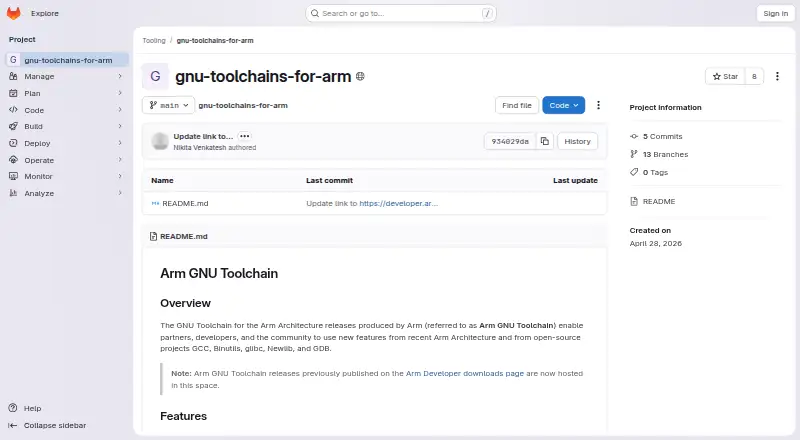
Arm GNU Toolchain is a free, open-source toolchain for building C and C++ software for Arm processors. Its integrated packages bring together GCC, Binutils, glibc, Newlib and GDB, including a debugger. It offers variants for bare-metal embedded work and Linux kernel or application development, with targets across Arm A-, R- and M-profile CPUs, including Cortex-A, Cortex-R, Cortex-M and Neoverse processors. Cross-toolchains are listed for Windows x86, Linux x86_64 and AArch64, and macOS x86_64 hosts. Arm publishes releases twice a year and checks them with the associated projects’ test suites for regressions. Community support is best effort, with no guarantee of prompt forum replies or future fixes. Releases are provided without a warranty and may not suit every use case. New releases from 15.3.Rel1 onward are published only on Arm’s GitLab project; its developer.arm.com downloads page is deprecated.
Who it suits
It suits developers and partners building C or C++ software for Arm, from bare-metal embedded targets to Linux systems. Linux, macOS and Windows are listed platforms, with the host options varying by toolchain.
What it does well
- Free to download and use.
- Includes GCC, Binutils, glibc, Newlib and GDB.
- Supports Arm A-, R- and M-profile targets.
- Offers bare-metal and Linux development variants.
What to know first
- Community support is best effort.
- Releases come without a warranty.
- New releases are on GitLab; the downloads page is deprecated.
Limits
The toolchain is free, but community support is best effort and comes without guaranteed prompt responses or fixes in future releases. Arm publishes the releases without warranty.
Plans
| Plan | Billed and limits | Price |
|---|---|---|
| Arm GNU Toolchain | Free to download and use · community supported · published with no warranty | Free |
As developer.arm.com lists them, read 30 Sept 2026. The maker's own page has the final word.
Getting started
- Open Arm’s toolchain downloads page and follow the link to its GitLab project for releases from 15.3.Rel1 onward.
- Choose a cross-toolchain matching your host: Windows x86, Linux x86_64 or AArch64, or macOS x86_64.
- Select the variant for bare-metal embedded development or Linux kernel and application development.
- Choose the package for your Arm target profile or processor family.
- Use the included tools, including GCC and GDB, for C or C++ development.
Arm GNU Toolchain is an open-source C and C++ toolchain for building software for Arm processors. It is best suited to developers who want GCC-based tools for embedded or Linux development across Arm’s A, R and M profiles. Its broad component set is useful, but best-effort support and no warranty make it a poor fit where dependable vendor fixes are essential.
Overview
The package brings together integrated, validated builds of GCC, Binutils, glibc, Newlib and GDB. That gives developers a compiler, binary utilities, libraries and debugger in one toolchain, rather than requiring them to assemble those core components separately. It serves both bare-metal embedded work and Linux kernel or application development.
Arm tests releases with the test suites from the respective source projects to check for new regressions, and publishes releases twice a year. That provides a regular update rhythm, though it is not a promise that every application or target-specific use case will be covered.
Key features
- Arm profile coverage: Targets include Arm A-, R- and M-profile CPUs, including Cortex-A, Cortex-R, Cortex-M and Neoverse processors. This makes it relevant across application, real-time and microcontroller development within the Arm ecosystem.
- Embedded and Linux variants: Separate variants address bare-metal development and Linux kernel or application work, so users can choose a toolchain suited to their target environment.
- Compiler and debugger components: GCC and GDB are joined by Binutils, glibc and Newlib. The mix covers core build and debug needs, with libraries suited to different development contexts.
- Regression checks: Source-project test suites are used to check for new regressions. This is a useful baseline, but it does not amount to a warranty or assurance of suitability for a particular project.
- Security information: Arm links to Security Updates covering vulnerabilities, reporting and fixes, giving users a route to track security issues.
Pricing
Arm GNU Toolchain is free to download and use, with no free trial or paid tier. Its open-source license model and zero price make it accessible for personal, community and commercial development, though community support is best-effort and the releases come with no warranty.
New releases from 15.3.Rel1 onward are published exclusively through Arm’s GitLab project; the developer.arm.com downloads page is deprecated. Arm directs packaging or release-build bugs to Linaro Bugzilla, while bugs in the underlying source projects should go to those projects’ own resources.
Platforms
Arm provides cross-toolchains for Windows x86, Linux x86_64 and AArch64, and macOS x86_64 hosts. These host options cover common desktop development systems, while the supported targets are Arm CPUs across A, R and M profiles.
Who it's for
Choose it if you need GCC-based C or C++ cross-compilation for Arm, whether your work targets bare-metal devices or Linux systems. It is especially suitable for developers who value a unified set of core compiler, utility, library and debugger components and can manage support and release updates themselves.
Look elsewhere if your project needs guaranteed response times, promised fixes or a warranty for a specific use case. Arm explicitly offers none of those assurances for these releases.
Pros and cons
Pros
- Wide Arm target range: A-, R- and M-profile coverage spans Cortex and Neoverse processors, making the toolchain useful across multiple Arm development contexts.
- Core components in one package: GCC, Binutils, glibc, Newlib and GDB provide a coherent starting point for compiling and debugging.
- Free and open-source: There is no purchase price or trial period to manage before adopting it.
- Regular releases with regression checks: Twice-yearly releases and source-project test suites offer a defined maintenance cadence.
Cons
- Support is not assured: Community support is best-effort, and Arm does not guarantee prompt forum replies or fixes in future releases.
- No warranty: Users must assess suitability for their own use cases rather than rely on a vendor commitment.
- Release location has changed: New releases from 15.3.Rel1 are on GitLab, while the former download page is deprecated; users following old download workflows need to switch.
Alternatives
Compare embedded systems toolchains if you want to consider a broader set of options for embedded development.
- Arm Keil MDK is worth considering for its free non-commercial Community plan, which includes Keil Studio, Keil μVision and Cortex-M device support; its pricing model is freemium.
- C2000Ware is the more relevant choice for C2000 microcontroller development; its free download requires export approval for the installer.
- Infineon ModusToolbox is a free software ecosystem for Infineon microcontroller development across Windows, Linux and macOS.
- RISC-V GNU Toolchain fits developers targeting RISC-V instead, with a free C and C++ cross-compiler for bare-metal or Linux ELF toolchains.
- CS+ is a free IDE option, though evaluation compiler limits can apply when using an evaluation compiler.
- e² studio is another free IDE; separate compiler packages are not included and may carry their own license terms or evaluation limits.
- ESP-IDF Extension for VS Code is an alternative for users considering a VS Code extension.
- MPLAB X IDE is another free IDE option for users comparing development tools.
Verdict
Arm GNU Toolchain is a strong fit for developers who need free, open-source GCC-based C and C++ tools across Arm profiles, with both bare-metal and Linux variants. Its breadth and included debugger are compelling; its best-effort support and lack of warranty are the main reasons to choose a toolchain with firmer support commitments instead.
Verdict
Arm GNU Toolchain brings core compiler, binutils, library and debugger components together for several Arm target profiles and development contexts. Users should account for the best-effort support and obtain new releases through GitLab.
Questions
Does Arm GNU Toolchain cost anything?
The listed plan is free. It is free to download and use.
Which programming languages does it support?
It supports C and C++.
Which host platforms are available?
Arm lists cross-toolchains for Windows x86, Linux x86_64 and AArch64, and macOS x86_64 hosts.
What tools are included?
Its packages are based on GCC, Binutils, glibc, Newlib, and GDB; the debugger is included.
Is Arm GNU Toolchain open source?
Yes. Its listed license model is open-source.
Where are new releases published?
Starting with 15.3.Rel1, new releases are published exclusively on Arm’s GitLab project. The developer.arm.com downloads page is deprecated.
Facts from Arm GNU Toolchain's own pages
- Architecture targets
- It supports CPUs based on the Arm A, R, and M profiles, including Cortex-A, Cortex-R, Cortex-M, and Neoverse processors. · developer.arm.com, 30 Sept 2026
- Bug reporting
- Arm directs bugs specific to release builds or packaging to Linaro Bugzilla and bugs in source projects to those projects' own resources. · developer.arm.com, 30 Sept 2026
- Components
- It includes integrated and validated packages based on GCC, Binutils, glibc, Newlib, and GDB. · developer.arm.com, 30 Sept 2026
- Development variants
- The toolchain has variants for bare-metal embedded development and Linux kernel and application development. · developer.arm.com, 30 Sept 2026
- Download location
- Arm says new releases starting with 15.3.Rel1 are published exclusively on its GitLab project, and the developer.arm.com downloads page is deprecated. · developer.arm.com, 30 Sept 2026
- Host platforms
- Arm lists cross-toolchains for Windows x86, Linux x86_64 and AArch64, and macOS x86_64 hosts. · developer.arm.com, 30 Sept 2026
- Languages
- It supports C and C++. · developer.arm.com, 30 Sept 2026
- Purpose
- The toolchain lets partners, developers, and the community use features from recent Arm architectures and open-source projects. · developer.arm.com, 30 Sept 2026
- Quality testing
- Releases are tested using the respective source projects' test suites to check for new regressions. · developer.arm.com, 30 Sept 2026
- Release cadence
- Arm says releases are published twice a year. · developer.arm.com, 30 Sept 2026
- Security resources
- The product page links to Arm Security Updates for information about vulnerabilities, reporting, and fixes. · developer.arm.com, 30 Sept 2026
- Support
- Releases are community supported on a best-effort basis, and Arm does not guarantee prompt answers on public forums or fixes in future releases. · developer.arm.com, 30 Sept 2026
- Warranty
- Arm publishes the releases with no warranty and says they may not suit specific use cases. · developer.arm.com, 30 Sept 2026
Where Arm GNU Toolchain stands on Freedom251
- Embedded Systems Toolchains#2 of 30