Helm
What Helm is
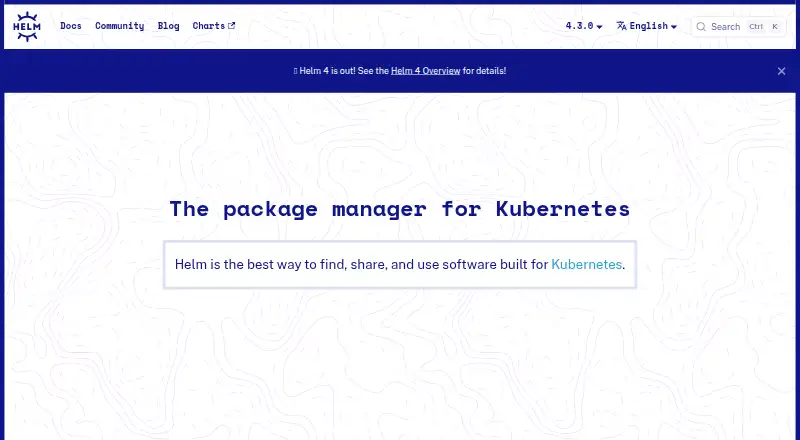
Helm is a free package manager for applications running in Kubernetes clusters. It groups related Kubernetes resources into versioned charts that can be shared, installed, upgraded, or rolled back. Charts can declare dependencies, and operators can supply different values to the same chart for development, staging, and production. Helm manages applications such as databases, monitoring stacks, and ingress controllers. Its command-line client communicates with the Kubernetes API server, while the Helm library handles chart operations. Release information is stored in Kubernetes Secrets, so Helm does not need a separate database. Charts can be kept on disk or fetched from remote repositories; Artifact Hub lists publicly available charts. Plugins extend Helm, including with custom chart-download protocols. It runs on Linux, macOS, and Windows as a self-managed command-line tool under the Apache-2.0 license. Helm focuses on applications inside a Kubernetes cluster; setting up and operating the cluster itself is outside its scope.
Who it suits
Helm suits application operators, distributors, developers, and supporting tool developers working with Kubernetes applications. It is not for setting up or operating the Kubernetes cluster itself.
What it does well
- Packages related Kubernetes resources into versioned charts
- Supports upgrades and rollbacks
- Charts can use different values across environments
- Stores release information in Kubernetes Secrets
What to know first
- Focuses on applications running in Kubernetes
- Cluster setup and operation are outside its scope
Plans
| Plan | Billed and limits | Price |
|---|---|---|
| Helm | Apache-2.0 license · command-line tool · self-managed | Free |
As helm.sh lists them, read 1 Oct 2026. The maker's own page has the final word.
Getting started
- Open the Helm website.
- Choose a supported installation method for Linux, macOS, or Windows.
- Install using a pre-built binary or the installer script, or use a listed community package manager.
- Use the command-line client to work with charts and the Kubernetes API server.
Verdict
Helm organizes Kubernetes application resources into reusable charts, with support for dependencies, environment-specific values, upgrades, and rollbacks. It is free and self-managed, but does not cover operating the cluster itself.
Questions
Is Helm free?
Yes. The listed Helm plan costs nothing and uses the Apache-2.0 license.
Which operating systems does Helm support?
Helm runs on Linux, macOS, and Windows.
Is Helm open source?
Yes. The listed plan uses the Apache-2.0 license, and Helm is maintained by the Helm community as a graduated Cloud Native Computing Foundation project.
What does Helm manage?
It manages applications running in Kubernetes through charts. Setting up and operating the Kubernetes cluster is outside Helm’s scope.
How can I install Helm?
Official methods include pre-built binary releases and an installer script. Community methods include Homebrew, Chocolatey, Scoop, Winget, Apt, dnf/yum, Snap, and FreeBSD pkg.
Where can I get Helm support?
Community support is available through Kubernetes Slack channels, a mailing list, developer calls, Stack Overflow, and GitHub.
Facts from Helm's own pages
- Application management
- Helm installs and manages applications such as databases, monitoring stacks, and ingress controllers from charts. · helm.sh, 1 Oct 2026
- Architecture
- The Helm client is a command-line tool that communicates with the Kubernetes API server, while the Helm library performs chart operations. · helm.sh, 1 Oct 2026
- Charts
- Helm packages related Kubernetes resources into versioned charts that can be shared, installed, upgraded, and rolled back. · helm.sh, 1 Oct 2026
- Configuration
- Helm supports supplying different values to the same chart for development, staging, and production environments. · helm.sh, 1 Oct 2026
- Dependencies
- Helm charts can declare dependencies on other charts and install them together. · helm.sh, 1 Oct 2026
- Founded
- 2015 · helm.sh, 28 Sept 2026
- Governance
- Helm is a graduated Cloud Native Computing Foundation project maintained by the Helm community. · helm.sh, 1 Oct 2026
- Plugins
- Helm plugins extend the core feature set and can provide custom chart download protocols. · helm.sh, 1 Oct 2026
- Purpose
- Helm is the package manager for Kubernetes applications. · helm.sh, 1 Oct 2026
- Repositories
- Charts can be stored on disk or fetched from remote chart repositories, with Artifact Hub listing publicly available charts. · helm.sh, 1 Oct 2026
- Scope limit
- Helm focuses on applications running in a Kubernetes cluster, while standing up and operating the cluster itself is outside its scope. · helm.sh, 1 Oct 2026
- Security
- Helm releases include cryptographic signatures, and the installation guide recommends verifying checksums and maintainer PGP signatures before installation. · helm.sh, 1 Oct 2026
- Storage
- Helm stores release information in Kubernetes Secrets and does not require its own database. · helm.sh, 1 Oct 2026
- Support
- Community support is available through Kubernetes Slack channels, a mailing list, developer calls, Stack Overflow, and GitHub. · github.com, 1 Oct 2026
- Supported installation
- Official installation methods include pre-built binary releases and an installer script; community methods include Homebrew, Chocolatey, Scoop, Winget, Apt, dnf/yum, Snap, and FreeBSD pkg. · helm.sh, 1 Oct 2026
- Users
- Helm identifies application operators, application distributors, application developers, and supporting tool developers as user roles. · helm.sh, 1 Oct 2026
Where Helm stands on Freedom251
- Cli Tools#9 of 32
- Kubernetes Deployment Tools#12 of 28