Freedom251 › Social Media Monitoring
Harken
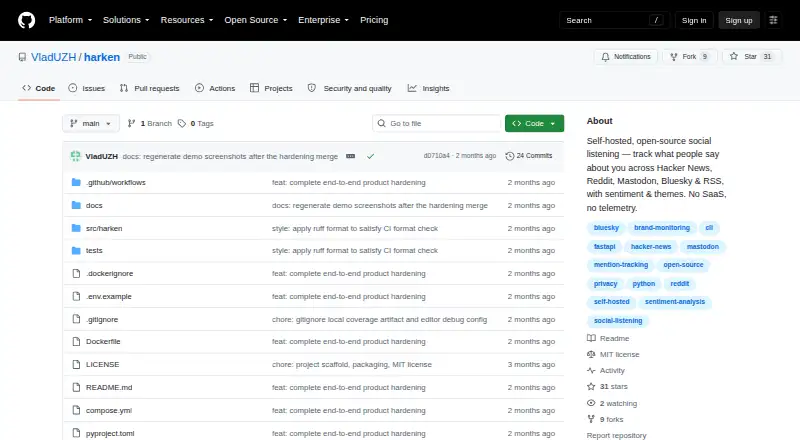
What Harken is
Harken tracks keywords, brands, or products across online sources and organizes mentions, sentiment, and themes in a local dashboard. Sources include Hacker News, Reddit, Mastodon, Bluesky, Stack Overflow, RSS, X, and YouTube. A built-in local lexicon analyzer scores sentiment, while optional LLM analysis can label themes. Harken offers a local web dashboard and a terminal CLI, stores its database in SQLite, and says it sends no Harken telemetry. Optional theme labeling can use Anthropic, OpenAI, or locally run Ollama. Alerts for negative mentions and configured volume or sentiment thresholds can go to Slack, generic webhooks, or SMTP email. The open-source MIT software is free to self-host, with no per-seat pricing, and includes API access. Tracking sends search terms to the selected source APIs; choosing Anthropic or OpenAI for theme labels sends a small sample of mention text to that provider. Hacker News and Bluesky work without credentials, while other sources may require credentials, feeds, or tokens. The quickstart requires Python 3.10 or later, and the repository includes Docker Compose instructions.
Who it suits
Harken is intended for indie founders, open-source maintainers, and privacy-conscious teams. It suits users who want a self-hosted way to monitor mentions and configure alerts.
What it does well
- Free, open-source MIT software with no per-seat pricing.
- Stores data locally in SQLite.
- Includes a web dashboard and terminal CLI.
- Supports Slack, webhook, and SMTP alerts.
- Optional theme analysis can use local Ollama.
What to know first
- Historical data is limited.
- Python 3.10 or later is required.
- Most listed sources require credentials, feeds, or tokens.
- Selected source APIs receive tracking search terms.
Limits
Historical data is limited. The Free plan is self-hosted; Reddit, Mastodon, RSS, X, and YouTube require credentials, configured feeds, or tokens as applicable.
Plans
| Plan | Billed and limits | Price |
|---|---|---|
| Free | Open-source MIT · self-hosted · no per-seat pricing | Free |
As github.com lists them, read 7 Oct 2026. The maker's own page has the final word.
Getting started
- Open the Harken GitHub repository.
- Prepare an environment with Python 3.10 or later, or follow the included Docker Compose instructions.
- Choose the sources to monitor; provide credentials, feeds, or tokens where required.
- Configure keywords, brands, or products to track.
- Open the local web dashboard or use the terminal CLI.
- Optionally configure theme labeling, alerts, or account roles.
Harken is a self-hosted tool for monitoring keyword mentions across online sources, with a local dashboard and terminal interface. It best suits indie founders, open-source maintainers, and privacy-conscious teams willing to configure their own sources. Its appeal is local storage and no Harken telemetry; its trade-off is that setup and some source credentials are yours to manage.
Overview
Harken brings mentions from sources including Hacker News, Reddit, Mastodon, Bluesky, Stack Overflow, RSS, X, and YouTube into a local dashboard. It scores sentiment with a built-in lexicon analyzer and groups mentions into themes, helping users scan both reactions and recurring topics. Historical data is limited, so it is better suited to ongoing monitoring than deep retrospective analysis.
Key features
The local web dashboard and terminal CLI give users two ways to work with monitoring results. Harken stores its database in local SQLite and says it sends no Harken telemetry. Tracking still sends search terms to the selected source APIs, and optional Anthropic or OpenAI theme labeling sends a small sample of mention text to that provider. Ollama is also supported for optional theme labeling.
Alerts can notify users through Slack, generic webhooks, or SMTP email when new negative mentions appear or configured volume and sentiment thresholds are reached. Optional account mode provides viewer, operator, and admin roles, with salted PBKDF2-HMAC-SHA256 password hashes and expiring opaque sessions. Hacker News and Bluesky work without credentials; Reddit, Mastodon, RSS, X, and YouTube require credentials, configured feeds, or tokens as applicable.
The quickstart requires Python 3.10 or later, and Docker Compose instructions are included. Those options make self-hosting practical for technically capable teams, but they do not remove the work of supplying credentials or operating the deployment.
Pricing
Harken's Free plan costs nothing. It is open-source under MIT, self-hosted, and has no per-seat pricing. API access is included, while historical data is limited. There is no free trial because the plan is free; the project also notes that paid tools offer broader hosted operations and vendor support.
Platforms
Harken is self-hosted and web-based, with a local web dashboard and terminal CLI. The Python 3.10-or-later requirement and Docker Compose instructions make it a fit for users comfortable managing their own environment, rather than those seeking a vendor-hosted service.
Who it's for
Harken fits founders and maintainers who want to follow brand, product, or keyword mentions without sending their monitoring database to a hosted Harken service. It can also suit privacy-conscious teams that are comfortable configuring source access and running their own deployment. It is a weaker fit for buyers who need broad hosted operations, extensive historical analysis, or vendor support.
Pros and cons
Pros
- Local SQLite storage and no Harken telemetry give users control over the monitoring database.
- Coverage spans forums, social networks, video, and RSS, with API access included.
- Local sentiment scoring, theme grouping, and configurable alerts help prioritize mentions without requiring an optional hosted LLM.
- The free MIT-licensed plan has no per-seat pricing.
Cons
- Historical data is limited, constraining long-range trend analysis.
- Several sources require credentials, configured feeds, or tokens, adding setup work.
- Choosing Anthropic or OpenAI for theme labels sends a sample of mention text to that provider.
- Self-hosting means users must manage the deployment, and paid hosted tools may offer broader operations and vendor support.
Alternatives
For a different balance of hosted access and self-hosting, consider dig, which has a free plan with 10 credits per month and a Pro plan at $25 a month with 50 credits per month, influencer vetting, crisis detection, and trend discovery. KWatch.io may suit readers focused on Reddit and Hacker News alerts: its free plan includes two keyword alerts for each, but tracks zero conversations; its Essential plan costs $19 a month.
Social Searcher is a web-based option with no-login free searches, capped at 100 real-time searches per day, one monitoring, and 500 saved posts per month. OpenMagpie is another free, self-hosted choice, with hardware and model provided by the user. Readers considering paid options can also compare Awshar AI, Sprinklr Social Listening, Synthesio, and Brand24.
Explore the broader AI Social Listening Tools and Social Media Listening Software directories for more options.
Verdict
Choose Harken if you want free, self-hosted mention monitoring with local storage, useful source coverage, and flexible alerts—and are prepared to configure and operate it yourself. Look elsewhere if limited historical data, source setup, or the absence of broader hosted operations and vendor support would get in the way.
Verdict
Harken offers self-hosted mention monitoring with local storage, sentiment scoring, and alert options. Review the credential requirements for your chosen sources and the data sent when using optional hosted LLM providers.
Questions
How much does Harken cost?
Harken is listed as free, with a free plan and no per-seat pricing.
Is Harken open source?
Yes. It is described as open-source MIT software for self-hosting.
Which platforms does Harken support?
It provides a local web dashboard and terminal CLI. The quickstart requires Python 3.10 or later, and Docker Compose instructions are included.
Which sources can it monitor?
Harken lists Hacker News, Reddit, Mastodon, Bluesky, Stack Overflow, RSS or Atom, X, and YouTube. Hacker News and Bluesky work without credentials; other sources may require credentials, configured feeds, or tokens.
Does Harken send data to outside services?
It says it sends no Harken telemetry and stores its database locally. Tracking sends search terms to selected source APIs, and Anthropic or OpenAI theme labeling sends a small sample of mention text to that provider.
Does it include API access?
Yes. API access is listed for the free plan.
Facts from Harken's own pages
- Alerts
- It supports Slack or generic webhooks and SMTP email alerts for new negative mentions and configured volume or sentiment thresholds. · github.com, 7 Oct 2026
- Analysis
- It scores sentiment with a built-in local lexicon analyzer and groups mentions into themes, with optional LLM analysis. · github.com, 7 Oct 2026
- Authentication
- Optional account mode supports viewer, operator, and admin roles, with salted PBKDF2-HMAC-SHA256 password hashes and expiring opaque sessions. · github.com, 7 Oct 2026
- Compatibility
- The quickstart requires Python 3.10 or later and the repository includes Docker Compose instructions. · github.com, 7 Oct 2026
- Free plan
- Yes · github.com, 21 Sept 2026
- Intended users
- The README describes Harken as suited to indie founders, open-source maintainers, and privacy-conscious teams. · github.com, 7 Oct 2026
- Interfaces
- Harken provides a local web dashboard and a terminal CLI. · github.com, 7 Oct 2026
- Optional LLM providers
- Optional theme labeling supports Anthropic, OpenAI, or locally run Ollama. · github.com, 7 Oct 2026
- Privacy detail
- Tracking sends search terms to selected source APIs, and choosing Anthropic or OpenAI for optional theme labels sends a small sample of mention text to that provider. · github.com, 7 Oct 2026
- Purpose
- Harken tracks mentions of keywords, brands, or products across online sources and presents sentiment and themes in a local dashboard. · github.com, 7 Oct 2026
- Sentiment analysis
- Yes · github.com, 21 Sept 2026
- Source requirements
- Hacker News and Bluesky work without credentials; Reddit, Mastodon, RSS, X, and YouTube require credentials, configured feeds, or tokens as applicable. · github.com, 7 Oct 2026
- Sources
- Sources include Hacker News, Reddit, Mastodon, Bluesky, Stack Overflow, RSS, X, and YouTube. · github.com, 7 Oct 2026
- Storage and telemetry
- Harken stores its database locally in SQLite and says it sends no Harken telemetry. · github.com, 7 Oct 2026
- Support
- The project invites issues and pull requests, and says paid tools offer broader hosted operations and vendor support. · github.com, 7 Oct 2026
Where Harken stands on Freedom251
- Social Media Monitoring#1 of 27
- Social Media Monitoring & Listening Software#1 of 26
- Social Monitoring#1 of 24
- Social Media Listening Software#7 of 86
- AI Social Listening Tools#3 of 31