Freedom251 › JavaScript Build Tools
Gulp
What Gulp is
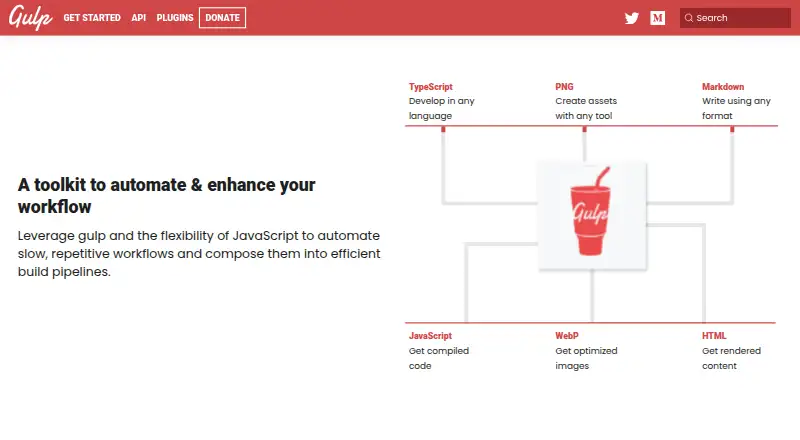
Gulp is a free toolkit for turning repetitive development work into automated build pipelines. Developers define tasks in JavaScript gulpfiles and can draw on Node modules; TypeScript or Babel can be used with matching transpiler modules. The `series()` and `parallel()` methods arrange tasks to run one after another or concurrently. For file workflows, `src()` opens a stream of file objects selected by globs, and `dest()` writes the pipeline output to the filesystem. Streams allow transformations in memory before writing files, while plugins—Node Transform Streams—can change file contents, names, or metadata. Gulp recommends plugins for file transformations and Node modules or libraries for other operations, and its site includes a plugin search page.
The `watch()` API can trigger tasks when matching files are created, changed, or deleted. On macOS, `fsevents` is optional, with a fallback watcher available when it is skipped. Gulp runs on Linux, macOS, and Windows, supports source maps, and offers a plugin API. The project describes integrations with major IDEs and use alongside PHP, .NET, Node.js, Java, and other platforms. Its repository identifies the license as MIT, and the project dates to 2013. Setup uses npm, with gulp-cli installed globally and gulp added as a project devDependency; Node.js, npm, and npx are prerequisites. Synchronous tasks are unsupported, so tasks need to signal completion asynchronously.
Who it suits
Gulp suits developers who want to compose recurring development or file-processing tasks into JavaScript-defined build pipelines. It is also relevant to teams working across Linux, macOS, or Windows and using the languages and platforms the project describes.
What it does well
- Free toolkit with an MIT license.
- Compose tasks sequentially or concurrently.
- Transform files through in-memory streams and plugins.
- Watch matching files for creation, changes, or deletion.
- Supports Linux, macOS, Windows, TypeScript, and source maps.
What to know first
- Synchronous tasks are unsupported.
- Tasks must signal completion asynchronously.
- Setup requires Node.js, npm, and npx.
Limits
Gulp does not support synchronous tasks; tasks must signal completion asynchronously.
Getting started
- Check that Node.js, npm, and npx are installed.
- Use npm to install gulp-cli globally.
- Add gulp as a project devDependency.
- Define tasks and workflows in a gulpfile using JavaScript, or use TypeScript or Babel with matching transpiler modules.
- Use `src()` to read selected files, plugins or libraries for operations, and `dest()` to write pipeline output.
Verdict
Choose Gulp if you want JavaScript-defined tasks, stream-based file processing, and control over sequential or concurrent task execution. Look elsewhere if your workflow depends on synchronous tasks, since Gulp requires asynchronous completion signals.
Questions
How much does Gulp cost?
Gulp is free, and its repository identifies the license as MIT.
Which operating systems does Gulp support?
Gulp runs on Linux, macOS, and Windows.
How do I install Gulp?
The Quick Start guide uses npm to install gulp-cli globally and gulp as a project devDependency. It asks users to check for Node.js, npm, and npx first.
Can I use TypeScript with Gulp?
Yes. The documentation describes using TypeScript or Babel with matching transpiler modules.
What platforms and IDEs does Gulp integrate with?
The project describes integrations with major IDEs and use with PHP, .NET, Node.js, Java, and other platforms.
Which Gulp versions receive security support?
The repository security policy supports version 4.x.x and marks versions below 4.0 unsupported. Enterprise security updates and licensing verification and indemnification are available through a Tidelift Subscription.
Facts from Gulp's own pages
- Code based configuration
- Gulp uses JavaScript code in gulpfiles to define tasks and workflows. · gulpjs.com, 8 Oct 2026
- Community
- The project invites contributors from every discipline to help maintain and improve Gulp. · gulpjs.com, 8 Oct 2026
- Compatibility
- The project describes Gulp as platform-agnostic and says integrations are built into major IDEs and it is used with PHP, .NET, Node.js, Java, and other platforms. · github.com, 8 Oct 2026
- Enterprise support
- Gulp for enterprise is available through a Tidelift Subscription, which includes security updates and licensing verification and indemnification. · gulpjs.com, 8 Oct 2026
- File input
- The src() API creates a stream for reading file objects from the file system based on globs. · gulpjs.com, 8 Oct 2026
- File processing
- Gulp’s `src()` and `dest()` methods read files into a stream and write pipeline output to the filesystem. · gulpjs.com, 8 Oct 2026
- File streams
- Gulp streams let workflows transform files in memory before writing them to disk. · gulpjs.com, 8 Oct 2026
- File watching
- The watch() API runs a task when files matching specified globs change. · gulpjs.com, 8 Oct 2026
- Founded
- 2013 · gulpjs.com, 28 Sept 2026
- Installation
- The Quick Start guide uses npm to install gulp-cli globally and gulp as a project devDependency. · gulpjs.com, 8 Oct 2026
- Integrations
- The project README describes integrations with major IDEs and use with PHP, .NET, Node.js, Java, and other platforms. · github.com, 8 Oct 2026
- JavaScript tasks
- Gulpfiles use JavaScript, and tasks can also use Node modules. · gulpjs.com, 8 Oct 2026
- Languages
- Gulpfiles can use JavaScript, and the documentation describes using TypeScript or Babel with matching transpiler modules. · gulpjs.com, 8 Oct 2026
- License
- The project's GitHub repository identifies its license as MIT. · github.com, 8 Oct 2026
- Plugin ecosystem
- Gulp plugins are Node Transform Streams that transform files in a pipeline, and the project site provides a plugin search page. · gulpjs.com, 8 Oct 2026
- Plugin guidance
- Gulp recommends using plugins for file transformations and Node modules or libraries for other operations. · gulpjs.com, 8 Oct 2026
- Plugins
- Gulp plugins are Node Transform Streams that can change files’ names, metadata, or contents in a pipeline. · gulpjs.com, 8 Oct 2026
- Purpose
- Gulp is a toolkit for automating slow or repetitive development workflows and composing them into build pipelines. · gulpjs.com, 8 Oct 2026
- Runtime requirement
- The Quick Start guide asks users to check that Node.js, npm, and npx are installed. · gulpjs.com, 8 Oct 2026
- Security support
- The repository security policy lists version 4.x.x as supported and versions below 4.0 as unsupported, and directs vulnerability reports to Tidelift. · github.com, 8 Oct 2026
- Task composition
- The `series()` and `parallel()` methods compose tasks for sequential or concurrent execution. · gulpjs.com, 8 Oct 2026
- Task limitation
- Synchronous tasks are not supported; tasks must signal completion asynchronously. · gulpjs.com, 8 Oct 2026
Where Gulp stands on Freedom251
- JavaScript Build Tools#8 of 27