Freedom251 › Game Matchmaking Software

GS2-Matchmaking
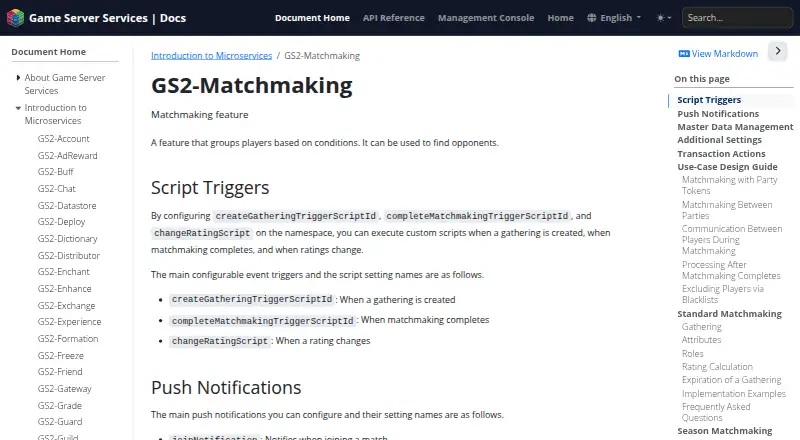
What GS2-Matchmaking is
GS2-Matchmaking is a managed service for grouping players by conditions and finding opponents. In standard matchmaking, a player creates a gathering and eligible players join; it is deleted when the required player count is reached. Matching conditions can use up to five player attributes, role capacities, ratings, allowlists, and blacklists. Ratings use a Glicko-2-based calculation, starting at 1500 and changing with game results. Party tokens let players create or join gatherings with party members already present; player tokens last 3 minutes and party tokens 10 minutes. Season matchmaking keeps gatherings for a set period and supports up to 1000 players per gathering. However, its search condition is limited to GS2-Experience rank, and players cannot leave a persistent gathering during the season. The service also supports latency or region matching and server allocation. SDKs are available for Unity, Unreal Engine 5, Godot 4, Go, PHP, Java, C#, TypeScript, and Python. The Individual free plan has eligibility and request-rate restrictions.
Who it suits
GS2-Matchmaking suits game teams building opponent searches, party matching, or persistent seasonal gatherings. Its SDKs cover game engines and several programming languages.
What it does well
- Standard matchmaking supports up to five player attributes.
- Party tokens support gatherings with existing party members.
- Season gatherings can hold up to 1000 players.
- Supports latency or region matching and server allocation.
- SDKs include Unity, Unreal Engine 5, and Godot 4.
What to know first
- Season searches only support GS2-Experience rank.
- Players cannot leave season gatherings during the season.
- Individual plan has eligibility and request-rate restrictions.
- Business Support is listed at 3,000 USD per month.
Limits
The Individual plan is free for individuals or corporations with sales under 10 million yen in the past 12 months, is unavailable above stated request-rate thresholds, and requires the GS2 logo at launch. Professional and Enterprise plans include a free allowance up to 200 USD monthly; their listed billing terms apply after usage exceeds that allowance.
Plans
| Plan | Billed and limits | Price |
|---|---|---|
| Individual | Sales under USD 100,000 in the previous 12 months · all features · GS2 logo required on title screen | Free |
| Prototyping | Pre-release prototype phase · includes Business Support · maximum three months | $1,000 a month |
| Professional Service | per hour · Requires Business Support · minimum one hour per session | $200, paid once |
| Business Support | per project · Private chat support · up to 15 support hours monthly | $3,000 a month |
| Enterprise | ASK · Free allowance up to 200 USD monthly; usage fee applies after limit | On request |
| Professional | Pay-as-you-go · Sales of USD 100,000 or more in the previous 12 months · USD 0.00003–0.0001 per API request · usage under USD 100/month free | On request |
As docs.gs2.io lists them, read 14 Oct 2026. The maker's own page has the final word.
Getting started
- Open the GS2-Matchmaking documentation website.
- Choose a supported platform or SDK for your game.
- Select an Individual, Professional, or Enterprise plan.
- Configure standard matchmaking conditions or season matchmaking for a specified period.
- Use the matching communication integrations recommended for your communication frequency.
GS2-Matchmaking is a managed player-grouping service for game teams that need to form matches around defined conditions. It is a strong fit for teams using GS2’s wider service and SDK ecosystem, but its persistent season mode and free-plan eligibility come with meaningful constraints.
Overview
Standard matchmaking creates a gathering that eligible players can join; once it reaches its required player count, the gathering is deleted. That makes it suited to assembling discrete matches, not maintaining a group between sessions. Teams can set up to five player attributes and specify recruitment capacity by role, with conditions covering attribute ranges, role aliases, ratings, allowlists and blacklists.
The service also supports party play, latency- and region-aware matching, and server allocation. Party tokens let a group create or join a gathering together, but their 10-minute lifetime—and the 3-minute lifetime for player tokens—requires a timely flow from token creation through matchmaking.
Key features
Ratings use a Glicko-2-based process, starting at 1500 and changing with game results. For games that need ratings to feed into seasonal competition, configured matches can integrate with GS2-SeasonRating, which creates a session ready to accept results after matchmaking completes.
Season matchmaking keeps gatherings persistent for a specified period, optionally set with GS2-Schedule, and supports up to 1,000 players in each gathering. That scale can suit long-running seasonal groups, but the mode is far less flexible than standard matchmaking: it only searches by GS2-Experience rank, and players cannot leave a persistent gathering during the season.
For communications, GS2 recommends GS2-Chat for low-frequency use up to three times per second and GS2-Realtime for high-frequency communication during matchmaking. After a match, GS2-Gateway can send in-game push notifications, GS2-JobQueue can register jobs, and GS2-Script can run custom scripts. These integrations make the service more compelling for teams assembling a broader GS2-based game backend than for teams seeking a standalone queue.
SDKs cover Unity, Unreal Engine 5 and Godot 4, as well as Go, PHP, Java, C#, TypeScript and Python. One security boundary matters: GS2 manages player data such as item counts server-side, but does not protect against tampering with game executables or runtime memory.
Pricing
The free Individual plan costs nothing. It is limited to individuals or corporations with sales under 10 million yen in the past 12 months, excludes users above stated request-rate thresholds, and requires the GS2 logo at launch. Those terms make it useful for eligible small projects, but a poor fit for established businesses or teams that cannot accept the branding and rate conditions.
Enterprise uses custom pricing, billed ASK, with a free allowance up to 200 USD monthly; usage fees apply after that limit. Professional is also custom pricing, billed pay-as-you-go at the usage fee. It is free until monthly usage exceeds 200 USD, at which point the entire usage amount is charged—not just the portion above the allowance. Both paid plans move beyond Individual’s eligibility rules, but teams should account for the different charging terms.
Basic forum support is free. Business Support costs 3,000 USD per month and includes up to 15 hours of support, a substantial additional cost for teams that need a defined support allocation.
Platforms
GS2-Matchmaking supports Android, iOS, Linux, macOS and Windows, along with API and web access. It is managed rather than self-hosted, despite self-hosted platform availability in its directory profile; teams choosing it should expect a managed deployment model.
Who it's for
Choose GS2-Matchmaking if your game needs configurable standard queues, party grouping, ratings or server allocation, particularly when GS2 integrations and SDKs fit the rest of your stack. It is less suitable when seasonal groups need to leave freely or search on conditions beyond GS2-Experience rank. The free tier is practical only for teams that meet its sales and request-rate conditions and can display the logo.
Pros and cons
- Pros: Standard gatherings support up to five attributes and role-based capacities, giving teams meaningful control over how matches fill.
- Pros: Party matching, Glicko-2-based ratings, latency/region matching and server allocation address several parts of match formation in one service.
- Pros: Broad engine and language SDK support plus post-match GS2 integrations can suit teams building around the same ecosystem.
- Cons: Season matchmaking is restricted to GS2-Experience rank and prevents players from leaving during the season.
- Cons: The free Individual plan has sales and request-rate eligibility limits and requires GS2 branding at launch.
- Cons: Professional charges the full monthly usage amount once usage exceeds 200 USD, while Business Support adds 3,000 USD per month.
Alternatives
Browse game matchmaking software to compare more options. For a free plan with no stated Individual-plan sales or logo conditions in its brief, consider brainCloud; its listed free plans include developer support and a development option. Choose Edgegap if you want to evaluate a paid service through a time-limited free trial on a shared environment, rather than start with GS2’s ongoing free Individual plan.
Metaplay is a better fit if local development is the priority: its free plan provides a full SDK and local server with no hard limits on local development. Photon Realtime may suit development-only projects that fit its 20 concurrent-user plan and 60.0 GB monthly traffic allowance. For teams that want a public-cloud option free while building and usage fees as players arrive, consider AccelByte Gaming Services.
If self-hosting is a priority, Colyseus offers a free open-source plan for self-hosting on your own servers. Epic Online Services is another free option with no royalty or hosting fees, though service usage restrictions may apply. SmartFoxServer offers a free Community Edition with a 100 concurrent-user limit.
Verdict
GS2-Matchmaking is a solid choice for game teams that want configurable standard matchmaking, party grouping and ratings alongside GS2 integrations and broad SDK support. Its strongest case is a GS2-centered backend with discrete match flows; look elsewhere if seasonal groups must be flexible, or if the Individual plan’s eligibility, rate and branding conditions do not work for your project.
Verdict
GS2-Matchmaking provides standard and seasonal gathering flows, ratings, party matching, and server allocation. Seasonal search and leaving rules are restrictive, and the free Individual plan has eligibility and request-rate conditions.
Questions
Is GS2-Matchmaking free?
Yes. The Individual plan is listed as free, subject to eligibility, request-rate thresholds, and a GS2 logo requirement at launch. Professional and Enterprise plans have a free allowance up to 200 USD monthly.
What does GS2-Matchmaking cost on paid plans?
Professional is billed pay-as-you-go at the usage fee; when monthly usage exceeds 200 USD, the entire usage amount is charged. Enterprise is billed ASK, with usage fees applying after the free allowance up to 200 USD monthly.
Which platforms and SDKs does it support?
Listed platforms include Android, API, iOS, Linux, macOS, self-hosted, web, and Windows. SDKs are available for Unity, Unreal Engine 5, Godot 4, Go, PHP, Java, C#, TypeScript, and Python.
Can players join matches as a party?
Yes. Party tokens allow a gathering to be created or joined with party members already present. Player tokens last 3 minutes, while party tokens last 10 minutes.
What are the limits of season matchmaking?
A season gathering can hold up to 1000 players for a specified period. Search supports only GS2-Experience rank, and players cannot leave the persistent gathering during the season.
What integrations are recommended?
The documentation recommends GS2-Chat for low-frequency communication up to 3 times per second and GS2-Realtime for high-frequency communication during matchmaking. After a match, GS2-Gateway can deliver in-game push notifications, GS2-JobQueue can register jobs, and GS2-Script can run custom scripts.
Facts from GS2-Matchmaking's own pages
- Attributes and roles
- Standard matchmaking supports up to five player attributes and lets a gathering set recruitment capacity by role. · docs.gs2.io, 29 Sept 2026
- Blacklist control
- User IDs can be blacklisted when creating or searching for a gathering, excluding those players from matchmaking. · docs.gs2.io, 14 Oct 2026
- Cloud delivery
- An independent 2020 PR release describes GS2 as a managed game-focused BaaS whose APIs cover accounts, currencies and event schedules without customer server operations. · prtimes.jp, 14 Oct 2026
- Communications integrations
- The documentation recommends GS2-Chat for low-frequency communication up to 3 times per second and GS2-Realtime for high-frequency communication during matchmaking. · docs.gs2.io, 29 Sept 2026
- Company founding
- Game Server Services states that it was established on September 7, 2016. · gs2.io, 14 Oct 2026
- Company headquarters
- The company page lists headquarters at 2-15-1 Shimoma, Setagaya-ku, Tokyo, Japan. · gs2.io, 14 Oct 2026
- Company legal name
- The maker identifies itself as Game Server Services 株式会社 (Game Server Services, Inc.). · gs2.io, 14 Oct 2026
- Customisation
- Server-side Lua scripts and AWS Lambda functions in the customer's AWS account can extend GS2 processing. · gs2.io, 14 Oct 2026
- Documentation depth
- The documentation includes tutorials, API references, technical documentation, design guides, samples, SDK setup and service-limit guidance. · docs.gs2.io, 14 Oct 2026
- Founded
- 2016 · docs.gs2.io, 23 Sept 2026
- Funding
- A 2018 independent industry report says the company raised JPY 80 million from Daiwa Corporate Investment, GameWith, KLab Venture Partners and DeNA. · gamebusiness.jp, 14 Oct 2026
- Game-engine SDKs
- Official SDKs are provided for Unity, Unreal Engine 5 and Godot 4. · docs.gs2.io, 14 Oct 2026
- Godot integration
- The Godot 4 SDK is copied into a project's addons/gs2 directory and offers both Ez and low-level API layers. · docs.gs2.io, 14 Oct 2026
- Headquarters
- Setagaya-ku, Tokyo, Japan · docs.gs2.io, 23 Sept 2026
- Limit: review evidence
- G2 says there are not enough Game Server Services reviews to provide buying insight. · g2.com, 14 Oct 2026
- Notable news: AWS award
- AWS reported that GS2 won the audience award in its 2018 Startup Architecture of the Year program. · aws.amazon.com, 14 Oct 2026
- Party matchmaking
- Party tokens let pre-formed groups enter a gathering together, and party-versus-party flows are supported. · docs.gs2.io, 14 Oct 2026
- Party play
- Party tokens allow a gathering to be created or joined with party members already present; player tokens last 3 minutes and party tokens last 10 minutes. · docs.gs2.io, 29 Sept 2026
- Post-match extensibility
- Completion can trigger GS2-JobQueue jobs, arbitrary GS2-Script execution, or GS2-Realtime gathering creation. · docs.gs2.io, 14 Oct 2026
- Post-match integrations
- After a match completes, GS2-Gateway can deliver in-game push notifications, GS2-JobQueue can register jobs, and GS2-Script can run custom scripts. · docs.gs2.io, 29 Sept 2026
- Praise: reduced backend burden
- Independent coverage presents GS2 as useful for developers who can build games but lack server-development expertise. · gamebusiness.jp, 14 Oct 2026
- Praise: serverless scalability
- AWS coverage highlights GS2's use of Lambda, API Gateway and DynamoDB to avoid idle virtual-server costs and support scaling. · aws.amazon.com, 14 Oct 2026
- Public API
- The API reference documents operations such as doMatchmakingByUserId, rating queries and early completion, with request limits and result schemas. · docs.gs2.io, 14 Oct 2026
- Purpose
- GS2-Matchmaking groups players based on conditions and can be used to find opponents. · docs.gs2.io, 29 Sept 2026
Where GS2-Matchmaking stands on Freedom251
- Game Matchmaking Software#7 of 28