Freedom251 › API Governance Software
Grapity
What Grapity is
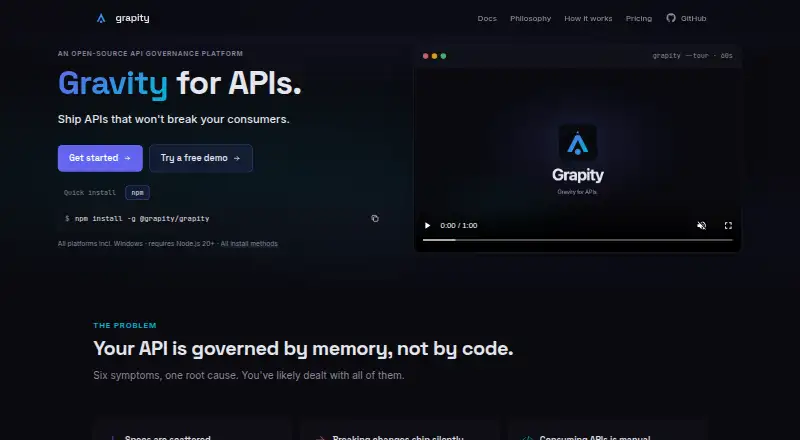
Grapity is an open-source API governance platform for teams managing API contracts and coordinating changes with consumers. Its Registry checks each pushed OpenAPI or AsyncAPI specification against its previous version. When it finds a breaking change, it blocks the change and explains why. The Registry also enforces semantic version increments and tracks deprecation lifecycles, including affected consumers and sunset dates.
The Hub gives teams a searchable API catalogue, endpoint exploration, side-by-side version comparisons and a timeline of versions. For Kong deployments, Grapity Gateway generates Kong configuration from registered specifications, and the CLI provisions it through decK. Kong can also send access logs to the Registry through its http-log plugin for queries and traffic statistics. Grapity supports CI/CD integration and role-based access control, and can run on the web, Windows, macOS, Linux or as a self-hosted service.
The project is licensed under Apache 2.0 and says no features are locked behind paywalls. Self-hosted use is free forever. Its Cloud plan is $29.95 a month, including five APIs and five users, with additional monthly charges for more APIs or users. The site also describes Forge typed clients, Schema registry bridges and Mind LLM-optimized specifications as planned for later.
Who it suits
Grapity suits teams that need to govern API contracts, catch breaking changes and coordinate deprecations with consumers. It can also suit teams using Kong that want configuration generated from registered API specifications.
What it does well
- Blocks breaking specification changes and explains the reason.
- Tracks consumers and sunset dates for API deprecations.
- Hub includes endpoint exploration and version comparisons.
- Supports OpenAPI, AsyncAPI, CI/CD and role-based access.
- Free self-hosted plan allows unlimited APIs and team members.
What to know first
- Cloud includes five APIs and five users before extra charges.
- Windows CLI installation uses npm or WSL; npm requires Node.js 20 or later.
Limits
The free Self-hosted plan is listed as free forever, with unlimited APIs and team members and self-managed PostgreSQL. Cloud costs $29.95 a month and includes five APIs and five users; each additional API costs $1.99 a month and each additional user costs $0.99 a month.
Plans
| Plan | Billed and limits | Price |
|---|---|---|
| Self-hosted | Free forever · Unlimited APIs · Unlimited team members · Self-managed PostgreSQL | Free |
| Cloud | $29.95/mo · 5 APIs and 5 users included · +$1.99 per additional API / mo · +$0.99 per additional user / mo | $29.95 a month |
As grapity.dev lists them, read 7 Oct 2026. The maker's own page has the final word.
Getting started
- Visit grapity.dev.
- Choose the self-hosted free plan or the Cloud plan at $29.95 a month.
- For CLI installation, use the macOS or Linux installer, or use npm or WSL on Windows.
- If installing through npm, use Node.js 20 or later.
- Register API specifications to use Registry checks and the Hub.
Grapity is an open-source platform for governing API contracts, versions and consumer access. It is best suited to teams that want compatibility checks and lifecycle controls alongside a searchable developer portal. Its strongest case is bringing those governance steps together, though its Cloud plan’s per-API and per-user charges can add up as teams grow.
Overview
Grapity compares pushed API specifications against their previous versions and blocks breaking changes with an explanation. That makes it useful for teams coordinating changes across API producers and consumers: the Registry can catch incompatible revisions before they move forward, while version rules give teams a way to manage deprecation rather than treating each release in isolation.
The project is open source under Apache 2.0, and its maker says features are not locked behind paywalls. It supports OpenAPI and AsyncAPI, with CI/CD integration and role-based access control. Forge typed clients, Schema registry bridges and Mind LLM-optimized specifications are described as future work, not current capabilities.
Key features
Contracts and lifecycle
The Registry enforces semantic version increments and tracks API deprecation, including consumers and sunset dates. These controls help teams make version changes explicit and see who may be affected before a sunset; they are most valuable when API ownership spans multiple teams.
Consumer visibility and gateway workflow
The Hub offers a searchable API list, endpoint exploration, side-by-side version comparisons and a version timeline. This gives consumers a way to inspect contracts and changes without relying solely on release announcements. For Kong users, Grapity Gateway generates configuration from registered specifications, and the CLI provisions it through decK. Kong’s http-log plugin can send access logs to the Registry for queries and traffic statistics, extending governance into operational visibility.
Pricing
The Self-hosted plan costs nothing, billed Free forever. It includes unlimited APIs, unlimited team members and self-managed PostgreSQL. This is the most flexible choice for teams able to run and maintain their own deployment; the trade-off is taking responsibility for that infrastructure.
Cloud costs $29.95 a month, billed $29.95/mo, and includes 5 APIs and 5 users. Additional APIs cost +$1.99 per API / mo and additional users +$0.99 per user / mo. The included allowances make the plan straightforward for a small team, but its incremental charges mean larger catalogs or teams will need to account for usage beyond both caps. Grapity also offers a free demo service; demo instances and credentials expire and are deleted after two hours.
Platforms
Grapity supports Linux, macOS, self-hosted deployment, the web and Windows. Its CLI has installers for macOS and Linux; Windows users are directed to npm or WSL, and npm installation requires Node.js 20 or later. That gives Windows teams options, but not a dedicated Windows installer.
Who it's for
Grapity fits teams that need to manage API contracts, prevent breaking changes and coordinate consumers, particularly where semantic versioning and deprecation dates are part of release governance. Kong teams can also use its configuration and log integrations. It is less compelling for organizations that only need a narrow API linting or testing tool, or that do not want to self-manage infrastructure and find Cloud’s included quotas too small.
Pros and cons
Pros
- Breaking-change checks include an explanation, helping teams understand why a specification revision is blocked.
- Unlimited APIs and team members on the free self-hosted plan avoid product-imposed catalog and seat caps.
- Consumer tracking, sunset dates and version comparison connect contract changes to their likely audience.
- Kong configuration generation and access-log querying extend the workflow beyond specification review.
Cons
- The free plan is self-managed and uses self-managed PostgreSQL, so teams must operate their own deployment.
- Cloud includes only 5 APIs and 5 users before monthly add-on charges apply.
- Windows CLI installation relies on npm or WSL rather than a dedicated installer; npm requires Node.js 20 or later.
- Several named capabilities, including typed clients and schema registry bridges, are future roadmap items rather than current features.
Alternatives
API Governance Software is the broader category to browse when comparing governance tools beyond Grapity.
Choose ATA API Governance if its free tier’s allowance of 30 endpoints, 1 team, 3 users and 5 Developer Studio applications better fits a small deployment; its Startup plan is $35.60 a year. Pick oasdiff when an open-source Apache 2.0 engine, CLI or GitHub Action for API diffing is the priority rather than Grapity’s combined governance and portal workflow.
Postman is another freemium option for teams seeking an API client and core tools, specifications, mock servers, Native Git and Collection Runner on its free plan. Choose Routebase if a free plan centered on 1 user, 2 projects, 1,000 mock requests per month and an auto-generated documentation portal suits the work better.
Zally is a free, MIT-licensed API linter maintained by Zalando, making it a narrower alternative when linting is the need. Choose Karate for its free MIT-licensed framework covering REST, GraphQL and SOAP API testing as well as browser and desktop UI automation.
API Architect offers a web-based free tier for 1 active project with essential features and community support; its Starter plan is €29 a month for 2 active projects and standard API analytics. Apigee API hub is available at no additional cost to eligible Apigee organizations in supported regions, with an API hub-supported region required.
Verdict
Grapity is a strong fit for teams that need contract compatibility checks, version lifecycle controls and consumer visibility in one API governance workflow. Its unlimited free self-hosted plan is a clear advantage for teams comfortable operating their own PostgreSQL-backed deployment. Look elsewhere if you need a managed option with room to grow without per-API and per-user add-ons, or if your requirement is only a focused linter or testing framework.
Verdict
Choose Grapity if your team needs API compatibility checks, version lifecycle controls and consumer visibility in one governance platform. Its free self-hosted plan includes unlimited APIs and team members. Consider the Cloud plan’s included limits and additional monthly charges when deciding how to run it.
Questions
Is Grapity open source?
Yes. Grapity says it is open source under the Apache 2.0 license and that no features are locked behind paywalls.
Does Grapity have a free plan?
Yes. Its Self-hosted plan is free forever and includes unlimited APIs and team members, with self-managed PostgreSQL.
How much does Grapity Cloud cost?
Cloud costs $29.95 a month and includes five APIs and five users. Additional APIs cost $1.99 a month each, and additional users cost $0.99 a month each.
Which API formats does Grapity govern?
The listed formats are OpenAPI and AsyncAPI.
Which platforms does Grapity support?
Grapity lists web, Windows, macOS, Linux and self-hosted availability. The CLI has macOS and Linux installers; Windows users are directed to npm or WSL.
Does Grapity integrate with Kong?
Yes. Grapity Gateway generates Kong configuration from registered specifications, and the CLI provisions it through decK. Kong can send access logs to the Registry through its http-log plugin.
Facts from Grapity's own pages
- Compatibility checks
- The Registry compares each pushed spec with its previous version and blocks breaking changes with an explanation. · grapity.dev, 7 Oct 2026
- Demo retention
- Demo instances and their credentials expire and are deleted two hours after creation. · grapity.dev, 7 Oct 2026
- Developer portal
- The Hub provides a searchable API list, endpoint exploration, side-by-side version comparison, and a version timeline. · grapity.dev, 7 Oct 2026
- Gateway integration
- Grapity Gateway generates Kong configuration from registered specs, and the CLI provisions it to Kong via decK. · grapity.dev, 7 Oct 2026
- Gateway logs
- Kong can send access logs to the Registry through its http-log plugin for querying and traffic statistics. · grapity.dev, 7 Oct 2026
- Installation
- The CLI supports macOS and Linux installers; Windows users are directed to npm or WSL, and npm installation requires Node.js 20 or later. · grapity.dev, 7 Oct 2026
- Intended users
- Grapity presents the product for teams that need to manage API contracts, prevent breaking changes, and coordinate API consumers. · grapity.dev, 7 Oct 2026
- License
- The project says it is open source under the Apache 2.0 license, with no features locked behind paywalls. · grapity.dev, 7 Oct 2026
- Privacy and security
- For its demo service and website, Grapity says it uses HTTPS, signed session cookies, and rate limiting, and does not store passwords or billing information. · grapity.dev, 7 Oct 2026
- Product
- Grapity describes itself as an open-source API governance platform for shipping APIs without breaking consumers. · grapity.dev, 7 Oct 2026
- Roadmap
- The site labels Forge typed clients, Schema registry bridges, and Mind LLM-optimized specs as coming later. · grapity.dev, 7 Oct 2026
- Support
- The maker lists [email protected] for contact and privacy questions, and says community support is available through GitHub Sponsors. · grapity.dev, 7 Oct 2026
- Versioning
- The Registry enforces semantic version increments and tracks API deprecation lifecycles, including consumers and sunset dates. · grapity.dev, 7 Oct 2026
Where Grapity stands on Freedom251
- API Governance Software#5 of 25