Freedom251 › API Governance Software
ATA API Governance
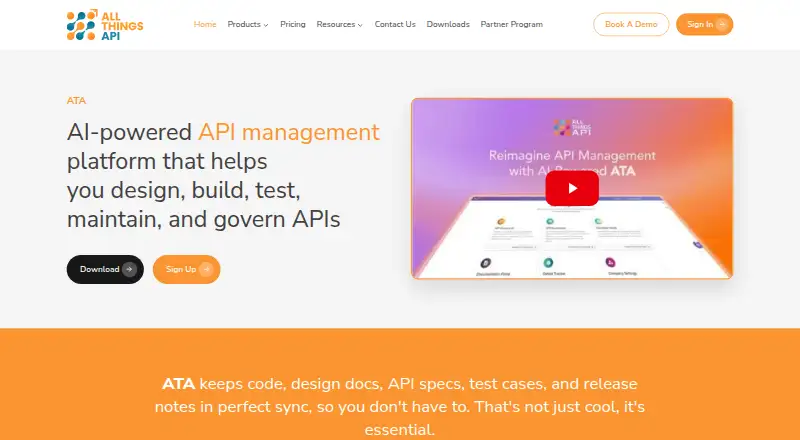
What ATA API Governance is
ATA API Governance helps teams manage API ownership, specifications, rules, lifecycles, and dependencies in one place. Its inventory records each API’s endpoint, method, version, exposure type, owner, and deployment status across environments. Teams can track APIs from draft to deprecated and manage multiple versions. A dependency tree connects owners, consumer teams, projects, and services to help assess the reach of a change. Custom governance rules check OpenAPI structure, methods, naming, headers, and security standards, with live feedback on violations; reusable schemas can flag mismatches. A dashboard reports security protocols in use, potential PII exposure, and APIs missing required schemas. Ask AI answers questions about projects, APIs, rules, schema usage, and versions. ATA offers web, desktop, Linux, command-line, agent, and browser-extension options. The free plan includes 30 endpoints; paid plans increase endpoint limits, and Enterprise limits are custom. ATA states its services are not designed for HIPAA, FISMA, or GLBA compliance.
Who it suits
It suits teams that need shared visibility and rules for APIs across projects and environments. Teams with HIPAA, FISMA, or GLBA compliance requirements should note that ATA says its services are not designed for those standards.
What it does well
- Tracks API owners, versions, and deployment status.
- Maps dependencies across teams, projects, and services.
- Custom OpenAPI rules provide real-time violation feedback.
- Free plan includes 30 API Governance endpoints.
- Available on web, desktop, Linux, and as an extension.
What to know first
- Free plan is limited to 30 endpoints.
- Basic and Startup endpoint limits are 100 and 500.
- Services are not designed for HIPAA, FISMA, or GLBA compliance.
Plans
| Plan | Billed and limits | Price |
|---|---|---|
| Free | UI automation basics · API testing · 3 users · 500 endpoints · 2 scheduled monitoring runs · 7-day monitoring history · 30 governance endpoints | Free |
| Basic | per user/month, billed annually · 10 users · 800 endpoints · 5 scheduled monitoring runs · 15-day monitoring history · 25,000 mock calls/user/month · 100 governance endpoints | $10.58 |
| Startup | per user/month, billed annually · 200 users · 7,500 endpoints · 60 scheduled monitoring runs · 60-day monitoring history · 100,000 mock calls/user/month · 500 governance endpoints | $35.60 |
| Enterprise | Custom users, endpoints, monitoring, history, testing, documentation, SSO and support · dedicated server listed at $10,000/month | On request |
As ata.dev lists them, read 15 Oct 2026. The maker's own page has the final word.
Overview
ATA API Governance is a portfolio governance product for teams that need to coordinate API ownership, standards and change impacts across multiple services. It suits organizations managing shared APIs across teams; its appeal is the combination of inventory, lifecycle tracking and configurable rules, though endpoint caps and regulatory boundaries deserve close attention.
Its inventory records endpoints, methods, versions, exposure types, owning teams and environment deployment status. Lifecycle tracking spans draft to deprecated and supports multiple versions. That breadth gives governance teams a clearer portfolio view than a collection of isolated specifications, while a visual dependency tree helps identify the teams, projects and services affected by a change.
Key features
Teams can set OpenAPI rules for structure, methods, naming, headers and security standards, with real-time violation feedback. Reusable schema components and mismatch alerts help keep APIs aligned to shared expectations. Style guide enforcement, linting, design review workflows and role-based access control make this a governance layer rather than just an inventory.
The dashboard surfaces commonly used security protocols, potential PII exposure and APIs missing required schemas. Those signals can direct review, but they are not a certification that an API is compliant or secure. Ask AI answers questions about projects, APIs, rules, schema usage and versions, potentially useful when navigating a broad portfolio.
ATA displays ISO 27001:2022, ISO 42001 and SOC 2 Type II badges. It says it encrypts sensitive information, limits access to authorized personnel and conducts regular security assessments and audits. Its subprocessors include OpenAI in the United States for AI research and deployment, and AWS in Northern Virginia for cloud product services. Teams handling regulated workloads should note that ATA's terms say its services are not designed for HIPAA, FISMA or GLBA compliance.
Pricing
The free plan costs nothing and allows 30 API Governance endpoints, 1 team and 3 users, plus 5 Developer Studio applications. It is a constrained way for a small team to assess portfolio governance, but the endpoint ceiling makes it a limited long-term fit as coverage grows.
Basic costs $10.58 a year (billed per user/month, billed annually). It raises the caps to 100 endpoints, 3 teams and 10 users, with 10 Developer Studio applications. This is the paid step for a small cross-team rollout, though its endpoint allowance remains modest.
Startup costs $35.60 a year (billed per user/month, billed annually), with 500 endpoints, 20 teams and 200 users, and 50 Developer Studio applications. It is the more credible fit for a growing organization that needs broader governance coverage. Enterprise has custom pricing and custom endpoint, user, team and application limits, plus SSO and a dedicated server option, making it the tier for organizations needing tailored capacity or those controls.
Paid plans offer Basic, Premium and Priority Support options. The pricing terms also matter at scale: endpoint limits rise by tier, while Enterprise is the only plan with a custom endpoint count.
Platforms
ATA offers a web platform, Windows and Mac desktop clients, Linux downloads, a command-line npm package, local and server agents, and the ATA Bridge browser extension. That mix accommodates browser-based work and teams that need desktop, command-line or agent-based access.
Who it's for
ATA is best suited to organizations coordinating API standards, ownership and dependencies across teams, especially where OpenAPI rules and shared schemas are important. It is less suitable for teams whose endpoint footprint exceeds the applicable caps without Enterprise, or for workloads requiring HIPAA, FISMA or GLBA compliance. Its support contact is [email protected].
Pros and cons
- Pros: Inventory, lifecycle status and dependency mapping bring ownership and change impact into one governance view.
- Pros: Custom OpenAPI rules, schema mismatch alerts and real-time feedback give teams practical ways to enforce shared conventions.
- Pros: Windows, Mac, Linux, web, CLI, agents and browser extension options suit varied development environments.
- Cons: Free is limited to 30 endpoints, and even Basic tops out at 100; larger portfolios need Startup or custom Enterprise capacity.
- Cons: The stated exclusion of HIPAA, FISMA and GLBA compliance rules ATA out for some regulated use cases.
Alternatives
Choose oasdiff if an open-source API diff engine, CLI or GitHub Action under the Apache 2.0 license is a better fit than ATA's broader governance approach. Choose Postman if API client and core tools, specs and mock servers, Native Git and Collection Runner matter more to your workflow.
Routebase is an alternative with a free tier covering one user, two projects, 1,000 mock requests per month, an auto-generated docs portal, and OpenAPI import and export. Karate is an alternative with a free MIT-licensed framework for REST, GraphQL and SOAP API testing, plus browser and desktop UI automation.
Apigee API hub is available at no additional cost to eligible Apigee organizations in supported regions. Apiway is an alternative with a free allowance of 200,000 credits on a company address or 100,000 on a personal address, once, and limits of 100 reads and 10 writes per minute. CodeRifts offers a free tier with 1,000 authorization cases per month and verification always free. Grapity is another alternative.
For more options, browse API Governance Software.
Verdict
ATA API Governance is a strong choice for teams that need a shared API inventory with lifecycle controls, dependency visibility and enforceable OpenAPI conventions. Choose it for portfolio governance and growing cross-team programs; look elsewhere if the tier endpoint caps are too restrictive or your compliance needs include HIPAA, FISMA or GLBA.
Verdict
ATA API Governance brings API inventory, lifecycle controls, dependency mapping, and configurable rules together. Check the endpoint caps and stated regulatory limits against your team’s needs.
Facts from ATA API Governance's own pages
- Access management
- Auditable approval workflows control which consumers can use particular APIs. · ata.dev, 15 Oct 2026
- Agent platforms
- ATA Agent downloads are offered for Windows, Mac and Linux. · ata.dev, 15 Oct 2026
- AI assistant
- Ask AI answers questions about projects, APIs, active governance rules, schema usage, and versions. · ata.dev, 2 Oct 2026
- API inventory
- API Governance provides a centralized inventory showing API status, versions, ownership and schemas. · ata.dev, 15 Oct 2026
- API testing
- ATA supports ad-hoc API testing, API chaining, security checks, performance checks, robustness testing and vulnerability testing. · ata.dev, 15 Oct 2026
- Ask AI
- The built-in assistant answers questions about projects, rules, schemas, API versions and governance policies. · ata.dev, 15 Oct 2026
- Browser extension
- ATA Bridge is a Chrome extension for recording interactions, capturing screenshots and creating issues. · chromewebstore.google.com, 15 Oct 2026
- CLI and CI/CD
- ATA CLI is distributed as an npm package for running tests and workflows from a terminal or CI/CD process. · ata.dev, 15 Oct 2026
- Company founded
- G2's seller profile lists Pioneer AI Technologies LLC as founded in 2024. · g2.com, 15 Oct 2026
- Company headquarters
- ATA lists a sales office at 545 Metro Place South, Suite 100, Dublin, Ohio, USA. · ata.dev, 15 Oct 2026
- Company legal name
- The product footer identifies the maker as Pioneer AI Technologies LLC. · ata.dev, 15 Oct 2026
- Company size
- LinkedIn lists Pioneer AI Technologies as a self-owned IT services company with 51–200 employees. · linkedin.com, 15 Oct 2026
- Compliance limitation
- Terms state that the service is not designed for HIPAA, FISMA or GLBA compliance obligations. · ata.dev, 15 Oct 2026
- Data processors
- ATA lists OpenAI in the United States for AI research and deployment and AWS in Northern Virginia for cloud product services as subprocessors, current as of July 21, 2025. · ata.dev, 2 Oct 2026
- Dependency mapping
- Dependency views show producer and consumer relationships and help assess the effect of API changes. · ata.dev, 15 Oct 2026
- Deployment and platforms
- ATA offers a web platform, desktop clients for Windows and Mac, Linux downloads, a command-line npm package, local and server agents, and the ATA Bridge browser extension. · ata.dev, 2 Oct 2026
- Desktop support
- The desktop client is installable on Windows and Mac computers. · ata.dev, 15 Oct 2026
- Documentation depth
- The documentation site organizes Governance.dev into API Governance, AI Governance, Controls and Compliance, Developer Studio and Engineering Health pillars. · docs.ata.dev, 15 Oct 2026
- Documentation portal
- Documentation Portal offers Markdown, HTML and visual editing, versioned publishing, API linking, access control and public or private sharing. · ata.dev, 15 Oct 2026
- Governance dashboard
- The dashboard reports API versions, schema status, usage, security protocols, PII exposure and ownership. · ata.dev, 15 Oct 2026
- Headquarters
- Dublin, Ohio, United States · ata.dev, 28 Sept 2026
- Integrations
- ATA advertises Jira issue synchronization and third-party integrations for sourcing and deployment. · ata.dev, 15 Oct 2026
- Inventory
- Its inventory lists APIs across teams and applications with endpoint, method, version, exposure type, owning team, and environment deployment status. · ata.dev, 2 Oct 2026
- Licence
- The terms identify Pioneer AI Technologies as owner of the site's source code and software content; no open-source licence is stated. · ata.dev, 15 Oct 2026
Where ATA API Governance stands on Freedom251
- API Governance Software#2 of 25