Freedom251 › Distributed Tracing Tools
Google Cloud Trace
What Google Cloud Trace is
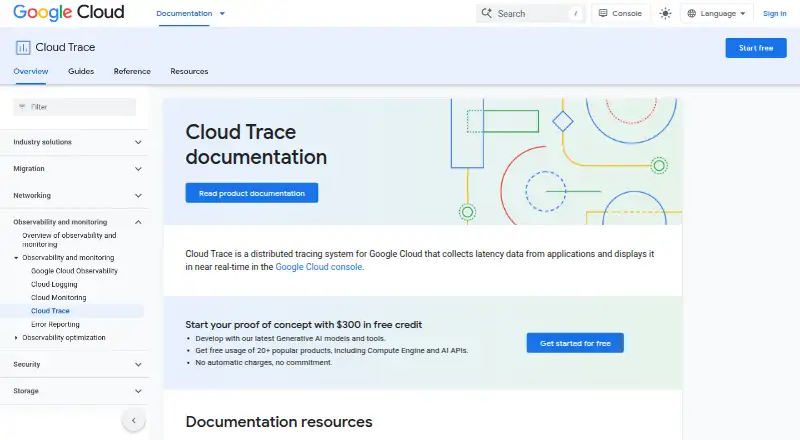
Google Cloud Trace collects latency data to help identify performance bottlenecks across services and generative AI applications. Trace Explorer shows aggregate latency in a heatmap and lets users filter data and inspect individual traces and spans. Observability Analytics provides a SQL interface for trace data and can join it with log data. Google recommends OpenTelemetry and provides instrumentation samples for Go, Java, Node.js and Python. Trace supports Linux workloads across Google Cloud environments such as Compute Engine, Google Kubernetes Engine, App Engine, Cloud Run, Cloud Service Mesh and Cloud SQL query insights, as well as non-Google Cloud environments; Apigee is listed as Public Preview. Some trace data is captured automatically for App Engine standard, Cloud Run functions and Cloud Run. Cloud Logging entries can be associated with traces and spans, while a linked BigQuery dataset supports joins with other BigQuery datasets. The free allowance covers the first 2.5 million spans per billing account each month; usage-based pricing is listed at $0.20 per month. Spans in the _Trace bucket are retained for 30 days.
Who it suits
Cloud Trace suits teams investigating latency across services and correlating traces with logs or BigQuery data. It is relevant to teams using OpenTelemetry or supported Google Cloud workloads, including some environments with automatic tracing.
What it does well
- Heatmap views aggregate latency across traces.
- SQL analytics can join trace and log data.
- Supports OpenTelemetry instrumentation samples for four languages.
- Trace data can be joined with BigQuery datasets.
- First 2.5 million spans per account each month are free.
What to know first
- Spans in the _Trace bucket are retained for 30 days.
- Assured Workloads residency or IL4 users should not send spans through the Cloud Trace API.
- Daily API ingestion quota varies from 3 million to 5 billion spans.
- Apigee support is Public Preview.
Limits
Spans stored in the _Trace bucket are retained for 30 days. The Cloud Trace API daily span-ingestion quota is 3,000,000 to 5,000,000,000 spans, while Telemetry API ingestion is excluded from that quota.
Plans
| Plan | Billed and limits | Price |
|---|---|---|
| Cloud Trace usage-based pricing | Monthly; first 2.5 million spans per billing account are free · First 2.5 million spans per billing account/month free · Auto-generated spans from App Engine Standard, Cloud Run functions, and Cloud Run are non-chargeable | $0.20 a month |
As cloud.google.com lists them, read 9 Oct 2026. The maker's own page has the final word.
Getting started
- Open https://cloud.google.com/trace
- Run Trace on a supported Linux or listed cloud environment
- Instrument services with OpenTelemetry using Go, Java, Node.js, or Python samples
- View latency in Trace Explorer
- Query trace data through Observability Analytics or linked BigQuery
- Associate Cloud Logging entries with traces and spans
Verdict
Cloud Trace offers latency visualization, SQL querying and connections to logs and BigQuery, with a free monthly span allowance. Review the retention, ingestion quota and data-residency caveat against your requirements before sending trace data.
Questions
Is Google Cloud Trace free?
Yes. A free plan is listed. Usage-based pricing is $0.20 a month, with the first 2.5 million spans per billing account each month free.
Which platforms and environments does Trace support?
It supports API and web access, Linux workloads, listed Google Cloud services, and non-Google Cloud environments.
Can Trace connect with logs?
Yes. Cloud Logging entries can associate with traces and spans and appear beside waterfall graphs or in Logs Explorer.
Can trace data be queried with SQL?
Yes. Observability Analytics provides SQL queries, and linked BigQuery datasets support joins and queries in BigQuery Studio or Data Studio.
How long are spans retained?
Spans stored in the _Trace bucket are retained for 30 days.
Facts from Google Cloud Trace's own pages
- API quota
- The Cloud Trace API has a daily span-ingestion quota of 3,000,000 to 5,000,000,000 spans, based on billing history and quota increase requests; this quota does not apply to Telemetry API ingestion. · docs.cloud.google.com, 9 Oct 2026
- Automatic tracing
- App Engine standard, Cloud Run functions, and Cloud Run automatically capture some trace data. · docs.cloud.google.com, 9 Oct 2026
- BigQuery
- A linked BigQuery dataset enables joining trace data with other BigQuery datasets and querying it from BigQuery Studio or Data Studio. · docs.cloud.google.com, 9 Oct 2026
- Company history
- Google Inc. was officially born in August 1998, and Google identifies its current headquarters as the Googleplex in Mountain View, California. · about.google, 9 Oct 2026
- Data residency caveat
- Google says not to use the Cloud Trace API to send trace spans when using Assured Workloads for data-residency or IL4 requirements. · docs.cloud.google.com, 9 Oct 2026
- Instrumentation
- Google recommends OpenTelemetry, with Go, Java, Node.js, and Python instrumentation samples. · docs.cloud.google.com, 9 Oct 2026
- Integrations
- Cloud Logging entries can be associated with traces and spans, and displayed alongside trace waterfall graphs or in Logs Explorer. · docs.cloud.google.com, 9 Oct 2026
- Latency analysis
- Trace Explorer displays aggregate latency on a heatmap and lets users filter data and inspect individual traces and spans. · docs.cloud.google.com, 9 Oct 2026
- Purpose
- Cloud Trace collects latency data to help troubleshoot performance bottlenecks across services and generative AI applications. · docs.cloud.google.com, 9 Oct 2026
- Retention
- Spans stored in the _Trace bucket are retained for 30 days. · docs.cloud.google.com, 9 Oct 2026
- Security controls
- Cloud Trace supports VPC Service Controls and uses Identity and Access Management to control access to resources. · docs.cloud.google.com, 9 Oct 2026
- SQL analytics
- Observability Analytics provides a SQL interface for querying trace data and joining it with log data. · docs.cloud.google.com, 9 Oct 2026
- Supported environments
- Trace runs on Linux in Compute Engine, Google Kubernetes Engine, Apigee (Public Preview), App Engine, Cloud Run, Cloud Service Mesh, Cloud SQL query insights, and non-Google Cloud environments. · docs.cloud.google.com, 9 Oct 2026
Where Google Cloud Trace stands on Freedom251
- Distributed Tracing Tools#5 of 32
- Application Performance Monitoring#8 of 37
- Runtime Monitoring Software#16 of 56