Freedom251 › AI Agent Platforms
Google Agent Development Kit
What Google Agent Development Kit is
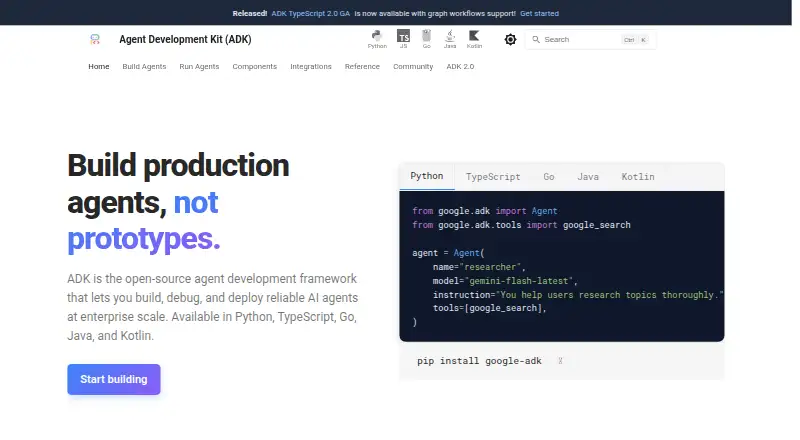
Google Agent Development Kit (ADK) is a free, open-source framework for building, debugging, evaluating, and deploying AI agents. It is available for Python, TypeScript, Go, Java, and Kotlin, and supports graph-based workflows that can combine fixed code steps with adaptive AI reasoning. Agents can be organized in hierarchies and delegate work to specialized agents. ADK works with Gemini and adapters for other model providers, including models running locally. Its integrations catalog spans MCP, Google Cloud, databases, search, observability, and third-party services. Evaluation tools let users build multi-turn datasets and run evaluations through the CLI or development UI. ADK also supports live agents with two-way text and audio streaming, session context, and links to longer-term memory services. Agents can be deployed to Google Cloud Agent Runtime, Cloud Run, GKE, or other container-friendly infrastructure, including local Docker or Podman environments. Security guidance covers identity, authorization, guardrails, sandboxed code execution, and network controls. Agent Config is narrower: it currently supports only Gemini and requires Python. Model and cloud service usage may require separate access or billing.
Who it suits
ADK suits developers building and deploying AI agents in one of its five supported languages, including those who need multi-agent workflows, evaluation, or voice support. It also suits teams seeking cloud or container-based deployment options.
What it does well
- Available in five programming languages
- Hierarchical agents can delegate specialized tasks
- Supports Gemini and other model providers
- Includes local evaluation tools
- Supports live text and audio streaming
What to know first
- Agent Config supports only Gemini models
- Agent Config requires Python
- Model and cloud usage may require separate billing
Limits
The framework is free, but model and cloud service usage may require separate access or billing. Agent Config currently works only with Gemini models and requires Python.
Plans
| Plan | Billed and limits | Price |
|---|---|---|
| Google Agent Development Kit (ADK) | Open-source framework; model and cloud service usage may require separate access or billing | Free |
| ADK framework | Apache 2.0 open source · no seat charge or usage cap | Free |
As adk.dev lists them, read 4 Oct 2026. The maker's own page has the final word.
Getting started
- Visit https://adk.dev/.
- Choose one of the supported languages: Python, TypeScript, Go, Java, or Kotlin.
- Follow the site's installation instructions for that language.
- Use the free open-source framework; arrange separate access or billing if needed for model or cloud services.
Google Agent Development Kit (ADK) is an open-source framework for building, evaluating, and deploying AI agents. It is best suited to developers who want to define agent behavior in code and choose among multiple languages, models, and deployment environments. Its range is compelling, but Agent Config has narrower model and language support than the wider framework.
Overview
ADK combines explicit, graph-based workflows with adaptive AI reasoning, so developers can set deterministic steps without giving up model-led decisions. Agents can also be arranged in hierarchies and delegate work to specialized agents. This makes ADK a strong fit for applications with distinct tasks or controlled workflows; it is less compelling for someone seeking a ready-made agent product rather than a framework to build with.
The framework supports Gemini, adapters for other model providers, and locally running models. Its integrations catalog covers MCP, Google Cloud, databases, search, observability, and third-party services. That breadth can help teams connect agents to existing systems, but Agent Config currently supports only Gemini and requires Python. Teams using another model or language should not assume that feature shares ADK’s broader compatibility.
Key features
ADK spans building, debugging, evaluation, and deployment. Developers can create multi-turn evaluation datasets and run evaluations locally through the CLI or development UI. Evaluating exchanges across multiple turns is useful when an agent’s behavior depends on context, rather than only on its response to a single prompt.
Live agents support bidirectional text and audio streaming, while session context management and integration points for longer-term memory services support conversations that need continuity. ADK also includes a visual agent builder, knowledge grounding, and human handoff. These capabilities broaden its use beyond code-defined workflows, though the framework’s central advantage remains the control it gives developers over how agents are built.
Deployment options include Google Cloud Agent Runtime, Cloud Run, GKE, other container-friendly infrastructure, and local Docker or Podman environments. This range suits teams with different hosting needs. Security guidance addresses identity and authorization, input and output guardrails, sandboxed code execution, and network controls; it gives developers areas to consider when designing an agent, rather than removing the need to implement appropriate protections.
Installation instructions cover Python, TypeScript, Go, Java, and Kotlin. Community resources are available, but Google and the ADK team do not support the content in external community resources, so teams should account for that boundary when relying on community help.
Pricing
ADK is open source and its free plan costs nothing. There is no paid framework tier described. Free access to the framework does not mean every deployment is cost-free: model use or cloud services may require separate access or billing.
This pricing suits developers who want to build without paying for the framework itself, including teams evaluating or self-hosting agents. The trade-off is that costs tied to chosen models and infrastructure sit outside that free framework price.
Platforms
ADK supports API, Linux, macOS, Windows, web, and self-hosted use. Combined with its language options and container-friendly deployment paths, that makes it adaptable to varied development and hosting setups. The practical fit still depends on the chosen model and services, and Agent Config’s Python requirement is a notable exception to the wider language support.
Who it's for
ADK is a good choice for developers and teams building agents that need structured workflows, delegated tasks, evaluation, voice interaction, or control over deployment. It is particularly suitable when model and infrastructure flexibility matter, and the team can work directly with a framework. It is a poorer fit for users who want an out-of-the-box agent experience or depend on Agent Config with a non-Gemini model or a language other than Python.
Pros and cons
- Pros: Five supported languages and adapters for other providers, including locally running models, give teams options beyond Gemini.
- Pros: Multi-agent hierarchies, graph workflows, and local multi-turn evaluation support both structured development and iterative assessment.
- Pros: Multiple deployment targets, including local containers and Google Cloud services, let teams choose where agents run.
- Cons: Agent Config is limited to Gemini and Python, constraining teams that would otherwise benefit from the framework’s broader model and language support.
- Cons: Free framework access does not cover potentially separate model or cloud service charges.
- Cons: Google and the ADK team do not support content in external community resources, which may matter to teams depending on community help.
Alternatives
For a broader selection, browse AI Agent Platforms.
Microsoft Copilot is a freemium option with a free plan and web, desktop, and mobile platforms; consider it when you want a user-facing product rather than a developer framework.
Vellum offers a free plan and a $30 a month Mighty plan; consider it if you prefer a freemium alternative with a defined paid tier.
Camunda offers a free self-managed development plan for local development and testing, as well as a free trial; consider it when that self-managed development path is the priority.
Flowise has a free plan capped at two flows and assistants, 100 predictions per month, and 5MB storage; consider it when a defined free usage allowance suits your needs.
Houston has a free personal workspace for up to three people, with limited usage and more than 1,000 integrations; consider it when a small team wants that integration range.
Retool offers a free plan and a Team plan priced at $10 a month per builder and $5 a month per internal user; consider it when that builder-and-user pricing model fits your team.
SmythOS has a free plan for one seat and a Builder plan at $39 a month with 100 fast API calls per day; consider it when those published plan limits match your expected use.
Agentforce Vibes offers a free option through Salesforce Foundations; consider it if you want to explore that alternative.
Verdict
Choose ADK if you are a developer who wants a free, code-oriented framework with broad language, workflow, evaluation, and deployment support. Its strongest reason to choose it is the ability to shape and assess agents across varied models and hosting environments; its main reason to look elsewhere is the Agent Config restriction, alongside separate potential model and cloud costs.
Verdict
ADK brings agent building, evaluation, and deployment into a framework with broad language and workflow support. Note the Agent Config restrictions and that model or cloud usage may carry separate access or billing requirements.
Questions
Is Google Agent Development Kit free?
Yes. ADK has a free plan and is an open-source framework. Model and cloud service usage may require separate access or billing.
Which programming languages does ADK support?
Python, TypeScript, Go, Java, and Kotlin.
Which platforms does it support?
The listed platforms are API, Linux, macOS, self-hosted, web, and Windows.
Can ADK use models other than Gemini?
ADK supports Gemini and adapters for other model providers, including locally running models. Agent Config currently supports Gemini models only.
Can agents work together or support voice?
Yes. Agents can be arranged hierarchically and delegate tasks. Live agents support bidirectional text and audio streaming.
Where can ADK agents be deployed?
Options include Google Cloud Agent Runtime, Cloud Run, GKE, other container-friendly infrastructure, and local Docker or Podman environments.
Facts from Google Agent Development Kit's own pages
- Agent orchestration
- The framework supports modular multi-agent composition, delegation and routing between specialized agents. · developers.googleblog.com, 15 Oct 2026
- API surface
- Official references include Python, TypeScript, Go, Java and Kotlin APIs plus CLI, configuration and REST API references. · adk.dev, 15 Oct 2026
- CLI
- Agents CLI can scaffold, build, test, evaluate and deploy ADK agents from an AI-enabled development environment. · adk.dev, 15 Oct 2026
- Company founded
- Google was founded in 1998 by Larry Page and Sergey Brin. · en.wikipedia.org, 15 Oct 2026
- Company legal identity
- Google LLC is Alphabet's technology subsidiary and is headquartered in Mountain View, California. · en.wikipedia.org, 15 Oct 2026
- Company size
- LinkedIn lists Google as a public software-development company with 10,001-plus employees and headquarters in Mountain View, California. · linkedin.com, 15 Oct 2026
- Context and memory
- ADK manages session context and provides integration points for longer-term memory services. · adk.dev, 4 Oct 2026
- Context management
- ADK manages sessions, memory, events, tool outputs and artifacts, including summarization and context compression controls. · adk.dev, 15 Oct 2026
- Deployment
- Agents can run locally, in containers, on Cloud Run, on GKE or on Google's managed Agent Runtime. · adk.dev, 15 Oct 2026
- Developer UI
- The local ADK web interface lets developers chat with agents and inspect events, state and execution traces step by step. · adk.dev, 15 Oct 2026
- Documentation depth
- The documentation site includes getting-started guides, component references, deployment, observability, evaluation, safety, MCP, A2A and API references. · adk.dev, 15 Oct 2026
- Evaluation
- Documentation covers evaluation criteria, user and environment simulation, custom metrics and optimization workflows. · adk.dev, 15 Oct 2026
- Graph workflows
- ADK 2.0 adds graph-based workflows that combine deterministic code with model reasoning and explicit execution paths. · adk.dev, 15 Oct 2026
- Installation
- The installation guide provides package installation instructions for all five supported languages. · adk.dev, 4 Oct 2026
- Installation requirement
- The Python quickstart requires Python 3.10 or later and installs the package with pip install google-adk. · github.com, 15 Oct 2026
- Integration ecosystem
- Google lists integrations spanning Google Cloud services, databases, observability platforms, communication tools, productivity apps and many third-party agent tools. · adk.dev, 15 Oct 2026
- Integrations
- The integrations catalog includes tools and connectors for MCP, Google Cloud, databases, search, observability, and third-party services. · adk.dev, 4 Oct 2026
- Languages
- Official implementations are provided for Python, TypeScript, Go, Java and Kotlin. · adk.dev, 15 Oct 2026
- Launch news
- Google announced ADK on April 9, 2025 at Google Cloud NEXT as an open-source framework for production agent and multi-agent development. · developers.googleblog.com, 15 Oct 2026
- License
- The Python ADK repository is licensed under the permissive Apache License 2.0. · github.com, 15 Oct 2026
- Limit: beta components
- ChatForest reports that Python 2.0 and Kotlin 0.1.0 were beta releases and that ADK for Android was not production-ready at review time. · chatforest.com, 15 Oct 2026
- Limit: ecosystem maturity
- ChatForest says ADK's community, tutorials and production case studies still lag behind LangGraph. · chatforest.com, 15 Oct 2026
- Limit: Google Cloud dependence
- Independent reviewers say the managed deployment path is Google Cloud-specific, creating friction for cloud-agnostic teams. · chatforest.com, 15 Oct 2026
- Limit: learning curve
- InfoWorld reports that ADK's extensive capabilities require substantial time and effort to learn. · infoworld.com, 15 Oct 2026
Where Google Agent Development Kit stands on Freedom251
- AI Agent Platforms#2 of 73