Freedom251 › Code Playground Software
Go Playground
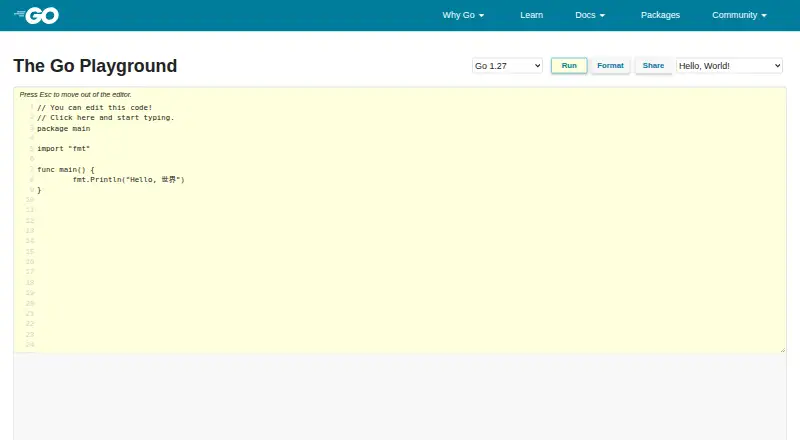
What Go Playground is
Go Playground is a free web service for compiling and running Go programs in a sandbox. Submit code and the service vets, compiles, links, and runs it, then returns the output. The interface includes Run, Format, and Share controls. If a program includes tests or examples but no main function, the service runs those tests. It uses the latest stable Go release and supports most of the standard library, with some exceptions. Each run starts at 2009-11-10 23:00:00 UTC, giving program time a fixed value. Execution time, CPU use, and memory are limited; programs can communicate outside the sandbox only through standard output and standard error. Sharing is public-only, and the service has no private projects, real-time collaboration, full-stack runtime, or deployment options. Benchmarks are likely unsupported because of the sandbox's limited resources. The Go project's public source repository includes the service's source code. For questions about using Go, the project points users to the golang-nuts discussion mailing list. Other sites wishing to use the service must contact the project first, use a unique user agent, and offer a service that benefits the Go community.
Who it suits
It suits people who want to compile and run Go code in a browser, including programs with tests or examples. It is less suited to work requiring private projects, collaboration, deployment, or unrestricted runtime resources.
What it does well
- Free web access with Run, Format, and Share controls.
- Runs programs and tests in a sandbox.
- Uses the latest stable Go release.
- Most of the standard library is available.
- Source code is publicly available.
What to know first
- Execution time, CPU, and memory are limited.
- Sharing is public-only; private projects are unavailable.
- Programs can communicate externally only through stdout and stderr.
- Benchmarks are likely unsupported.
Limits
The free plan limits execution time, CPU, and memory, and exposes only most of the standard library. Programs can communicate externally only through standard output and standard error.
Plans
| Plan | Billed and limits | Price |
|---|---|---|
| Go Playground | Execution time, CPU, and memory are limited · Only most of the standard library is available · Programs can communicate externally only through stdout and stderr | Free |
As go.dev lists them, read 7 Oct 2026. The maker's own page has the final word.
Getting started
- Open https://go.dev/play/ in a web browser
- Enter or paste a Go program
- Select Format if you want the code formatted
- Select Run to compile and execute it
- Use Share to create a public share
Verdict
Go Playground provides a straightforward browser-based way to run Go code and tests. Its sandbox and public-only sharing make it a limited fit for workloads that need more resources, privacy, or deployment options.
Questions
How much does Go Playground cost?
Go Playground is free on the web, with the listed plan priced at $0.
Which platforms does it support?
It is available on the web.
Can programs access the network?
No. A Playground program communicates externally only through standard output and standard error.
Can I keep projects private?
No. Sharing controls are public-only, and private projects are not available.
Does it run tests and examples?
Yes. If a program has tests or examples and no main function, the service runs those tests.
Which Go version is used?
The Playground uses the latest stable release of Go.
Facts from Go Playground's own pages
- Benchmarks
- Benchmarks will likely not be supported because programs run in a sandboxed environment with limited resources. · go.dev, 7 Oct 2026
- Deployment options
- none · go.dev, 22 Sept 2026
- Deterministic time
- The Playground starts program time at 2009-11-10 23:00:00 UTC to make program output deterministic and easier to cache. · go.dev, 7 Oct 2026
- Founded
- 2010 · go.dev, 28 Sept 2026
- Free plan
- Yes · go.dev, 22 Sept 2026
- Full-stack runtime
- No · go.dev, 22 Sept 2026
- Go version
- The Playground uses the latest stable release of Go. · go.dev, 7 Oct 2026
- Maker
- The Go project is an open source project developed by a team at Google and contributors from the open source community, and is distributed under a BSD-style license. · go.dev, 7 Oct 2026
- Network access
- The only communication a Playground program has with the outside world is through standard output and standard error. · go.dev, 7 Oct 2026
- Private projects
- No · go.dev, 22 Sept 2026
- Purpose
- The Go Playground is a web service that receives Go programs, vets, compiles, links, and runs them in a sandbox, then returns their output. · go.dev, 7 Oct 2026
- Real-time collaboration
- No · go.dev, 22 Sept 2026
- Security
- The Go Playground runs submitted programs inside a sandbox and limits their execution time, CPU usage, and memory usage. · go.dev, 7 Oct 2026
- Share and format
- The Playground interface provides Run, Format, and Share controls. · go.dev, 7 Oct 2026
- Sharing controls
- public_only · go.dev, 22 Sept 2026
- Source code
- The Playground source code is available in the Go project's public source repository. · go.dev, 7 Oct 2026
- Standard library
- Playground programs can use most of the standard library, with some exceptions. · go.dev, 7 Oct 2026
- Support
- The Go project directs questions about using Go to its golang-nuts discussion mailing list. · go.dev, 7 Oct 2026
- Tests
- If a program contains tests or examples and no main function, the service runs the tests. · go.dev, 7 Oct 2026
- Use on other sites
- The Go project says other sites may use the Playground service if they contact the project first, use a unique user agent, and provide a service that benefits the Go community. · go.dev, 7 Oct 2026
Where Go Playground stands on Freedom251
- Code Playground Software#22 of 58
- Coding Playgrounds#54 of 138